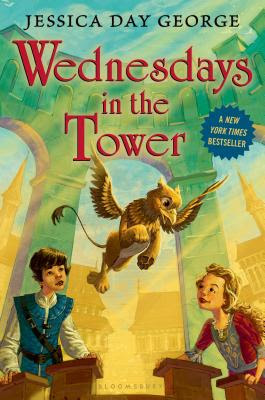
by Jessica Day George
Middle Grade
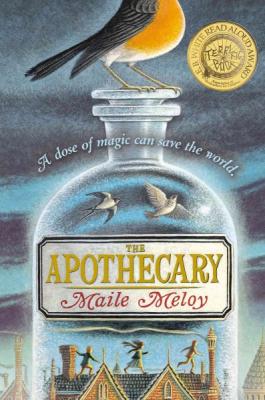
The Apothecary
by Maile Meloy
ages: 11+
First sentence: “I was seven and living in Los Angeles when Japan surrendered at the end of World War II, and first vivid memories are of how happy and excited everyone was.”
Support your local independence bookstore: buy it there!
Janie doesn’t want to move to London.
She has her perfect (well, of a sort) life in California. Her parents are in the movie business. She adores Katherine Hepburn, she wants to be friends with the popular kids. But that all goes up in flames when her parents get on McCarthy’s Red List and are called into Congress to testify. They decide they can’t sell out their friends, so they uproot and move to London instead.
Thrown from sunny California to dreary February, post-war London, Janie is feeling hopeless. That is, until she meets Benjamin. Cute boy is a start. And then, the two of them are witnesses when Benjamin’s father goes missing, leaving a mysterious book behind. It turns out that Ben’s father is an apothecary: not just the dispense your pills sort, but a magical/science sort that can do amazing and wonderful things.
Ben and Janie, of course, need to go rescue him. (This is a middle grade novel, after all.) Which means, they need to figure out the Greek (and Latin) of the book, put together the spells (which include turning into a bird and becoming invisible), and unravel the plot Ben’s father was mixed up in, in order to do so.
On the one hand, this was a beautifully illustrated, gorgeously written book. Meloy has a gift with language, and it was a pleasure to read. But I couldn’t shake the feeling that this was a book that grownups think kids should like. A had some major issues with it, not the least being she didn’t get the historical setting at all. But a couple other kids at the book group didn’t mind it so much, and actually enjoyed the adventure (but not so much the slight romance).
So, I think we’ll just be on the fence with this one.
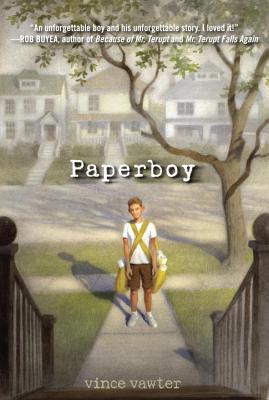
Paperboy
by Vince Vawter
ages: 10+
First sentence: “I’m typing about the stabbing for a good reason. I can’t talk.”
Support your local independent bookstore: buy it there!
I picked this up when it came into the store a few weeks back mostly because it had been a while since I’d read a good, non-fantasy middle grade book. And the idea of this one — a boy with a severe stutter who takes over a paper route for a month in Memphis in the 1950s — sounded like it could be good.
I’ll be upfront on this one: I bailed. I admire Vawter for telling what was, for him at least, a very personal story about a disability that doesn’t get enough page time. But, a lot of things bothered me about this one. The short paragraphs. The lack of quote marks. The slow pace of the story. And — although it pains me to admit this one — the way he wrote the stutter.
It just didn’t gel with me. Maybe next time.
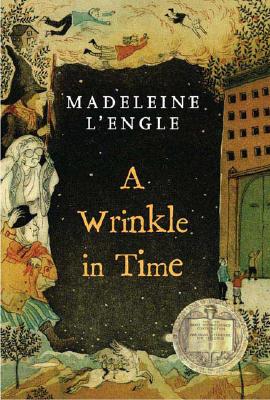
Audiobook: A Wrinkle in Time
by: Madeline L’Engle
read by the author
Ages: 7+ (listening)
Support your local independent bookstore: buy it there!
I threw in a bunch of audiobooks on our recent trip to Michigan, hoping that we’d listen to a couple as we went. Turned out that we only listened to one, and that this was the one everyone seemed most excited for.
I really don’t have much to add with this reread from the last time. I was expecting the religion, and while I sat musing for a while that the idea of sameness as the Great Evil is a very American idea (though I liked this quote — and I paraphrase — “Alike does not mean equal.” True.), I mostly just let the story flow over me and didn’t engage with it very much.
So, I’m going to give you my girls’ reactions:
K, who is 7, spent much of the book wondering what was going on. She did get the basic content of the book, but often said, “The words don’t mean anything to me.” We had to stop frequently to explain things to her.
A, really enjoyed it. In fact, out of all of the girls, she’s the one who was the most interested in the whole story. She really liked Meg, thought Charles Wallace was charming, and may (or may not; she’s not telling) have ended up with a little crush on Calvin (though he is no Percy Jackson).
C, was the most interested in starting the book, but by the end was complaining that Meg was TOO HYSTERICAL. “Can’t she just shut up and do something already?” That is an interesting perspective: the girls in our middle grade fiction have become more confident and more assertive than they used to be. I’m not saying that Meg is a shrinking violet; just that she does burst into hysterics quite often.
M, who had read it before (“Is this the one with the huge brain?”) was charmed again (“Oh be quiet! Awkward kid flirting; it’s so amusing.”), but not really thrilled.
And Hubby kept comparing it to Harry Potter: Cal is Ron, definitely. But we debated whether Meg was Harry or Hermione. We decided that Meg was probably Harry and Charles Wallace was Hermione. Everything relates to Harry Potter these days, doesn’t it.
Oh, a bit on the narration: I loved hearing Madeline L’Engle — pronounced lengle as opposed to la engle; I didn’t know that — narrate her book. While it wasn’t as mesmerizing as Neil Gaiman’s narrations of his books are, it still was quite charming.
Not a bad way to introduce several of my kids to the series, at any rate.
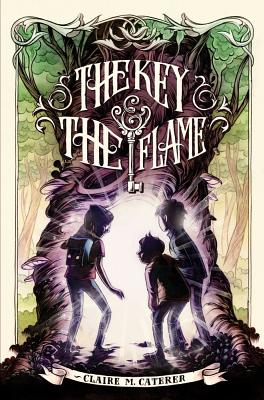
The Key & The Flame
by Clare M. Caterer
ages: 9+
First sentence: “
Support your local independent bookstore: buy it there!
Eleven-year-old Holly Shepard isn’t extraordinary. She isn’t that bright, and is often chided for being off-task at school. She’s not good at anything much, not like her brother Ben. So when her family moves for a summer to a small village in England, she doesn’t expect anything extraordinary; it’s all just more of the same. That is until the landlord of their cottage gives Holly a old key that opens a door. In an oak tree. Which turns out to be a portal to another world, Anglielle, where Holly is someone extraordinary: an Adept come to save the country from the oppressive King. She’s also tasked with rescuing her brother Ben and friend Everett – both who came through the portal with her, and were immediately captured.
Overall, it had a feel of one of the old fantasies from the 60s — Narnia, maybe, or Half Magic. And there is something for everyone: swordfights and adventure was well as magic. Additionally, while there is conflict and danger, those who fill the role of “bad guys” aren’t terribly bad, and the book, in the end, doesn’t have an overly dark feel. Maybe the lack of tension will turn off some readers, but I do hope that there are those – like me – who find Caterer’s return to a more classic fantasy adventure refreshing.
One for the Murphys
by Lynda Mullaly Hunt
ages: 10+
First sentence: “Sitting in the back of the social worker’s car, I try to remember how my mother has always said to never show your fear.”
Support your local independent bookstore: buy it there!
Carley has lived with her mother in Vegas her whole life. It wasn’t terrific — they scraped by mostly — but they did okay the two of them. But then, Dennis came into their lives, they ended up in Connecticut, and after a horrible, horrible night, Carley has ended up in foster care.
Enter the Murphys — husband, stay-at-home-mom, three boys — who are everything a Perfect Happy Family should be. Carley has no idea what to do with that, or how she fits in this situation. She wants to go back to her mom, but she’s not sure how to make that work. And yet, the appeal of the strength of a happy family and a “normal” life is huge.
I only have one thing to say about this: it’s wonderful. I loved that there was a strong, amazing mother figure in the story, someone who knew how to love and understand and wasn’t all drugs and alcohol and neglect. Sure, there was that, too, and sometimes I hated Carley’s mother for that. But I was glad for the normalness of the story. And the quiet strength that comes from giving so completely to another human being.
In fact, it made me cry, which caught me off guard. But a child who is well and truly loved? That’s a beautiful thing. And this is a beautiful book.
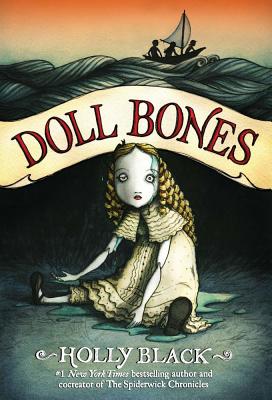
Doll Bones
by Holly Black
ages: 9+
First sentence: “Poppy set down one of the mermaid dolls close to the stretch of asphalt road that represented the Blackest Sea.”
Support your local independent bookstore: buy it there!
Zach is 12, a pretty good student, on the basketball team, kind of popular. And his two best friends are Alice and Poppy. Having girls for best friends isn’t a terribly unusual thing, except what they did was play games. Specifically: one long, elaborate imaginary game with dolls/action figures.
But they’re too old to be playing those sorts of games, right? Zach’s dad thinks so, at least, and in a fit of bad parenting, he tosses out all of Zach’s action figures. Which sets forth a chain of events that involve Polly unlocking the Queen — a very old china doll her mother won’t let them touch — and then being visited by the ghost of a dead girl. It turns out that the Queen is made from the bones and ashes of a girl long since dead, and who wants to be buried in a nearby town. Which lead to the three friends sneaking out in the night, going on one last, final Quest to fulfill the Queen’s wishes.
I should say, first off, that I was assuming this book would be creepy. Like Coraline creepy. It wasn’t, at least not for me. There are ghosts, there are close calls, and weird circumstances and people, but it didn’t get my spine tingling. I’m actually grateful for that, because I was able to focus on the more poignant story: that of the painful — for some — transition from childhood to young adulthood. It’s not a transition I made easily (I went kicking and screaming, actually), and I’ve noticed the bumps and bruises from that transition in M and C. Black handles it beautifully. The awkwardness, the feeling of being left behind by close friends, the desire to hang on to the things of childhood, the insecurity of facing the future: they’re all there. Dressed up in a Quest, an adventure, a ghost story. Maybe kids won’t pick up on it, but I do hope some do. I would have loved this book as a 10 or 11 year old, loved knowing that I wasn’t alone in feeling the way I did about getting older.
Oh, and as another side note: A and I were talking the other day about how in adventure books they never stop to go to the bathroom. Or get common colds. Or get sunburned. I loved how Black addressed that:
Adventuring turned out to be boring. Zach thought back to all the fantasy books he’d read where a team of questers traveled overland, and realized a few things. First, he’d pictured himself with a loyal steed that would have done most of the walking, so he hadn’t anticipated the blister forming on his left heel or the tiny pebble that worked its way under his sock, so that even when he stripped off his sneaker he couldn’t find it.
He hadn’t though about how hot the sun would be either. When he put together his bunch of provisions, he never though about bringing sunblock. Aragorn never wore sunblock. Taran never wore sunblock. Percy never wore sunblock.
And because of all that, I love this one.
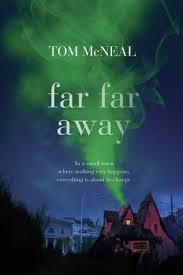
Far, Far Away
by Tom McNeal
ages: 11+
First sentence: “What follows is the strange and fateful tale of a boy, a girl, and a ghost.”
Support your local independent bookstore: buy it there!
Release date: June 11, 2013
Review copy provided by my place of employment.
In the little town of Never Better there is a legend: if you eat a Prince Cake you will fall in love with the first person you look at. Jeremy blames that for his mother running away, and his father’s decline into… well, decline. And there is a problem, though no one seems to think it one: children keep disappearing. There’s is also an oddity: the ghost of Jacob Grimm (yes, that Grimm) talks to Jeremy, which doesn’t make him the most popular kid. (Well, his dad doesn’t help, either.) Little does Jeremy know, however, that a prank a popular girl named Ginger talks him into will get him into a huge heap of trouble. And little does he know where that trouble will lead.
As much as I wanted to like this one, I had several issues with it.
I don’t particularly mind intrusive narrators, as long as their funny. Case in point: A Tale Dark and Grimm and The Incorrigible Children of Ashton Place. In both of those instances, the narrator was 1) funny, and 2) added something to the story. In this case, the narrator drove me crazy. For two reasons 1) because Jacob Grimm was an adult. And 2) why on earth is an adult — even if he is a ghost — playing a main role (and he does) in a middle grade book? (I guess those are kind of the same point, but I’m pretending they’re not.) I ended up skimming everything Jacob said or did, mostly because all of his exposition and explanation held up the story.
I’ve read enough middle grade novels to know that you need to have your middle grade characters actually do things. I think this really fell flat for me because Jeremy and Ginger were mostly reactive characters. Sure, they set off the action in the first place, by playing the prank on the baker, but after that, they reacted to everything. And in the end, it was the ghost — the adult — who solved the conflict. Not exactly something that kids are going to want to read. (Who wants to read about the adult who comes in and saves the day? That’s real life, people.) Additionally, I didn’t realize that the characters were supposed to be 16 years old. They acted 12. I thought they were 12. It wasn’t until after that I realized they were supposed to be older.
Also, I’m invoking Ms. Yingling‘s plea: PLEASE get to the main action before page 190, which is when I gave up trying to read the whole story and just jumped to the ending. And 370 pages was TOO long for this story.
Perhaps I missed the point (I often do): this had a Grimm fairy tale feel to it (and a Grimm fairy tale ending). But, there was just too much going against this one for me to enjoy.
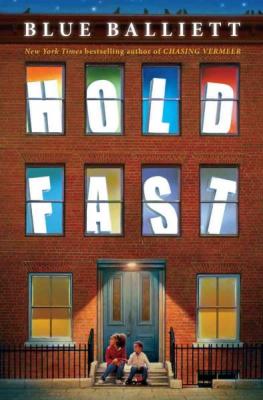
Hold Fast
by Blue Balliet
ages: 9+
First sentence: “It was the bitterest, meanest, darkest, coldest winter in anyone’s memory, even in one of the forgotten neighborhoods of Chicago.”
Support your local independent bookstore: buy it there!
Early Pearl is happy living in her small inner-city Chicago apartment with her family. They don’t have much — her parents barely finished high school before Early was born, though her dad scrapes a living by as a page for the Chicago Library — but they have each other, and the words that her dad, Dash, loves so much.
Then one fateful January day, Dash disappears. Early’s mother, Summer, is devastated, and goes to the police, but since this is inner city Chicago, everyone just assumes he couldn’t handle it and has run off. Summer is insistent that he hasn’t, and her worst fears are confirmed when some masked men break into their apartment, stealing everything they have, rendering Early, her mother, and her younger brother Jubilation (Jubie for short) homeless.
Early’s on her mother’s side: her father didn’t just run off. Something happened to him. And because her mother is having a difficult time dealing with the homeless shelter (and to be fair: she’s depressed), it’s up to Early to find the clues and figure out what has happened to Dash.
There was much to love about this book. From the onomatopoeia in the chapter titles (and themes) to the use of Langston Hughes’ poetry, to the exploration of the homeless plight in the cities. Early is a spunky character, one with determination and heart, and you can’t help but feel for the situation — however implausible — she’s put in. Balliet does an excellent job portraying not only the discrimination homeless people feel, but also the hopelessness in the shelters.
It wasn’t a perfect mystery: there were elements that kind of came out of nowhere, and it was more than a little implausible — even for a middle grade book — that an 11-year-old could figure things out the way she did. And while I enjoyed Early, I never felt like I was able to connect with the other characters the way I felt I should have.
That said, the picture Balliet paints of inner cities is a stirring one, especially for those out here in mid-America. And for that, this book is important, I think.
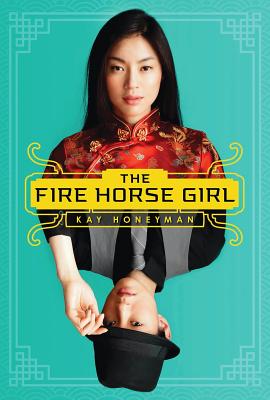
The Fire Horse Girl
by: Kay Honeyman
ages: 11+
First sentence: “There one was a girl, a fire horse girl.”
Support your local independent bookstore: buy it there!
It’s China in the early 1920s, and while some progress has been made for women — our 17-year-old protagonist Jade Moon never had her feet bound — there is still are a lot of restrictions. Once that Jade Moon struggles with. And there’s an added layer of stress: Jade Moon is a Fire Horse girl — one that was born in the Chinese zodiac year of the horse that matched up with an element of fire. As is often Chinese way, that means she’s labeled as cursed: she’s stubborn, she’s head strong, she’s outspoken. She’s everything the Chinese don’t want in a daughter (at least at that time).
So, when a stranger proclaiming to be a lost uncle’s adopted son shows up, offering her father a trip to the United States, Jade Moon begs to go along. She figures there will be more opportunity for her in the U.S., less restrictions, and more room for her to be who she really is.
Of course things aren’t as rosy as Jade Moon thought they would be; there wouldn’t be a book if there were. While I didn’t find myself entranced by this book, I was interested in all the historical detail Honeyman included. The portrait of Angel Island was less than rosy; there was a immense dislike and distrust of the Chinese during that time period, and officials would do anything they could to keep the Chinese from entering the U. S. Then, there’s the references to both the gangs that ran Chinatown and the brothels the women were kept in. Nothing explicit, but Honeyman did an excellent job making this book feel like the 1920s. As for Jade Moon herself, while I liked her, I found that I couldn’t quite connect with her.
In the end, it was a good book, but not a fabulous one. Which isn’t bad.