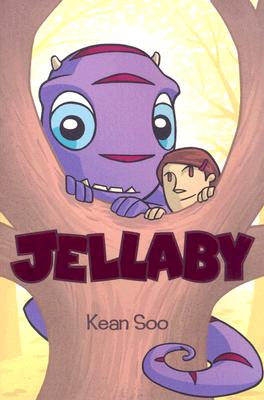
Jellaby

by Kean Soo
ages: 9+
Support your local independent bookstore: buy it there!

This monster, this book, is very cute. I fell in love with Jellaby (it’s the monster on the cover) as soon as it appeared in the book. It’s charming, it’s cute in a monsterish sort of way, and made me want to wrap it up and put it in my pocket.

It’s just the beginning of a story — I need to find the next part; I want to know what happens! — but it’s a good beginning. Portia is a girl who’s father is missing (did he die? did he disappear?), and she’s not adapting to that well. She’s struggling in school, her mother leaves her alone a lot. And then she finds Jellaby. It’s a friend (she makes another friend in the bullied kid, Jason Tham), someone to keep her company. And then, by random chance, she discovers that Jellaby is a lost soul, too. Together her and Jason concoct a plan to get Jellaby back to his home.

That plan is just put in motion in this book. It’s really mostly background and set up, though it’s done incredibly well. There’s something deep going on in the book, even if I can’t quite figure out what it is. Which means, I’m definitely curious as to where the story is going, and the adventures Portia, Jason and Jellaby will have.

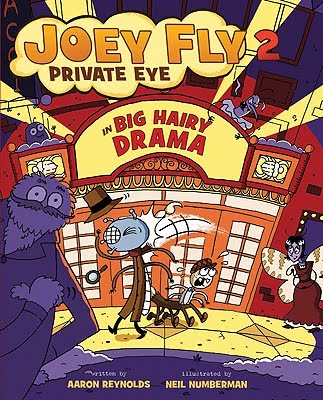
Joey Fly, Private Eye in Big Hairy Drama

by Aaron Reynolds/Illus. by Neil Numberman
ages: 9+
First sentence: “Life in the bug city.”
Support your local independent bookstore: buy it there!
Review copy sent by the author

Joey Fly and his sidekick, Sammy Stingtail are on the case. Again. This time, a big-time (and big) theater owner is asking him to find his main star, the four-winged, long-legged Greta Divawing. Joey and Sammy are up to it of course (they’re up to anything). It’s just a matter of tracking down the bug who did it.

The question is: which bug would that be?

This book is much like the first in the series: smart and fun and interesting. It’s well-written and funny, and has elements that will appeal to both boys and girls (mine were very excited to see it when it came in the mail!). The story has some great twists and turns, plus sliding a bit of educational information in there. There’s a little bit for everyone, but nothing feels shortchanged or slighted. And visually, it’s quite engrossing: it’s worth stopping and poring over the frames to find all the little things Numberman has hidden in there.

In short, it’s a great little series.

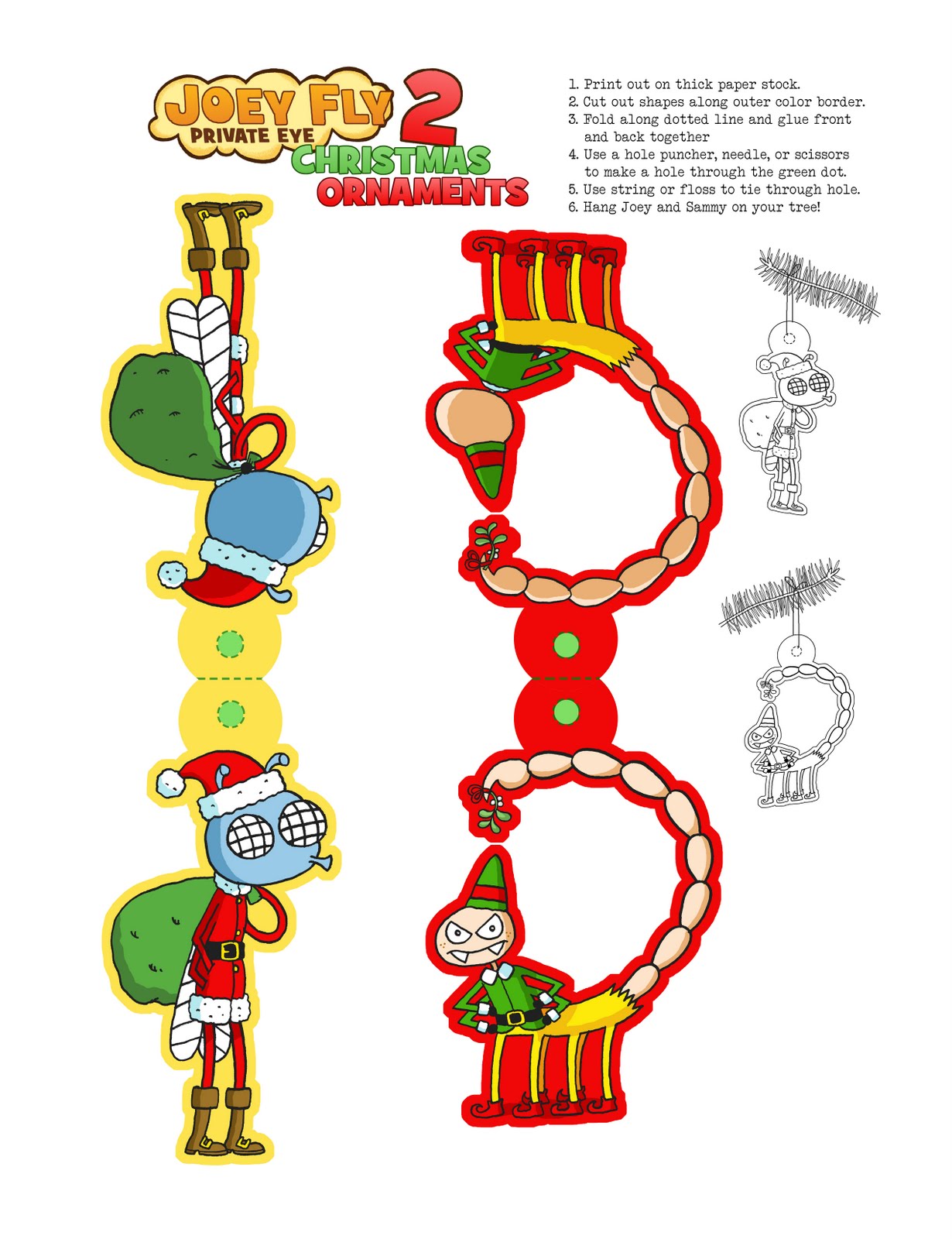
As an added bonus, the author/illustrator are offering up these ornaments to print off and cut out. Click to embiggen, and enjoy!

Jane Eyre: The Graphic Novel

by Charlotte Bronte/Adapted by Amy Corzine
ages: 12+
First sentence: “Now that typhus has felled both my sister and her husband, we must look after their child.”
Support your local independent bookstore: buy it there!

I read Jane Eyre a couple of years ago, and found that I really enjoyed it. So, when my in person book group decided to read it for this month’s book, I figured I’d give the graphic novel a try, just to see how it held up.

And while I found that the pictures were a poor substitute for the narration, I really quite enjoyed it.

The drawings were easy enough to follow, and the book was stripped down to it’s basic elements: Jane’s perseverance and the love story with Mr. Rochester. It’s not a bad thing to have the book taken down to those bare elements; in fact it makes them shine by putting them in center stage. The ending, after she finds Mr. Rochester again, was quite poignant.

It’s a good introduction to the classic, however I wonder if by doing it this way, too many people will read the graphic novel and think that they don’t need to go read the book now. And that would be a shame.

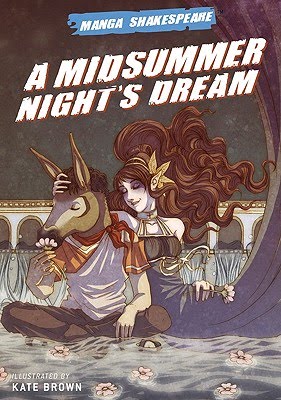
Manga Shakespeare: A Midsummer Night’s Dream

by William Shakespeare/drawn by Kate Brown
ages: adult
First sentence: “Now, fair Hippolyta, our nuptial hour draws on apace.”
Support your local independent bookstore: buy it there!

I decided to take a little break from fantasy novels and read this… fantasy play. Actually, C was looking through and pointed out that it’s essentially the worlds first chick flick. Very true. Romance, silliness, and everyone gets the guy in the end.

My opinion hasn’t changed in the three years since I read it last. It’s all a bunch of silliness. Oberon’s a bit of a jerk (in fact, most of the men are). It’s still better seen, rather than read, but reading it in Manga form was fun. The drawings were interesting — a cross between ancient Greece and modern (they were wearing togas AND ties). It was a little disconcerting: it’d have been nice if Brown had decided which to choose. But on the other hand, it worked with the silliness of the play; it was almost if they couldn’t decide what on earth to do with themselves. But, it wasn’t too distracting. I did wish it were in color, though. But that’s just me.

Not as good as seeing the play, but it works. I’m finding I like Manga Shakespeare. It’s a good way to access the plays.

French Milk

by Lucy Knisley
ages: 16+
First sentence: “My last night in Chicago for six weeks, and unseasonably warm for December.”
Support your local independent bookstore: buy it there!

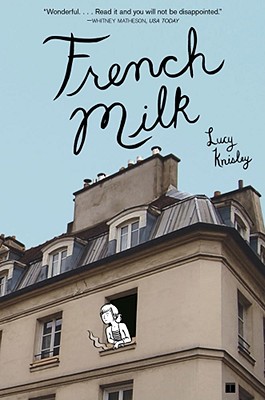
This slim travel memoir/graphic novel is about Lucy’s trip to Paris with her mother the semester before she graduates from college. It’s very much a young adult book; Lucy’s trying to figure out her future, dealing with rejections and insecurities about what path to take, and so it, at times, becomes highly angst-ridden. The book is best the times when Lucy lets her ego go, and she sits back and enjoys what Paris has to offer. The food! The art! The architecture! The history! The people!

The trip is in January, and so the book has a very winter feel. But even with that, it’s a joyful experience. Told through drawings and pictures, Lucy captures Paris in a way I’ve never read before. The only thing it lacked, I think, was a sense of smell. I saw what she saw, I felt what she felt, but I wanted to smell it all as well. It was a touristy book, but she also went off the beaten path, discovering shops and markets and museums that your average tourist wouldn’t have the time. (In other words: I’d love to have the opportunity to be this kind of tourist!)

Mostly, though, what this book made me do is long to be in Europe again. The pace of life, the sensibilities, the food… I’m just a European at heart, I guess. And this book tapped into that for me. And I really enjoyed that.

Amulet

by Kazu Kibuishi
Vol 1: The Stonekeeper
First Sentence: “We were supposed to pick up Navin at eight o’clock. We’re late”
Support your local independent bookstore: buy it there!

Vol 2: The Stonekeeper’s Curse
First sentence: “Let go of me. I don’t want to see him.”
Support your local independent bookstore: buy it there!

First off, I read this one backwards, and got Volume 2 first. While it works okay as a stand-alone, I highly recommend getting Volume 1 first and reading them in order. It makes much more sense that way.

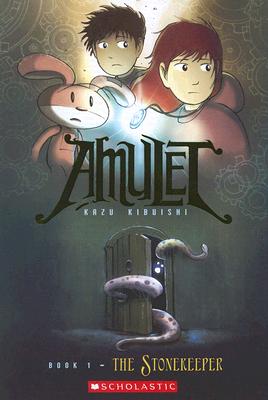
After the car accident that kills their father, Emily, her brother Navin move with their mother out to the woods, into the country house owned by their mother’s Grandfather Silas. It doesn’t seem like anything exciting, until on their first night they are lured into the basement by a strange noise. Which turns out to belong to a strange beast that kidnaps their mother. Emily and Navin follow twists and turns, aided by a strange necklace that Emily found in the house, discovering the strange new world below.

In the second book, the story continues: Emily’s mother has been poisoned, and it turns out that the evil Elf King is out to get Emily. In search of an antidote for her mother, Emily takes on the elves as well as fighting the overpowering influence of the stone. She meets a guide, and learns that there is an underground resistance, which Navin happily joins, to overthrow the king. What her part in all of this, and whether or not she can save her mother, remains to be seen.

Yeah, it’s all a bit Star Wars and Lord of the Rings (C, who also read them even noticed the similarities), but it’s gorgeously drawn, and a rollicking adventure. The world is creative, combining both fantasy elements — like the powers of the stone — with technology — Emily and Navin are accompanied in their endeavors by a collection of robots, ranging from the crotchety to the overly-sensitive. Emily’s personal bodyguard is a pink bunny robot named Miskit, which I found to be highly amusing. It’s well-paced; there’s always something to keep the pages turning. All of which makes me curious for the next installment.

A great addition to middle grade graphic novels.

The Storm in the Barn

by Matt Phelan
ages: 11+
First sentence: “The dust can have it.”
Support your local independent bookstore: buy it there!

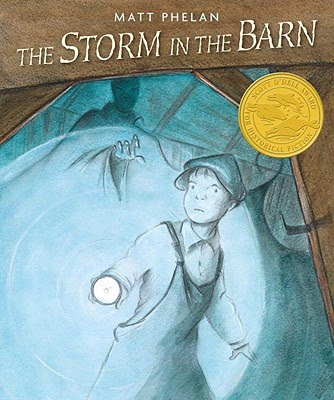
I don’t quite know what to say about this one. I picked it up because of SLJ’s Battle of the Kids Books, but I’m not sure what I expected. First off, it’s gorgeously drawn. I do love the mood it evokes: the browns and blues of the Dust Bowl. There are subtle things too, like a raised eyebrow, or a simple tear that make this book just beautiful to look at. Almost like I was looking at timeless photographs.

That and it references Ozma of Oz (well, it is set in Kansas, after all), which is nice. Alluding to the desert that Dorothy has to cross and the hardships she goes through to get back to Oz make a nice parallel to the story of our 11-year-old hero, Jack, as he deals with the trials of the Dust Bowl, and learns to face his fears about what just might be in the neighbor’s barn.

But.

I’m not sure I quite got the story. There’s a mythical element to it, a larger-than-life aspect that just didn’t sit well. There were parts that confused me, and I had to go back and reread (relook?) at them a few times in order to make sense. It’s told mostly through pictures; there’s very little dialogue, and I’m afraid I missed elements that would have made the story more cohesive. For me. But, this was not really a pouring over book; there weren’t little details that made me want to linger over the individual pictures. It wanted to propel itself forward; I always felt a little annoyed when I had to turn back and reread a section.

Frankie Pickle and the Pine Run 3000

by Eric Wight
ages: 8-10
First sentence: “Presenting… the Prince of Peril… the Sultan of Suspense… the Duke of Danger… the Amazing Piccolini!”
Support your local independent bookstore: buy it there!
Review copy sent to me by the author.

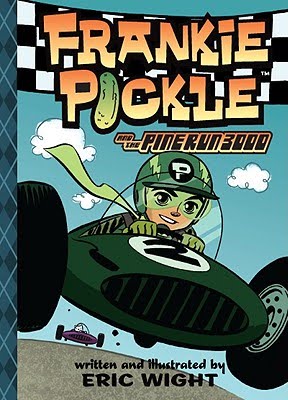
Frankie and his super-cool imagination are back at it again. This time, however, his challenge is leveling up in Possum Scouts. He can’t seem to keep up with the badges and won’t get to level up with the rest of his troop. Unless… he can win the annual Pine Run 300.

He knows he can do it, and runs to the hobby store (which includes a hilarious diversion with a lawn gnome) to pick up supplies. He sequesters himself in his room — brushing off his dad’s offer of help — and creates… well… a creation. It’s not quite a car, and in a test run, it completely bombs. Only after his first attempt fails does he turn to his father for help. And in doing so, he discovers that not only is the impossible possible, it’s also kind of cool to do things with your dad.

Told with the same humor and creativity as the first Frankie Pickle, it’s sure to tickle the funny bone of any eight-year-old.

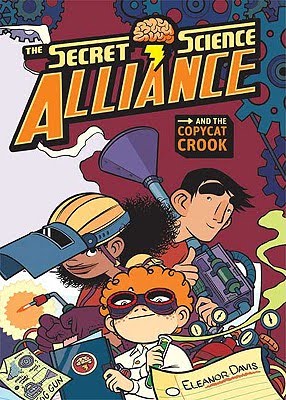
The Secret Science Alliance and the Copycat Crook

by Eleanor Davis
ages: 9+
Support your local independent bookstore: buy it there!

Meet Julian Calendar, your typical nerd. He’s the smartest in the class, a closet inventor. He’s also bullied, picked on, and generally maligned. So, when his parents inform him that they’re moving to a new town, and he’s going to have to start over, he jumps at the chance.

At first, he thinks everything’s going to be exactly the same at his new school, in spite of his hilarious, yet misguided, efforts to “fit in”. It’s not until he meets Ben and Greta and gets inducted into their super-secret science club — they’re all inventors of sorts, and they name themselves the Secret Science Alliance (or S.S.A.) — that he realizes that he has a place and a purpose.

And then the fun begins.

See, there’s this dork of an inventor, famous though he is, who doesn’t like children. And yet… it seems he’s stolen the S.S.A.’s invention notebook, and is actually building and taking patents out on them. It makes the kids (rightfully) angry, and it’s up to them to stop him, since no adult will believe them. The book, which is full of sly asides and notes about science and inventors, comes to a rollicking conclusion with our three heroes saving the day.

My only complaint is that it’s a bit cluttered for me, that there was so much in there it was almost hard to follow the narrative. That said, C adored the book. And you really can’t get a higher recommendation than that.

Graphic Novel Adventures

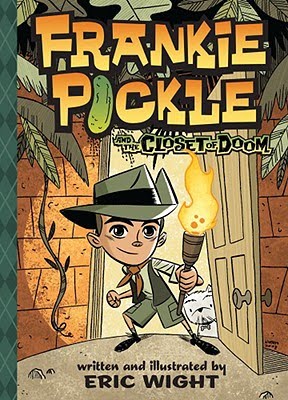
Frankie Pickle and the Closet of Doom
by Eric Wight
ages: 8+
First sentence:”I’ve been called a lot of names: treasure seeker, relic hunter, grave robber.”
Support your local independent bookstore: buy it there!

Frankie Pickle (aka Franklin Lorenzo Piccolini) is just your average adventurer. Rescuing cities from destruction by your evil robots. Battling lava monsters. Avoiding cleaning up his room. Nothing atypical here.

That is, until is mother decides that he should just not pick up his room. Who cares, after all? And thus begins a week in which Frankie gets his way… and discovers just how dangerous that can be.

This is a fun little graphic novel. It’s more graphic novel than middle grade book, though it does flip between the two styles. All of Frankie’s adventures — from Indiana Jones-style through to superheroes saving the day — are in comic book style, which really adds to the excitement. Sometimes, it’s better to draw than to describe, and this is one of those times. On top of that, it has a cute little message (hey, kids: clean rooms aren’t that bad!) at the end.

Loads of fun.
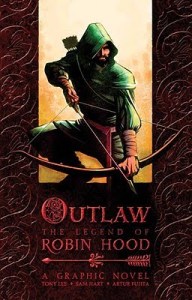
Outlaw: the Legend of Robin Hood
by Tony Lee/Sam Hart/Artur Fujita
ages: 11+
First sentence: “A moment, if you please!”
Support your local independent bookstore: buy it there!

I’ve come to realize that I have the same love of Robin Hood mythologies that I do for King Arthur. Either it’s because they’re medieval British guys or because they’re fabulously interesting myths that are open to some fascinating interpretations. I’m not quite sure.

At any rate, I was more than eager to pick up this graphic novel adaptation of the legend to see what Lee, Hart and Fujita have to add to the lore. And, for the most part, I thought it was okay. All the traditional elements were there: Robin was a former noble, home from the crusades, and turns outlaw to protest and protect his people from the evil that is the Sheriff of Nottingham. In this version, the sheriff is a bit of a lackey, and it’s Guy of Gisburn who’s the real heavy and bad guy. Friar Tuck, Will Scarlet and Maid Marian are all there playing individual roles. Little John has an expanded part in this, being the original outlaw and Robin essentially joins them.

Other than the first few pages, which show a sort-of Batmanesque origin story for Robin Hood, there wasn’t anything interesting done with the lore. It was the Robin Hood story, straight up no chasers. Which is all fine and good, but not exactly what I was hoping for. That, and the drawings bugged me. There was too much in shadow, and it was hard to tell who exactly was whom. By the time I had everyone straight, the story was nearly over. It was adventuresome, and there were moments of the sauciness that I love in my Robin Hood, but mostly it was melodramatic.

Not exactly what I was hoping for.