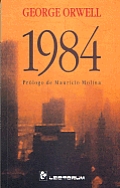
 Hear that?
It’s the sound of me surfacing, exhaling, sighing with relief now that I’m finished with George Orwell’s classic distopian novel (the word on the back of our copy is “negative utopia”, but then it was also published — and bought by Hubby — in 1984). It went down like bad medicine; combined with my usual January blues, I was thrust into a funk that was only abated by liberal dosages of 30 Rock.
Now that it’s done, I can look at it at least partially objectively. It is a classic, but a very dated one. It’s very blatantly, obviously a product of World War II.
Let me sum up for those who haven’t read it (so you don’t have to): Winston Smith, 39 years old, is a Party member in Oceania. He works in the Ministry of Truth (the “propaganda” ministry — the ministry names were funny, in a morbid way: Truth is propaganda; Peace is war; Love is the police; Plenty is economic affairs), as a recorder of some sort. He spends his days altering history, making minor corrections in the records of the past whenever someone disappears, or the economic realities come out differently than predicted, or they change with whom they are at war. He is unhappy; partially because he leads an unhappy life, but partially, also, because he questions this history-making. He remembers that things used to be different; he remembers his childhood. And so, he begins rebelling in small ways. He gets a diary, and writes in it. He takes a lover, Julia (Party members aren’t supposed to have sex). And, after what could be weeks or months, they get caught. Winston is tortured, beaten down, electrocuted, re-programmed and sent back into the world.
There’s this one point where O’Brien, the Party member responsible for Winston’s re-programming, goes on about the faults of previous totalitarian regimes: they created martyrs. They killed their enemies, sure after torturing them or humiliating them, but they killed them nonetheless. “Above all,” he tells Winston, “we do not allow the dead to rise up against us. You must stop imagining that posterity will vindicate you, Winston. Posterity will never hear of you. You will be lifted clean out of the stream of history.”
Chilling, isn’t it. It’s a dated book, as a mentioned before, and not just because the technology is dated. It’s more than that: we’ve moved past the ideas in the book as a society. I really don’t think this book works as a “warning” any more.
It’s not that there isn’t totalitarian regimes anymore. There is. (I was shocked at how well Orwell depicted Mao and the Cultural Revolution, before it happened. Eerie.) But we’re in a much more global society, a much more capitalistic one (for good or bad). There’s authoritarian countries — China, still, Cuba and Russia under Putin — but they’re not the super-scary places that Orwell was writing about. Saddam Hussein is gone. The only one left, that would fit this book’s description is North Korea. It’s scary, it’s depressing, it’s evil… and yet it’s not the way the world is going. There’s too much information flowing — take the internet — too much capital, there will never be a world like the one Orwell imagined.
But as a political novel, a look at what could-have-been, it it could have been compelling (though depressing) book. Yet, I wasn’t compelled. I was repulsed. Physically sickened. Depressed. It took some talking to Hubby, but I finally hit upon it: Orwell has no hope. There is no way out in this book. There is no hope for a brighter future. This is the way things will be. Accept it, love it, or become run over by it. And I couldn’t. I couldn’t take it.
And so, I suffered through (I should have given up, but I did so want to be part of the discussion, and I can’t do that if I go in and say “I didn’t finish the book.” There’s also the very large chance that most of the other women who come will have not read the book, so somebody had to.), very very grateful for the world we live in today.


 This is me exercising my right to give up on a book that I just am not enjoying.



 The Book Nut