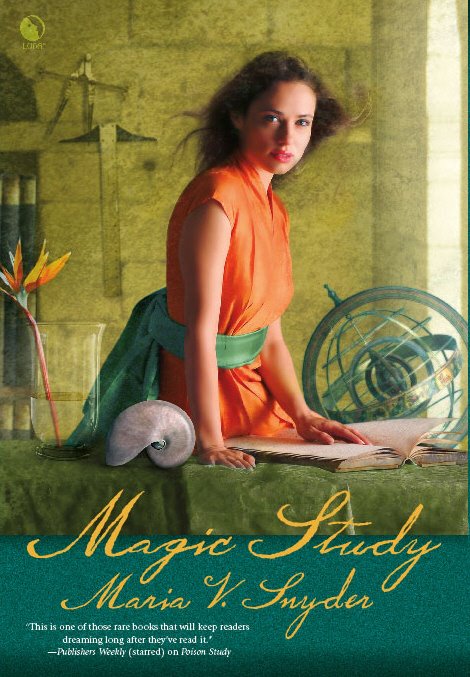
Magic Study

by Maria V. Snyder
ages: 14+
First sentence: “We’re here,” Irys said.
Book 2 for 48 HRC

When we last left our amazing duo of Valik and Yelena, she was exiled because she was a magician. The only hope for her was to head south into Sitia, the land of magicians, in the hopes that she could be reconciled with her family, and learn how to control her new found abilities, even if it means being separated from the love of her life.

Unfortnately, because she is Yelena, that also means trouble.

This one is as action-packed as the first in the series (and as dark; Snyder has a thing for bad guys torturing young girls/children… why is it less disturbing when it’s a fantasy novel than if it’s a “true crime” one?), but it’s more about Yelena and less about Valik. Which has its drawbacks, since Valik is well… awesome. (So, what did he look like for you? Me, he came off as Richard Armitage. Don’t ask me why. Could be that we watched Robin Hood last night…) And so, while the book doesn’t feel stalled, it lacks the certain sparkle that Valik brings. And, it lacks the tension of the first one — I think I like books with romantic conflict better than ones where the main characters are all lovey-dovey (even Robin Hood in season two has lost some of its sauciness… sigh.) — but that doesn’t mean it was bad. Far from it.

On to the third!

Buy it at Amazon, Powell’s, or your local independent bookstore.

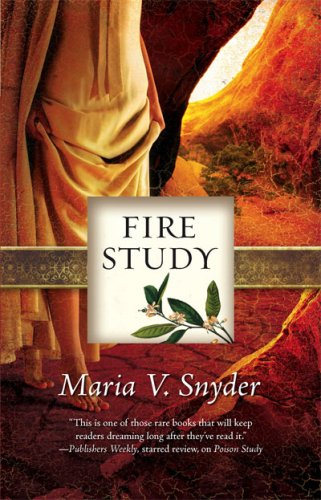
Poison Study

by Maria V. Snyder
ages: 14+ (though M read it and was okay with it)
First sentence: “Locked in darkness that surrounded me like a coffin, I had nothing to distract me from my memories.”
First one for the 48 hour Book Challenge

Shall I list the people who inspired me to check out the book (Em, Kailana, Tricia, Corinne, and M, among others…)?

Or should I just say that yeah, yeah, yeah, this one is good? Really, really, really good. And that I was lame in letting it sit on my nightstand for so long (except I did that on purpose, because I knew it would be an awesome trilogy to read for this challenge).

Basic story: Yelena is in prison for murder. When her execution date comes up, she is offered a choice: hanging now, or become the Commander’s food taster. She — of course, since the book is longer than three pages — decides to take the gamble and become the food taster. It’s more complicated than that, because the General whose son she murdered is out for revenge, and well, things get, um, complicated with Valik, the Commander’s chief of security and her boss. Assassinations, revenge, plot twists, betrayal, friendship…

Remember that list I had for the perfect fantasy? Yep. This one works, too.

And I’m off to read the next in the triology.

Buy it at: Amazon, Powell’s, or your local independent bookstore.

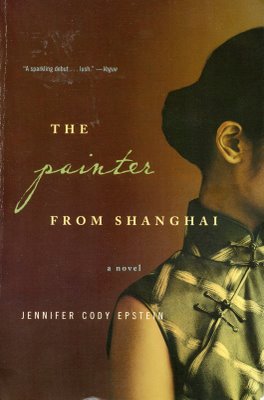
The Painter from Shanghai

by Jennifer Cody Epstein
ages: adult
First sentence: “When the session is over, Yulaing retreats to the chipped sink in the atelier’s corner.”

I don’t know how to start this. After my recent experience with historical fiction, you would think I would be more wary about reading more. But, perhaps my experience was that I was too close to the subject, and that hindered my enjoyment of it.

Well, nothing could be further from my life than that of the Chinese painter Pan Yuliang.

Epstein’s book reads like a good Zhang Yimou movie — a harsh, brutal, lush, hopeful, soaring, and gripping glimpse into China’s past. Yuliang was sold into prostitution at age 14 by her uncle, in order to pay off opium debts. After several years in the brothel, she is rescued by Pan Zanhua, a government worker who ends up taking Yuliang as his second wife in order to avoid scandal. It’s through Zanhua, though, that Yuliang was introduced to art, and because of him that she managed to find her true calling in life.

Not that it was easy: it was difficult for a woman in China in the 1920s to get into an art program, it was controversial for artists to paint nudes, and after she got a scholarship to Paris and later Rome, it was difficult and controversial for her to go back again. But, through it all, she stayed true to her art, her passion, even when it cost her dearly.

Sure, there’s probably that line-blurring, and perhaps someone will even complain that Epstein didn’t get it “right”. But, for me, Epstein’s novel is a lush look into the world of postmpressionist art, the politics of China as well as Yuliang’s life over several decades. It might sound like a lot to handle in one novel, but Epstein makes it work. She even makes present tense narration — something which usually grates on me — work beautifully. It’s a lyrical first work, and makes one hopeful for what Epstein has to offer us in the future. My only complaint is that it didn’t come with pictures; thankfully, Epstein has rectified that by putting samples of the artist’s work up on her webpage.

Of course, as always with a TLC tour, there are a myriad of opinions to choose from. Be sure to check them all out:

Tuesday, June 2nd: The Literate Housewife Review
Wednesday, June 3rd: Book-a-Rama
Monday, June 8th: She is Too Fond of Books
Tuesday, June 9th: S. Krishna’s Books
Wednesday, June 10th: Becky’s Book Reviews
Thursday, June 11th: Redlady’s Reading Room
Monday, June 15th: Dolce Bellezza
Tuesday, June 16th: Peeking Between the Pages
Wednesday, June 17th: A Work in Progress
Thursday, June 18th: Beth Fish Reads
Monday, June 22nd: Pop Culture Junkie
Tuesday, June 23rd: Do They Have Salsa in China?
Wednesday, June 24th: Bookworm with a View
Thursday, June 25th: So Many Precious Books, So Little Time
Friday, June 26th: Savvy Verse and Wit
Monday, June 29th: Nerd’s Eye View

Buy it from: Amazon, Powell’s, or your local independent bookstore

The Actor and the Housewife

by Shannon Hale
ages: adult
First sentence: “Becky was seven months pregnant when she met Felix Callahan.”
Release date: June 9, 2009
ARC sent to me by the publisher.

Becky is your normal, average, run-of-the mill, Mormon mother of (almost) four (she’s pregnant with her fourth when the book opens). She doesn’t work, instead focusing most of her energies on running her house and taking care of her kids and husband. She does dabble in screenwriting, and sends one off to a publishing house on a whim, not expecting much of anything. To her surprise, an agent asks to meet with her; she flies out to LA, and it’s at this meeting that her future changes: she meets, accidentally, Hollywood heart-throb Felix Callahan. When she and Felix discover they’re staying at the same hotel, and he offers to buy her dinner, Becky figures it’s a once-in-a-lifetime, never-to-be-repeated experience (and will make a great story); besides, what do a Mormon mom and a British actor have in common, anyway?

Turns out that they the have formed a bond — purely platonic, of course — that keeps them connected through thick and thin. Over the course of eleven years, through good times as well as bad, Becky and Felix keep their friendship strong, and find the rewards that come from having a best friend.
Only in Hale’s adept storytelling hands can something this far-fetched become a poignant story of a Mormon woman, who in the face of a fairly prohibitive religious community (where men and women don’t usually form friendships outside of marriage) happens to have an unconventional friendship, with not only a man, but someone who is outside of the community and faith. The story becomes not one about friendship — there’s really not much given as a basis for Felix and Becky’s friendship; it’s just stipulated by Hale that they are — as it is a story about Becky, and how her friendship with Felix affects her life. There’s laughs (at least for me; Hale happens to have a sense of humor that I appreciate), there’s tears (lots and lots), there’s uncomfortable moments (especially for me, as a Mormon) as well as moments of true joy. Hale has a fascinating story here, and she knows how to milk it for all that it’s worth.
That said, I’m not sure that this book will be for everyone. It’s a very Mormon book, in the way Chaiam Potok’s are Jewish: Becky is Mormon, it permeates her life, her thinking, her being. It’s who she is. And while Hale does explain elements of the religion and culture, someone who is not familiar with it has the potential to be hanging at loose ends, wondering why this character would even begin to think this way. On the other hand, it’s not a conventional Mormon book; she doesn’t pander to traditional Mormon literature conventions, something which I greatly apprecaited. I liked Hale’s portrayal of Mormonism; she treats the religion and culture with love and good-humored ribbing. But, for a Mormon reader, who’s expecting the story to go in particular ways (it’s a book by a Mormon author with a Mormon main character, after all), they might be sorely disappointed.
Then again, it’s not a conventional chick-lit book, even though that’s the way Bloomsbury is marketing it. For one, it’s a very married book; more important than her relationship with Felix is her relationship with her husband, Mike. I liked her portrayal of them as a married couple: it’s a healthy, giving, committed relationship, one in which both partners feel loved, respected and valued. There’s very little romance, in the traditional chick-lit sense. And the ending, for better or for worse, is not a conventional ending (in any sense). I was surprised with the direction Hale took the story, but, in the end, very gratified.
I have to say, overall I adored it. I laughed, I cried, I fantasized, and it touched a place within me that I don’t often like to look at. I wondered… what if? But, then I put the book down, and looked out at my four girls playing outside with my dear husband, and was grateful for what I’ve got. And, perhaps, that’s all that Hale really wanted to do with this story.

The 19th Wife

by David Ebershoff
ages: adult
First sentence: “In the one year since I renounced my Mormon faith, and set out to tell the nation the truth about American polygamy, many people have wondered why I ever agreed to become a plural wife.”

Three bloggers, whose opinions I respect and who are all members of my church, have read and reviewed this book. Two had positive reactions to it; the other didn’t. Needless to say, it made me curious, and when Lisa Munley of TLC Tours offered me the chance to be a part of another tour of The 19th Wife, I accepted.

My dad once said, when we were watching Chariots of Fire and I made some sort of comment about how amazing it was that something happened “that way”, that the movie makers were out to make a good drama. And good drama isn’t always good history.

That thought ran through my mind quite often as I read The 19th Wife.

The story is both basic and complex: it’s a historical “biography” of a real person, Ann Eliza Young, the 19th polygamous wife of Brigham Young. It’s also a murder mystery: Jordan Scott, who has been kicked out of the Firsts’ polygamous compound in Southern Utah, is drawn back to his home because his mother has been accused of killing his father. The two stories are interwoven and intertwined (in more ways than one) as the book unfolds.

The problem I had with the novel was not with its portrayal of the LDS church’s past, or its portraits of our first two prophets, its portrayal of an early form of something I hold sacred, or even its implied criticism of the church’s present stance on gay marriage. No, the thing that bothered me most was that the line between history and fiction was incredibly blurred. Chalk this up to Ebershoff being a great writer, or my being overly paranoid, but I couldn’t tell, especially in the Ann Eliza sections, where history stopped and fiction began. Which led me to wonder what Ebershoff’s motivations in writing the book were. To tell an interesting story, obviously, but what else? Why does he compare the early church to a modern polygamous cult? Is he exploring the nature of faith and belief? Or how far people will go in following an egomaniacal leader? Is he passing judgment on the LDS Church for its history with polygamy (or suppressing women), and comparing that, to a lesser degree, to its stance on gay marriage?

Am I just reading too much into this novel?

Okay, yeah, I know it’s a novel, and the job of a novel is to blur the lines between fact and fiction. But, while reading this, I also thought of the myriad of reactions to The Da Vinci Code when it first came out; a friend of mine told me to read it, because it was brilliant, because she’d never been told the truth before. I wondered if this book — for both members of our church and those who aren’t — might serve the same purpose. It’s not that we shouldn’t question our history, or that Ebershoff doesn’t have a right to rewrite it for us, but that it’s a fiction book, a story being told, and I wonder if people won’t take it as “truth”.

Which brings me to what I felt was the crux of the novel. It’s a “letter” from Ann Eliza’s son, Lorenzo Dee, to a fictional scholar, circa 1939:

Even so, history has one flaw. It is a subjective art, no less so than poetry or music. The true historian has two sources: the written record and the witness’s testimony. This is as it should be. Yet one is memory and the other is written, quite often, from memory. There is nothing to be done about this defect except acknowledge it for what it is. Yet this is your field’s Achilles’ heel. You say in your letter the historian writes truth. Forgive me, I must disagree. The historian writes a truth. The memoirist writes a truth. The novelist writes a truth. And so on. My mother, we both know, wrote a truth in The 19th Wife — a truth that corresponded to her memory and desires. It is not the truth, certainly not. But a truth, yes.

I should note that Ebershoff is coming to Wichita and will be at Watermark Books on June 9th at 7 p.m. (Hey, Bobby, can you help spread the word?) I am planning on going, not only because I was asked as part of this tour, but because now that I’ve finished the book, I’m quite curious to meet the author — and his motivations for writing this — behind this book.

For more opinions, head over to the other stops on the tour:

Monday, May 18: Hey, Lady! Whatcha Readin’?
Wednesday, May 20th: A Guy’s Moleskin Notebook
Thursday, May 21st: Becky’s Book Reviews
Tuesday, June 2nd: Biblioaddict
Thursday, June 4th: A Life in Books
Friday, June 5th: Bookgirl’s Nightstand
Monday, June 8th: Live and Let Di
Tuesday, June 9th: Ramya’s Bookshelf
Wednesday, June 10th: As Usual, I Need More Bookshelves
Thursday, June 11th: A Novel Menagerie
Monday, June 15th: The 3 R’s: Reading, ‘Riting, and Randomness
Tuesday, June 16th: The Book Faery Reviews
Wednesday, June 17th: Shelf Life
Friday, June 19th: In the Shadow of Mt. TBR

The Woman in White

by Wilkie Collins
ages: adult(ish)
First sentence: “This is the story of what a Woman’s patience can endure, and what a Man’s resolution can achieve.”

First off — and I know it’s bad form to do this — I have to say novels that have been serialized and I have not gotten along in the past. Yes, I stand here and say that I dislike Dickens. Sorry. But, novels like these tend to go on and on and on and round and round and round and take FOREVER to get to the stinking point. Which drives me batty.

That said, I — mostly — liked this one. Yes, it was serialized, but for the most part, Collins handled that serialization quite well. He is a master of the cliffhanger. At one point while reading this book (if you really need a summary go here; it takes way too bloody long to explain, as I discovered the other night when trying to sum it up for my husband…) that if I had been alive in 1859 when this was being serialized, I would have totally lined up to get a copy. Every single day/week/time.

The mostly part is because the middle part is the best. It takes a while to get going — say 150 to 200 pages. But by the time Walter (our hero) is out-of-country (having been Spurned in Love) and Marian and Laura (our two heroines: Marian being strong and sensible and ugly; Laura weak, flighty and beautiful. Guess which one gets the guy…) are in the house of Sir Percival and under the influence of Count Fosco (our villains) and you don’t quite know what everyone is up to… that’s the good part. It’s okay after the first couple of twists, and Walter (who came back) sets about avenging the women, and is on the trail of Sir Percival’s Secret and there are still several twists you don’t quite expect. But the last 120 pages… yawn. I skimmed. I slid. I wished it would go faster… think of it as a really, really good TV show that kept you engaged throughout the entire run, and then completely and totally tanked on the season/series finale. Then you’ve pretty much got how I felt.

That said, I think I’m going to give Moonstone a go, if only because I’ve heard it’s better (that, and it’s on the schedule for my in-person book group…). And because, all my complaining aside, I did enjoy the ride that this book was.

The Screwtape Letters

by C. S. Lewis
ages: adult
First sentence: “My dear Wormwood, I note what you say about guiding your patient’s reading and taking care that he sees a good deal of his materialist friend.”

This book is a difficult one. To categorize — where does a religious epistolary allegory go? Non-fiction? Fiction? To read — it’s a dip-in-and-put-down book, not one that can be devoured, or even read in large chunks. And, to review — what does one say about the formidable C.S. Lewis, especially about his Christian writing?

Well, for one: I’m glad I read it. It gave me a lot to think about, even if I didn’t particularly get “into” it (lack of plot, lack of characters except for Screwtape himself). And not just the idea of everyone having a personal devil, but Lewis’s idea of Christianity itself, and what it should be, and what Christians should be doing.

For two: the preface that C.S. Lewis wrote in 1960. That I found fascinating. My favorite quote in the whole book was from the preface:

I like bats much better than bureaucrats. I live in the Managerial Age, in a world of “Admin.” The greatest eveil is not now done in those sordid “dens of crime” that Dickens loved to paint. It is not done even in concentration camps and labour camps. In those we see its final result. But it is conceived and ordered (moved, seconded, carried and minuted) in clean, carpeted, warmed, and well-lighted offices, by quiet men with white collars and cut fingernails and smooth-shaven cheeks who do not need to raise their voice.

I can get behind that.

For three: Well… it’s about time I read something other than Narnia, actually diving into some of Lewis’s Christian writing. So, for that, the experience was worth it.

Will I be reading more? I’m not going to rush downstairs (yes, we own them all) to pick up another one. It’s not really my “kind” of reading. But, eventually, some opportunity will present itself to read Mere Christianity or The Great Divorce or one of the other ones, and I won’t turn it down.

People of the Book

by Geraldine Brooks
ages: adult
First sentence: “I might as well say, right from the jump: it wasn’t my usual kind of job.”

I have heard nothing but wonderful things about this book (a close friend of mine adored it, as well as many of the book bloggers I read), and so when Julie at FSB Associates wrote and offered me a review copy, I jumped at the chance. (Granted, I did wonder why she wasoffering me a popular book, a critically acclaimed book… I don’t usually get the “good” stuff.) Sure, I said, I’ve had decent enough luck with Geraldine Brooks in the past (liked Year of Wonders; didn’t like March, which just goes to show that I have vastly different tastes in books than the Pulitzer Prize committee). Why not give this one a try?

For those of you who don’t know, People of the Book is a sweeping work of historical fiction that centers around a real book: the Sarajevo Haggadah. It’s a beautifully illuminated manuscript, something that has baffled historians for centuries: Where did it come from? Who illustrated it? A situation just ripe for a vivid imagination.

Brooks grounds her work in the character of Hanna Heath, an Australian book conservator, who in 1996 was hired to conserve the book before it went on display in the Bosnian National Museum. In the process, she discovers things about the book which leads the story back through time. The format is one of the wonderful things about the book: it reads almost like several short stories, yet the overlying plot of Hanna, her life, and her connection with the book binds it together as a novel. It’s really quite brilliant.

But the thing I really liked about this one is that grounds her historical fiction in the human element. It’s a re-imagining history that feels historical, yet isn’t horribly offensive (though there are definitely some cringe-worthy moments). I also enjoyed the twist at the end, and how it all managed to get resolved. Very, very nice.

I’ll stop effusing now, mostly because I’m supposed to be hanging out with A and K, and they’re bugging me. Seriously, though: if you haven’t read this one, do. It’s worth all the praise it’s getting.

Ancedotes of Destiny and Ehrengard

by Isak Dinesen
ages: adult
First sentence (of the first story): “Mira Jima told this story.”

I bought this book ages and ages ago (maybe 12 years?), and although I read it when I first got it, I have to honestly say it’s been sitting on the shelf, mostly unwanted. It’s managed to survive a few move-induced book purges, so there must have been something I liked about it. I just couldn’t remember what. Thanks to the Classics Challenge, I got it off the shelf, dusted it off, and cracked it open to see if I could remember what I liked about it.

Out of the five short stories and the novella, I liked two: the novella and one story. (I do have to admit that I didn’t even read one of the stories. I tried, but I couldn’t get into it.) Two out of six isn’t good odds, but the two are positively sublime. (I suppose I could go into a reflection of Dinesen’s unevenness, but I won’t.)

Babbette’s Feast is the short story that I enjoyed, and the remembered reason for keeping the book. It’s set in Norway. Two sisters of a fairly Puritan sect run by their father take in a refugee from the French Revolution, Babette. She lives with them for 12 years, and then one day, she informs the sisters that she won the lottery and is the recipient of 10,000 francs. Babette decides that what she really wants to do is cook a meal for her benefactresses, and cook she does. Unfortunately, they don’t quite understand what that means until it’s almost too late, yet, in the end, realize what a work of art and grace and service the meal was. I had misremembered it as having a magical realism slant, which it doesn’t. However, that doesn’t mean it wasn’t thoroughly captivating. Actually, at one point, I thought that it reminded me quite a bit of A.S. Byatt’s writing at its best: beautiful, evocative, dense, and somehow sublime.

The novella, Ehrengard, is much like Babbette’s Feast in its descriptiveness. It’s peripherally the story of a prince and princess who fall in love, but don’t quite manage to wait until their wedding day. In the need to cover up the royal faux pas, the Grand Duchess consults with Herr Cazotte, a famous artist as to what to do. They decide to send the prince and princess off to a remote mountain estate and surround them with people who are very loyal and very trustworthy (of course, Cazotte will be included). Among the people is Ehrengard, a daughter of a retired general. She’s beautiful, loyal, and Cazotte decides that he must paint her. However, he doesn’t just want to paint her, he wants to capture her, make her his own, so that the whole world will know that she belongs to him (I never could quite figure out if this was sexual or not…). At any rate, the plot is immaterial. Again, it’s Dinesen’s language that makes the story compelling. Her descriptions, the passion in which Cazotte is captivated by Ehrengard.

What Dinesen doesn’t do is endings, which I think is part of the reason I didn’t like the other stories. They wrap up, but somehow I’m always left feeling like there should have been something more, like I was left dangling in the wind. They — even the ones I like — feel unfinished. I’m sure it’s something she did on purpose, but that doesn’t take away the unfinished feeling I had when I was done reading.

Even with that, though, the two stories were enjoyable to re-read. And so the book will remain on the shelves for the time being.

The Death of Ivan Ilyich

by Leo Tolstoy
ages: adult
First sentence: “On learning of Ivan Ilyich’s sudden demise and death, his former colleagues begin vying for promotion; it seems neither in life nor in death has Ivan Ilyich made any lasting impression.”

I haven’t read anything by Tolstoy in quite a long time; after finishing Anna Karenina about 12 years ago, I figured there really wasn’t much else I needed to read by him. Thankfully, I have book groups (and challenges) to knock me out of my little box, and get me to read things I normally wouldn’t have. This (obviously) was one of those times.

Ivan Ilyich leads a completely proper and ordinary life. He had a nondescript childhood, he worked his way through primary and law school, a woman fell in love with him and so he got married. He worked his way up through the bureaucracy, and when things got annoying at home, he threw himself into his work. The money wasn’t always enough, and his wife was often a pain, but he was mostly happy.

Then his side began hurting him.

The bulk of the novella is spent with Ivan Ilyich coming to terms with (eventually; he tries to deny it for quite a while) his eventual death. But, really, it’s all about the ideas (which is good, because NOBODY in the novella is even remotely likeable. Except for maybe that peasant guy whose name escapes me. He was okay. Everyone else was shallow and completely annoying). And it made me think. How am I living my life? Am I as shallow and superficial as Ivan is? What could I do differently? What will I do when faced with death? How will I handle the pain? (Thank heavens for modern medicine: they can at least diagnose things correctly, and give us pain medication that will work!) Am I ready to die? (No. Is it wrong that I go through my life as if I will never die?)

Deep thoughts, no?

In the end, I suppose, that’s why this book is a classic — I found Tolstoy’s prose rambling, but not overly long, by the way — because it addresses the basic human condition: the reasons why we do what we do in life, and the challenge that we have in facing our ultimate end. Which is always worth thinking about.