Frozen Heat

by Richard Castle
ages: adult
First sentence: “Oh, yeah, that’s it Rook,’ said Nikki Heat.”
Support your local independent bookstore: buy it there!
Others in the series: Heat WaveNaked Heat, Heat Rises

On the one hand, I miss the fluff of the first two novels in this series. It used to be that it’d just be a recap of the season, with a plot that loosely ties together different episodes. But, starting in the third book, these took on a life of their own, and in this one there was very little about the season that I recognized. I wonder if that’s because there isn’t much to work with, or because the story in the books is so far removed from the story on the show that it really is its own animal now.

That isn’t to say that I didn’t like it: I did. But much like seasons 3 and 4 of Castle, the books have become more serious, and I can’t help but miss the fluff.

It’s been 10 years since her mother’s murder, and although Nikki Heat has moved on, she hasn’t forgotten. So, when a woman shows up dead in a meat truck, shoved inside Nikki’s mother’s suitcase, she realizes that she has her first lead on her mother’s case in a long, long time. She digs in, and comes across firewalls — in her precinct, in her personal life, in the secrets she’s digging up  — and is thwarted on every turn by the dead bodies that keep piling up.

Of course, her lover and sometimes partner, journalist Jameson Rook, is there to help sort out the puzzle pieces, whisk her off to Paris (for research! And for a RTWOTC — Romantic Trip While On The Case),  and to be emotional support when things get too much for the stoic Nikki Heat.

Hubby asked me when I finished how this held up as a mystery. Honestly, I’m not sure. I’m not well-versed enough in the genre to tell if this was a good mystery, or if it was just a by-the-numbers one. But, I was entertained, it did keep me reading, and I didn’t figure out the twist ending (though, to tell the truth, I wasn’t working that hard, either.)  But, since it’s so far removed from the show at this point and has resolved things that the show has left hanging, I’m curious to see what the writer(s) of this one come up for next year’s book.

Could be interesting.

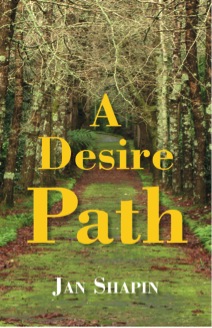
A Desire Path

by  Jan Shapin
ages: adult
First sentence: “By the time Japan surrendered, Andy’s disappointment extended to just about everything.”
I’d tell you to buy it at your local independent bookstore, but you can’t. 😦
Review copy provided by the author.

It’s the 1930s, the height of the Depression, and everywhere people are struggling. To find work, to find a path, to find themselves. Andy’s in Washington, D.C. when he meets up with an old friend (she always liked him more than he liked her), Anna Mae, who, in the wake of her successful books about Communisum, has fallen in with a hot-shot defense lawyer. Andy falls for the lawyer’s wife, and they fall into an affair. One which goes on for a while, but is finally ended because Ilse isn’t willing to leave her husband and family. In the midst of all this, Anna Mae has her own trials: her father’s mind is going, and she needs to find a home for him, since she’s in Russia and neither of her brothers live nearby. On top of that, after years of reporting on Communism, Anna Mae finally has decided to take the plunge and join the party. Except the people in charge of the party in Seattle are petty and want revenge for the part they think Anna Mae has in all this. Ilse, over the years, is an impartial observer of all this, not really engaging — aside from her affair with Andy — and mostly just being a friend.

I was offered this book to review because I liked the author’s previous one, quite a bit. She seemed to have a way with making grand epics seem personable. But this three-pronged story didn’t do that for me. I struggled to connect with the characters, to find meaning in why these three disparate stories were connected. Aside from the obvious — that they knew each other, and knowing Anna Mae led Andy and Ilse together — there really wasn’t any reason for their stories to be told together.

Out of the three stories, though, I did find Anna Mae’s fascinating. The book I would have really loved to read is the one about Anna Mae, about her journey into reporting about Communism, the reasons behind her ending up in the Soviet Union, her tumultuous relationship with her father, how she and Andy met. In comparison, Andy and Ilse’s affair seems trite, a fleeting moment of passion without the depth that I think the characters wanted to believe they had.

Shapin’s writing is still spare and elegant; giving life and meaning to lives that aren’t that meaningful. It’s what kept me turning pages, even while I was frustrated with the direction of the story. I really did want to like this book; I like the author. But in the end, I just felt that it was flat. Which is disappointing.

Audiobook: Major Pettigrew’s Last Stand

by Helen Simonson
read by  Peter Altschuler
ages: adult
Support your local independent bookstore: buy it there!

A while back a woman came into the store looking for some Georgette Heyer books. Unfortunately, we didn’t have any in the store (shame on us), so I started hunting around for some read-alikes. She’d read all the obvious ones (Jane Austin), we were lacking in Shannon Hale as well, and then I stumbled upon this one. I remembered, somewhat vaguely, that it was British and that it had gotten some good buzz, and so I recommended it to her. She bought it, and I crossed my fingers that it would work.

And then, I chided myself: if I recommended it to someone who liked Georgette Heyer (which I do), why wouldn’t I like it? So, I picked up the audio book to listen to while I putter around town sans kids.

The bottom line? It was a grand suggestion for someone who loved Georgette Heyer: at turns funny and sweet; very, very British; and with a lovely wedding at the end. I adored listening to it.

I do have to admit, also up front, that I adored it because Peter Altschuler is a brilliant narrator. All the right voices, all the right inflection (Roger was a Twit! I kept shouting at him. I’m sure the other drivers thought I was insane.), all the right emphasis in the right places, so I got the humor and I understood the conflict and I loved (absolutely adored) the Major.

For the five of us who live under a rock, the  basic story is one of Major Ernest Pettigrew, widower, whose brother has just died. He’s a bit at a loss the  day of, and so when Mrs. Jasmina Ali (widow), comes to collect for the paperboy, he just kind of falls into a friendship with her. He soon discovers that 1) she’s wonderful and 2) it doesn’t matter, to him, that she’s Pakistani, though it seems to matter a lot to the villagers of Edgecombe St. Mary. It’s a domestic drama: the things that happen are ordinary things. Antique guns are involved, as are American developers, and lots and lots of cultural tension. Through it all, the Major is impeccably honorable and quite British, but somehow, all comes right in the end (though there’s a bit of a tense scene wherein Islam does not come off well, and I thought was quite unnecessary), with the Major and Mrs. Ali following their hearts.

I didn’t realize that it was a modern setting, but for the most part, it all worked. The characters are really what drive this story: from the not-meaning-to-be-racist-and-yet-are village ladies; to the twit of a son Roger; to his American fiance, Sandy (I liked her too); to the orthodox, yet conflicted, nephew of Mrs. Ali, all are intriguing and complex. Very few (maybe the bumbling vicar, and the loud, obnoxious American developer) are straight-up caricatures, something which I appreciated.

A delightful way to spend a few hours.

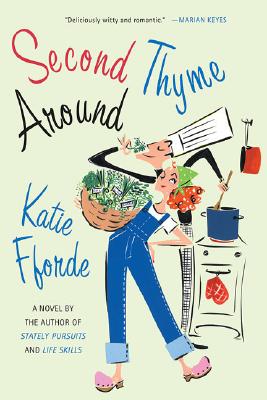
Second Thyme Around

by Katie Fford
ages: adult
First sentence: “Well? Are you going to come in?”
Support your local independent bookstore: buy it there!

Ten years ago Perdita’s life fell apart. Sure, she was young — only 19 — but she loved Lucas. And even though their marriage wasn’t much of anything, he didn’t need to slap her in the face by running off with an older woman.

Now, Perdita has gotten her life together and owns a vegetable supply business, growing unique and unusual high-end vegetables for the local spa and high-end restaurant. Sure, she doesn’t have a boyfriend, but who needs one when her business and her relationship with her elderly next-door neighbor and close friend, Kitty, takes up so much of her time. So, it comes as a bit of a shock when Lucas shows up in the kitchen of the high-end restaurant she supplies, having taken over. Since when did he become a chef (especially since he was a stock broker last she knew)? And while he’s as abrasive and bossy as ever, since when did he develop a nice streak?

I picked this up because I wanted something fluffy, something fun, something romantic, and something British. On those counts, it succeeded quite nicely. It was quite fluffy, it was somewhat romantic, and it was definitely British.

But I’m not sure it held up as a story. Aside from the fact that it wasn’t insta-love (yay!), I didn’t get the chemistry between Lucas and Perdita. She spent the whole book hating him, thinking he was just boorish and domineering (which he was), and then, boom: she was back in bed with him. What makes them think that this time around they’d be able to make it work? Sure, she’s ten years older, but I wasn’t convinced that they’d be good together. Or even that they wanted to be together. It didn’t make sense.

Aside from that problem (major though it is), it was a fun little diversion. I just wish it could have been better.

Memoirs of an Imaginary Friend

by Matthew Dicks
ages: adult
First sentence: “Here’s what I know:”
Support your local independent bookstore: buy it there!
Review copy provided by my place of employment.
Release date: August 21, 2012

I’m kind of at a loss where to begin with this one. The owner at the bookstore handed it to me because it looks vaguely YA(ish), and imaginary friends have something to with kids, right?

But that isn’t what this novel is at all.

In a fascinating approach to things, Dicks has written a novel from the imaginary friend’s point of view. And, much in the way a fantasy writer creates a world, Dicks has created a whole world for Budo, nine-year-old Max’s friend, to reside in. First off: just because Max is the only one who can see him, does not mean that Budo isn’t real. He can see our world, experience our world, he just can’t interact with other people. He can, however, interact with other imaginary friends, and from doing that, he’s realized two things: 1) Max imagined him very well, because next to some of the other friends, Budo looks almost real; and 2) he’s quite old — being six — and that is unusual. Most other imaginary friends don’t last that long.

It starts out oddly; you don’t know quite where Dicks is going with this story, especially since it becomes very clear early on that Max has some form of autism. Although it’s never said outright, most of the signs are there. But as the story goes on, you realize that it’s because Max is autistic that Budo exists. And that fact becomes crucial to the plot.

I’ll be straight with you: I got to a certain point in the book, and I was afraid I’d have to abandon it because one character was abusing Max. That is not the case. There are scary, and sad, things going on, but it’s not abuse, thankfully. Because the book is remarkable. Not only for the world building, but for the heartbreakingly honest way Budo reacts to the situations with Max, and ends up being the unsung hero. I rarely think books are “heartwarming”, but I do think that of this one. Heartwarming, creative, unique.

Amazing. It will make you want to believe in imaginary friends all over again.


The Sherlockian

by Graham Moore
ages: adult
First sentence: “Arthur Conan Doyle curled his brow tightly and thought only of murder.”
Support your local independent bookstore: buy it there!

It’s 1900, three years after famed author Arthur Conan Doyle killed off his most famous character, when he receives a box with a pipe bomb in it. It doesn’t kill him, but it does set him on a trail: someone murdered an innocent woman, and Doyle’s going to figure out who it is.

It’s also 2010, and Harold White has become the newest inductee into the Baker Street Irregulars, the most prestigious of the Sherlockian groups. While at the conference, he discovers the murder of the group’s most illustrious scholar, Alex Cale, who had recently found a diary of Doyle’s that had gone missing 80 years before.

Both men will find themselves knee-deep in mysteries that will confound them, and have them asking the ultimate question: What Would Sherlock Do?

I have to admit that I’m not a Sherlock buff. Sure, I like the new BBC series (and even the old one, with Jeremy Brett), but I’m not really a fan. And nowhere near the fanatic that the characters in the book are. And yet, I found myself strangely compelled by this mystery. Partially, I think, it was having Conan Doyle (and Bram Stoker!) be a character. I found his inner life interesting (even if it was mostly fictionalized), especially his loathing of his most famous detective. Harold, as well, was a fascinating character; smart not because he was brilliant, but because he was well-read and able to connect the dots.

But the mystery left a little to be desired. I felt that for all the build-up that we were given, the solution to the mystery was, well, a bit lame. Perhaps that was the author’s intent: the fun was in the journey, but not in the resolution.

And if that was the case, then he succeeded: because getting to the end was a lot of fun. Even if the end was a bit, well, lame.

Shadow of Night

by Deborah Harkness
ages: adult
First sentence: “We arrived in an undignified heap of witch and vampire.”
Support your local independent bookstore: buy it there!
Others in the series: Discovery of Witches

How about this for a brief teaser: if you liked Diana Gabaldon’s Outlander, you’ll probably really like this one.

The long explanation is a lot more complicated, however. There were elements of Shadow of Night that I really liked. And there were some that I didn’t. But my major problem with the book — and this is one I have with many works of “adult” fiction — is that I thought a good third to half of this book was wholly unnecessary.

Because of the conflicts set up in Discovery of Witches (which I won’t go into, but partially are caused by the love Matthew and Diana have for each other; witches and vampires aren’t supposed to mate.), and because Diana needs help figuring out what kind of witch she is (and to control her magic), they end up in the past. In England, circa 1590, to be exact. Which brings me (so soon?) to problem number one: too often, I felt Harkness was using her status as a historian to show off. I got the sense that she set the book in the past not because it best served the story (though in some ways, it did), but because she KNOWS STUFF and wanted to share. Too often I was pulled out of the story because of some name dropping (though Diana has a moment of exasperation, wondering out of all the people in England in the past, how come Matthew knows all the famous ones. That kind of helped.) and historical elements. It was hard for me to enjoy the past because she kept pulling me out of it with details about clothes, food, the weather, and blasted Christopher Marlow.

Anyway. Matthew and Diana aren’t in England very long before they cause a ruckus and get sent to Sept Tours, Matthew’s ancestral home. Where his dead father is still very much alive. And who forces them to get married. (In way too many pages. Followed by many, many more pages of [not graphic, or even titillating] married sex.) Back to England they go, where (in some of the best passages) Diana begins to figure out that she’s a unique sort of witch, and gets a handle on her magic. Oh, and manages to get pregnant by the vampire.

Before you think that Harkness went all Breaking Dawn on us, she didn’t. Oh, sure, there are influences there: Matthew is just as protective and oppressive as Edward; apparently it’s in a vampire’s “nature”. The difference is that rather than being pushed around, Diana takes him on. Thank heavens for that; in many, many ways, Diana as a character is the best part of this novel. She’s strong, interesting, clever, inquisitive, and plain fun to be around as a character.

There’s more, of course: It’s a nearly 600 page book, and Harkness finds ways to fill them out. And it’s not a bad book, per se: I did finish it. Because even with all the extra historical stuff, and the poor plotting (for my YA-saturated brain), I am invested in Matthew and Diana’s story. Which means, I’m already asking when the next one will be out.

If you’re still interested in this one after all that, I’m offering a giveaway of this book. I’ll even throw in a set of five pins, and a temporary tattoo. Maybe you’ll like it more than I did. You have until Friday, July 13th (ooooh, auspicious) to enter.

A Lady Cyclist’s Guide to Kashgar

by Suzanne Joinson
ages: adult
First sentence: “I unhappily report that even Bicycling for Ladies WITH HINTS TO THE ART OF WHEELING – ADVICE TO BEGINNERS – DRESS – CARE OF THE BICYCLE – MECHANICS – TRAINING – EXERCISES, ETC. ETC. cannot assist me in this current predicament: we find ourselves in a situation.”
Support your local independent bookstore: buy it there!

Two things drew me to this book. First, the cover: I love it. I don’t know why (it’s not a young girl in a pretty dress, after all), but something about it just calls to me. And second, that first sentence. It’s wonderful, full of promise, of something … exciting.

And the premise sounded interesting as well: it’s 1923, and Evangeline English and her sister, Lizzie, have thrown their lot in with a evangelical missionary and are traveling to the wilds of Eastern Turkestan/Upper China. Lizzie and the missionary, Millicent, are there to convert people; Evangeline is there to write a book about cycling in this wild, unknown (at least to the English) place. It doesn’t go well, to say the least. They try to help a girl give birth, but the mother ends up dying, and they are placed under house arrest and given charge of the baby. From there, things only go down hill. There’s a lot of resistance to their missionary message, and Millicent is overbearing; she and Evangeline don’t get along.

However, that’s not the only story: it’s modern day London, and Frieda, the daughter of hippy parents and world traveler — is in a dead-end relationship with a married man. She’s back in town after a trip to Cairo, when two unusual things happen: one, she gets a letter telling her that she is the next-of-kin for an Irene Guy, whom she’s never even heard of; and a Yemeni man, Tayeb, parks himself outside of her door. Both of these things will change her life.

I spent a good portion of the book trying to figure out how these two stories were connected. I should have realized how much sooner than I did; if you’re paying attention, it’s pretty obvious. Even so, each of the stories might have made a decent book on their own; together it kind of seems forced. I wanted more from each of the stories, more than I got anyway, and I feel like in combing them Joinson somehow cheated me of the full story. That, and I think the most interesting character was the elusive Ilene Guy; her story seemed like the most intriguing.

That said, it wasn’t a bad book. There’s enough in it to keep my attention throughout it all, and while I didn’t love it in the end, at least I wasn’t bored by it. And that’s something.

Right?

Good Omens

by Terry Pratchett and Neil Gaiman
ages: adult
First sentence: “It was a nice day.”
Support your local independent bookstore: buy it there!

This is one of those “everything but the kitchen sink” kind of books. There’s witches (who carry bread knives around for protection, because that’s the sort of witch they are) and witch hunters. Prophetesses (well, one: who wrote the Nice and Accurate Prophecies of Agnes Nutter, which is surprisingly correct) and anti-Christs (well, one. He’s eleven.). Demons and angels. Not to mention the four riders of the Apocalypse, as well as several telephone salespeople.

And all are headed toward Lower Tadfield. Because, of course, that’s where the End of the World/The Great War/Impending Doom is going to take place.

I adore Gaiman and Pratchett separately, so I figure together (and, yes, it was about time I read this book!) they’d be brilliant. And they were. So much so, that I think I missed a good 60% of the jokes. Completely. It’s not that I didn’t like the book: I did. I laughed at parts, I kept turning pages, I did love bits and pieces of it. But really (and Hubby says it’s because I haven’t seen The Omen, nor do I have plans to), I felt like I was sitting in on a conversation where I got some of what was being talked about, but was, for the most part, left completely out to pasture.

Which means, although it’s brilliant (I really did like the forward and afterward in my 2006 edition), it’s not my favorite Gaiman or Pratchett.

Ilium

by Dan Simmons
ages: adult
First sentence: “Rage.”
Support your local independent bookstore: buy it there!

There are books and then there are Books. Ones that throw their heft around, demanding things (heaven forbid!) of you as a reader. This is one of Those Books.

To be fair: I don’t think I’m smart enough for this book. For starters, there’s just so bloody much going on. It’s got Greek mythology, dystopian post-apocolyptic societies, Proust, Shakespeare (in more ways than one!), magic, technology, robots, some weird species called morovecs, and Little Green Men on Mars.

The plot, you ask? Well, there’s three:

  • On Mars, the Gods of Olympus are re-enacting (possibly) the Iliad, using dead 20th- and 21st- century scholars to observe and predict the action. 
  • On Earth (possibly), there is a group of friends who end up setting off to find the post-humans (no, I’m not quite sure what they are, either) and end up meeting a 1400-year-old Jewish woman who leads them to an asteroid above earth where the post-humans are supposed to be. Along the way, one of the party gets eaten by a dinosaur (or maybe that happens first?) and they meet Odysseus.
  • There are two moravecs (robotic entities, mostly scholars of Earth, that live on the moons of Jupiter) sent on a mission to figure out why Mars has been terraformed.

 For me, the Iliad one was the most interesting, and really what kept me reading the book. Then came the dystopian-human-Earth one. I do have to admit, that for a good half of the book, I skimmed the moravec chapters. I can only take so much Proust. That said, I kept hoping the three plots would converge and start to make sense. They do end up converging — and honestly, about two-thirds of the way through, it got really interesting — but I’m not sure about the making sense part.

See, the entire book, all 570 pages of it, was an elaborate set up for the next book, Olympos. (I’ve never read the Iliad: is it just a huge set-up for the Odyssey?) Which really, really frustrated me. I wanted some sort of ending, some sort of resolution, and I’m left hanging in a major way. So, I’m torn: do I want to read yet another Book (it’s 690 pages, for heaven’s sake!) just so I can figure out what the whole story was about? Or do I just cut my losses and walk away?

I’m leaning toward the latter.