June Jacket Flap-a-Thon

I’m suffering from a cold/allergies, and I feel like I’ve got a head stuffed full of cotton. I’m not sure how coherent this is going to be this month, but I’ll try.

5.
Ever (HarperCollins): “Falling in love is easy… even for Kezi, though she knows her days are numbered. And head-over-heels, come-what-may love is inevitable if her heart’s desire is Olus, the Akkan god of the winds. But accepting death is hard, especially when romance is new. Falling in love is easy for Olus if his beloved is Kezi, a beautiful mortal, a dancer and rug weaver from the city of Hyte. But facing Kezi’s approaching death is unbearable. Love brings Kezi the will to fight her fate. Love gives Olus the strength to confront his fears. She questions her faith and seeks truth in dark places. He suffers a god’s trial when she needs a champion. Together — and apart — they encounter spiders with webs of iron, the cruel lord of the land of the dead, the mysterious god of destiny, and the tests of the Akkan gods. If they succeed, they will be together; but if they fail, Olus will have to endure the ultimate loss, and Kezi will have to make the supreme sacrifice. Newbery Honor author Gail Carson Levine has created a stunning new world of flawed gods, unbreakable vows, and ancient omens. Her story about love, destiny, and belief is spellbinding.”

Actually, it was this jacket flap that made me want to read the book. (Well, that and a couple bloggers’ gushing reviews.) Always a good sign.

4. Persepolis: The Story of a Childhood (Pantheon):“Originally published to wide critical acclaim in France, where it elicited comparisons to Art Spiegelman’s Maus, Persepolis is Marjane Satrapi’s wise, funny, and heartbreaking memoir of growing up in Iran during the Islamic Revolution. In powerful black-and-white comic strip images, Satrapi tells the story of her life in Tehran from ages six to fourteen, years that saw the overthrow of the Shah’s regime, the triumph of the Islamic Revolution, and the devastating effects of war with Iraq. The intelligent and outspoken only child of committed Marxists and the great-granddaughter of one of Iran’s last emperors, Marjane bears witness to a childhood uniquely entwined with the history of her country. Persepolis paints an unforgettable portrait of daily life in Iran: of the bewildering contradictions between home life and public life and of the enormous toll repressive regimes exact on the individual spirit. Marjane’s child’s-eye-view of dethroned emperors, state-sanctioned whippings, and heroes of the revolution allows us to learn as she does the history of this fascinating country and of her own extraordinary family. Intensely personal, profoundly political, and wholly original, Persepolis is at once a story of growing up and a stunning reminder of the human cost of war and political repression. It shows how we carry on, through laughter and tears, in the face of absurdity. And, finally, it introduces us to an irresistible little girl with whom we cannot help but fall in love.”

I thought this does a good job of giving the reader an overview of the book, illuminating the fact that it’s a graphic novel, and yet not giving away too much of the plot.

3. The Penderwicks on Gardam Street (Alfred A. Knoff): “The Penderwick Sisters are home on Gardam Street and ready for an adventure! But the adventure they get isn’t quite what they had in mind. Mr. Penderwick’s sister has decided it’s time for him to start dating—and the girls know that can only mean one thing: disaster. Enter the Save-Daddy Plan—a plot so brilliant, so bold, so funny, that only the Penderwick girls could have come up with it. It’s high jinks, big laughs, and loads of family warmth as the Penderwicks triumphantly return.”

Short, to the point, and immediatly grabs the people that loved the Penderwicks. I’m not sure how well it’ll do getting readers not familiar with the first book interested, though, and for that reason it’s not higher on the list.

2. the mysterious edge of the heroic world (athenum books for young readers):
“Amedeo Kaplan seems just like any other new kid who has moved into the town of St. Malo, Florida, a Navy town where new faces are the norm. But Amedeo has a secret, a dream: More than anything in the world, he wants to discover something — a place, a process, even a fossil — some treasure that no one realizes is there until he finds it. And he would also like to discover a true friend to share these things with. William Wilcox seems like an unlikely candidate for friendship: an aloof boy who is all edges and who owns silence the way other people own words. When Amedeo and William find themselves working together on a house sale for Amedeo’s eccentric neighbor, Mrs. Zender, Amedeo has an inkling that both his wishes may come true. For Mrs. Zender’s mansion is crammed with memorabilia of her long life, and there is a story to go with every piece. Soon the boys find themselves caught up in one particular story — a story that links a sketch, a young boy’s life, an old man’s reminiscence, and a painful secret dating back to the outrages of Nazi Germany. It’s a story that will take them to the edge of what they know about heroism and the mystery of the human heart. Two-time Newbery winner E. L. Konigsburg spins a magnificent tale of art, discovery, friendship, history, and truth.”

I always like it when the jacket flap reflects the style of the book, and I think this one captures E.L. Konigsburg perfectly.

1. The Fall of the Kings (Bantam): “In an ancient city full of dreams, no king rules anymore. And some thing that it’s for the best… Generations ago the last king fell, taking with him the final truths about a race of wizards who ruled at his side. But the blood of kings runs deep in the land and its people, waiting for the coming together of two unusual men: THE GENTLEMAN. Heir to an ancient house and a modern scandal, Theron Campion — a young nobleman of royal lineage — chooses his lovers with reckless abandon. Tormented by his twin duties to his family and his own bright spirit, he seeks solace in the precincts of University. But no one can live in two worlds forever. THE SCHOLAR. A brilliant and charismatic teacher ruled by a passion for knowledge, Basil St. Cloud is in love with the ancient kings. Of course, everyone now knows that the wizards were charlatans, the kings their dupes and puppets. Only Basil is not convinced. Against a rich tapestry of artists and aristocrats, students and strumpets, scheming spies and renegade royalists, Basil and Theron will find themselves playing out an ancient drama destined to blow open their society’s smug vision of itself — and reveal that sometimes the price of uncovering history is being forced to repeat it….”

Not my favorite book this month — actually, it was probably my least favorite — but every time I read this jacket flap copy, I think “wow, that’s gotta be a good book”. That’s got to count for something.

The One Worst:
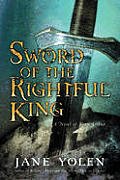
Sword of the Rightful King (Harcourt, Inc.): “The newly crowned King Arthur is unsure of himself; worse, the people are unsure of him. Too many people want the throne, and treachery is everywhere. Merlin must do something before the king is betrayed, or murdered, or–worst of all–gets married. So Merlin magically places a sword into a slab of rock, lets it be known that whosoever removes the blade will rule all of England, and invites any man who would dare, to try to pull out the sword. After a bit of showmanship, Arthur will draw the blade (with a little magical help, of course), and the people will rally around the young king. Except someone else pulls the sword out first. . . .”

Biggest complaint (yet again): when the jacket flap includes one sentence from the plot that doesn’t happen until the last 30 pages. I kept expecting the whole plot to revolve around the “someone else pulls the sword out first” when that was really an afterthought in the book.
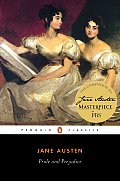
Pride and Prejudice

Ah, the consummate Jane Austen. The Most Popular Jane Austen (thanks, Colin Firth…). The Chick Lit Jane Austen. What is there really to say about Pride and Prejudice??

I used to say that I read it annually, that it was my favorite Jane Austen. Honestly, though: I don’t, and it’s not. But, I do love it for what it is: a genuinely funny, sweet, wonderful romantic comedy. (My mother’s complaint about the A&E version of the book is that they played up the romance too much and short-changed the comedy. It really is a funny book.) Lizzy and Darcy are the perfect romantic leads: the lovers who don’t realize that they’re in love until they’re already most of the way there. (I thought reading this was very appropriate after having seen Much Ado About Nothing. Lizzy and Darcy have much in common with Beatrice and Benedict.) The man who can’t resist the woman, even though he really tries hard. The woman who loathes the man until she realizes that he’s really much more than he appears. They fight the urge to fall in love, for different reasons: there are no star-crossed, obsessed (Bella and Edward!), pining lovers here. And, because of that, because of their wit and banter, and because of the whole tension surrounding their relationship, that final kiss (well… in the movie), their final tumble into and acceptance of their love is that much more sweet and fulfilling. It is truly a perfect book to read on a hot, summer day.

That is what I can say.

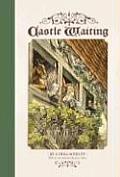
Castle Waiting

I found this book through a commenter on Fuse’s Rapunzels Revenge review who suggested it as a follow up for those who were looking for more after reading Shannon and Dean Hale’s graphic novel. It sounded interesting, our library had it, I put a hold on it, and M graciously picked it up for me on Friday (because she was hoping that there would be something for her).

I’m torn about this one. I liked it very much — the art was black and white, comic strip style, but it worked well in this situation. (Though part of me longed to see the color of things. I do think that color would have overwhelmed the page in some places.) Linda Medley is a good artist, and is incredibly inventive with the world she has created.

But. I liked the story at the beginning: using the Sleeping Beauty fairy tale as a jumping off point, Medley creates a world where Sleeping Beauty’s castle is used as a refuge. A woman, Jain, makes her way there, pregnant with her lover’s baby, seeking refuge from an abusive husband. There, she finds comfort and companionship with the castle residents, whom in turn ask no questions and love and accept her odd-looking baby.

So far, so good. I was enjoying hearing Jain’s story, enjoying the characters that were a part of the castle, enjoyed the novelty of the world Medley had created. But then, for the third part of the book, Medley chooses to abandon everything she had done before, and take off in a completely different direction, telling the story of one of the castle’s residents, Sister Peace. It’s not that Sister Peace’s story was uninteresting; the story of how the Solicitine Order came to be and how Peace became to be a part of it, and of her friend Nessie escaping her abusive husband and finding a better life for herself was all very interesting, it’s just that I kept searching for some kind of connection to the story that went before, some kind of cohesiveness, and some kind of ending of the story I was previously enjoying. I never got that, and it kind of spoiled the novel for me. If only…

Ah, well.

House of Dance

First, I have to send a big Thank You to Em for this book. She had a contest to win a copy a while back, and I won one. Signed by the author, even. So, you can imagine both my excitement and my hesitation when beginning it.

Excitement because it’s always exciting to win something.

Hesitation because what if I didn’t like it? It’s never fun to win something and then not like it.

I did like it though. Very much. I knew early on, though, that I liked it not for the plot — 15-year-old Rosie is dealing with her grandfather’s impending death, as well has her mother’s affair with a married man — but because of the language. (This is the second book in as many weeks where I was captivated by the writing. Who knows: maybe eventually, I’ll even be able to read — and like — Dickens.) It was a simple book, spare in its writing, but that’s a good thing. I felt like Kephart chose her words with poetic carefulness — every word that was there was there for a reason, and designed to give the reader the most vivid picture possible.

For example (from a randomly selected page):

And then I tilt my own eyes high, to find a slice of sky. That was how I discovered the cluster of balloons — the bobbing silver, white, and pink with the sunbeams trapped inside.

And later:

We did the whole thing again, and my head felt slung against itself. There were three of me in the mirror and four of Max in the room, and he was laughing, shaking his head. “We’re oging to have to do that again,” he said. “Rosie.” As if he had to remind me who I was.

It’s all like that. Very evocative. If the language wasn’t so beautiful, so precise, so picturesque, that I would have lost interest because the plot was kind of lackluster. I enjoyed Rosie’s interactions with her grandfather, but the conflict with her mother over her relationship with a married man felt kind of forced. There was a bit of romance with the next-door-neighbor boy, Nick, but nothing to swoon over. My favorite parts — aside from Kephart’s descriptions of the music of Ella Fitzgerald and Sammy Davis Jr. — were the the ballroom dance lessons. Perhaps it’s because I was a bit of a ballroom dancer back in college, but I was able to picture what she was describing, able to see the dance studio, able to feel the rhythms. I’m not sure if it would have worked so well for me had I not been a dancer once.

One last quote, for the road:

Annie Pearl in the end brought down the house with any flower that blooms in ruby red, because ruby red is the color of July, which is the color of passion, which is the color of a life being lived. Ruby red is the heart, and ruby red was the color of my borrowed shoes , the color of the dress that Miss Marie had sewn for me. Ruby red bloomed everywhere.

Sword of the Rightful King

I have mixed feelings about this book by master storyteller, Jane Yolen. It’s not so much a retelling of the Arthurian legend, but rather a rethinking of the tales. She takes elements of the original legend — most specifically the sword in the stone — and turns it upside down and inside out. I liked what she did with it, but there was a part of me that felt dissatisfied in the end.

Arthur’s been king for four years, and still there’s unrest in the country. Not everyone — most notably, Morgause (in her typical role of North Witch, master of the black arts) — is convinced that Arthur should be High King. So his mage, Merlinnus, devises a plan: put a sword in a stone, with some writing on it that declares that the person who draws the sword will be king, and challenge anyone to pull it out. Of course, only Arthur can, since Merlinnus put a spell on it so that would be the only possible solution.

Yet this book isn’t so much about Arthur, as it is about Gawen. He shows up near the beginning, desiring to become one of Arthur’s knights. He gets shuffled off — because of his size and quick wit — to be Merlinnus’s assistant instead. There’s something puzzling about Gawen… how he knows so much, his observations, his becoming one of Arthur’s trusted advisors.

I liked Gawen… I liked him even more at the end, even though I felt the ending was a bit rushed. (Yes, there is a secret there, but I had my suspicions about a third of the way through, and figured it out a little more than halfway, so it’s not really that big of a secret.) It had the elements of everything I like: intrigue; magic; Merlin as his old cranky self; Arthur as a loveable, bear-like king; and I admit I didn’t even mind this Morgause too much. I really liked Gawen. But maybe that was it: Gawen was too perfect, to pert, too right, too observent, too… too much. And in the end, I thought it just was a bit unbalanced. Maybe a little less would have been more here.

Still, it’s a interesting — if imperfect — interpretation of the Arthurian legend.

100 Best Books

3M did a memeish type thing with EW’s 100 best books of the past 25 years. (I’ve seen it around other places, too, but they escape me right now…) Since I like lists, I thought I’d give it a whirl.

You can find the original list list here.

I’ve read the books in bold, and I own the books in green.

1. The Road , Cormac McCarthy (2006)
2. Harry Potter and the Goblet of Fire, J.K. Rowling (2000)
3. Beloved, Toni Morrison (1987)

4. The Liars’ Club, Mary Karr (1995)
5. American Pastoral, Philip Roth (1997)
6. Mystic River, Dennis Lehane (2001)
7. Maus, Art Spiegelman (1986/1991)
8. Selected Stories, Alice Munro (1996)
9. Cold Mountain, Charles Frazier (1997)
10. The Wind-Up Bird Chronicle, Haruki Murakami (1997)
11. Into Thin Air, Jon Krakauer (1997)
12. Blindness, José Saramago (1998)
13. Watchmen, Alan Moore and Dave Gibbons (1986-87)
14. Black Water, Joyce Carol Oates (1992)
15. A Heartbreaking Work of Staggering Genius, Dave Eggers (2000)
16. The Handmaid’s Tale, Margaret Atwood (1986)
17. Love in the Time of Cholera, Gabriel García Márquez (1988)
18. Rabbit at Rest, John Updike (1990)
19. On Beauty, Zadie Smith (2005)
20. Bridget Jones’s Diary, Helen Fielding (1998)
21. On Writing, Stephen King (2000)
22. The Brief Wondrous Life of Oscar Wao, Junot Díaz (2007)
23. The Ghost Road, Pat Barker (1996)
24. Lonesome Dove, Larry McMurtry (1985)
25. The Joy Luck Club, Amy Tan (1989)
26. Neuromancer, William Gibson (1984)
27. Possession, A.S. Byatt (1990)

28. Naked, David Sedaris (1997)
29. Bel Canto, Anne Patchett (2001)
30. Case Histories, Kate Atkinson (2004)
31. The Things They Carried, Tim O’Brien (1990)
32. Parting the Waters, Taylor Branch (1988)
33. The Year of Magical Thinking, Joan Didion (2005)
34. The Lovely Bones, Alice Sebold (2002)
35. The Line of Beauty, Alan Hollinghurst (2004)
36. Angela’s Ashes, Frank McCourt (1996)
37. Persepolis, Marjane Satrapi (2003)
38. Birds of America, Lorrie Moore (1998)
39. Interpreter of Maladies, Jhumpa Lahiri (2000)
40. His Dark Materials, Philip Pullman (1995-2000)

41. The House on Mango Street, Sandra Cisneros (1984)
42. LaBrava, Elmore Leonard (1983)
43. Borrowed Time, Paul Monette (1988)
44. Praying for Sheetrock, Melissa Fay Greene (1991)
45. Eva Luna, Isabel Allende (1988)
46. Sandman, Neil Gaiman (1988-1996)
47. World’s Fair, E.L. Doctorow (1985)
48. The Poisonwood Bible, Barbara Kingsolver (1998)
49. Clockers, Richard Price (1992)
50. The Corrections, Jonathan Franzen (2001)
51. The Journalist and the Murderer, Janet Malcom (1990)
52. Waiting to Exhale, Terry McMillan (1992)
53. The Amazing Adventures of Kavalier & Clay, Michael Chabon (2000)
54. Jimmy Corrigan, Chris Ware (2000)
55. The Glass Castle, Jeannette Walls (2006)
56. The Night Manager, John le Carré (1993)
57. The Bonfire of the Vanities, Tom Wolfe (1987)
58. Drop City, TC Boyle (2003)
59. Krik? Krak! Edwidge Danticat (1995)
60. Nickel & Dimed, Barbara Ehrenreich (2001)
61. Money, Martin Amis (1985)
62. Last Train To Memphis, Peter Guralnick (1994)
63. Pastoralia, George Saunders (2000)
64. Underworld, Don DeLillo (1997)
65. The Giver, Lois Lowry (1993)
66. A Supposedly Fun Thing I’ll Never Do Again, David Foster Wallace (1997)
67. The Kite Runner, Khaled Hosseini (2003)
68. Fun Home, Alison Bechdel (2006)
69. Secret History, Donna Tartt (1992)
70. Cloud Atlas, David Mitchell (2004)

71. The Spirit Catches You and You Fall Down, Ann Fadiman (1997)
72. The Curious Incident of the Dog in the Night-Time, Mark Haddon (2003)
73. A Prayer for Owen Meany, John Irving (1989)
74. Friday Night Lights, H.G. Bissinger (1990)
75. Cathedral, Raymond Carver (1983)
76. A Sight for Sore Eyes, Ruth Rendell (1998)
77. The Remains of the Day, Kazuo Ishiguro (1989)
78. Eat, Pray, Love, Elizabeth Gilbert (2006)
79. The Tipping Point, Malcolm Gladwell (2000)
80. Bright Lights, Big City, Jay McInerney (1984)
81. Backlash, Susan Faludi (1991)
82. Atonement, Ian McEwan (2002)
83. The Stone Diaries, Carol Shields (1994)

84. Holes, Louis Sachar (1998)
85. Gilead, Marilynne Robinson (2004)
86. And the Band Played On, Randy Shilts (1987)
87. The Ruins, Scott Smith (2006)
88. High Fidelity, Nick Hornby (1995)
89. Close Range, Annie Proulx (1999)
90. Comfort Me With Apples, Ruth Reichl (2001)
91. Random Family, Adrian Nicole LeBlanc (2003)
92. Presumed Innocent, Scott Turow (1987)
93. A Thousand Acres, Jane Smiley (1991)
94. Fast Food Nation, Eric Schlosser (2001)
95. Kaaterskill Falls, Allegra Goodman (1998)
96. The Da Vinci Code, Dan Brown (2003)
97. Jesus’ Son, Denis Johnson (1992)
98. The Predators’ Ball, Connie Bruck (1988)
99. Practical Magic, Alice Hoffman (1995)
100. America (the Book), Jon Stewart/Daily Show (2004)

Only 28. Less than I thought… There are some interesting choices here… for instance, Goblet of Fire. That’s not nearly Rowling’s best book. And I think some of them are just because they were extremely popular — Da Vinci Code, for example — rather than good. But there are some good books on there too.

Feel free to take it and pass it along. 🙂

In the Mood

I saw this challenge over at Becky’s (fitting, since she’s hosting it) a while back, and have been putting off joining it… Last week, though, it hit me: I’m in the mood for some serious chick lit. It’s summer, it’s hot, and my brain is much too fried for anything terribly taxing. Therefore, I’m joining up. Gimme some YA romance!

My list of six, as of right now (a couple aren’t at the library, so we’ll see if they come in, or if I just change my mind):

An Abundance of Katherines
, John Green
13 Little Blue Envelopes, Maureen Johnson
Love, Stargirl, Jerry Spinelli
Suite Scarlett, Maureen Johnson
Breaking Dawn, Stephenie Meyer
The Juliet Club, Suzanne Harper

Let the swooning begin!

Watchmen

Earlier this year, when I began to discover an interest in graphic novels, Hubby got all excited. See, he was one of those guys: the ones who hang out at the comic book stores, reading about superheros and buying D&D stuff. Not that I have anything against all that — I married him after all, and he still plays D&D, as does M — but I never did it myself. (Nor did my brothers. We were Star Wars and computer geeks around my house). Anyway, I digress. He got all excited because now that I was reading graphic novels, he could finally share some of his comic books with me (aside from telling me about them when he drags me — mostly willingly, I admit — to superhero movies). He dug out this series of twelve — by Alan Moore and Dave Gibbons — and told me it was brilliant and that I had to read it.

And so, when I was looking yesterday for something non-French and non-novel, I pulled this out of my TBR pile and began reading.

First impression: it’s not nearly as well drawn as the other graphic novels I’ve read. I don’t know if the genre has evolved since the 1980s (it was written in 1986), or if there’s just a distinct comic book style. Either way, all their women look like men with breasts and the color scheme grated on me.

Second impression: It’s a very 80s story, which generated a lot of discussion between Hubby and me. The basic plot is begun with the death of a “costumed adventurer” (not superhero!), and another adventurer’s (possibly insane Rorschach) “inquiries” into the murder, and his attempts to warn his friends of a plot to kill off all the adventurers. This, of course, spirals into a more and more complicated plot (which includes a man who got completely blown up by radiation, and then proceeded to put himself back together into a true, um blue — he really is blue — super man), which includes a possibly evil genius, world domination, and an alien invasion. (Got all that? Neither did I.)

Back to the 80s comment. This series really is a product of the late-Cold War mentality: the idea that the Russians could blow us up at any minute, a mistrust of the computers that were increasingly being put in charge (think War Games… a movie I adored and watched at least two dozen times one summer), a community mentality that could easily evolve into a mob mentality, a lack of ready information (they had to watch the 6:00 news and read newspapers!) which all added to the air of uncertainty and panic. The world has moved on from that point — not only because of the falling of the Iron Curtain, but also because information is so readily available, at the same time communities are less connected — and so, much of the panic and the end-of-the-world attitudes are foreign and slightly hysterical now.

Third impression: I really don’t go in for serials. It’s the same problem I have with Dickens (sorry). I feel like that when works are serialed, the authors tend to go overlong in getting to their point. (As opposed to authors who sit down to tell a story straight in one novel. I have some of the same problem with long series, like The Sisters Grimm or, yes — sacrilege — Harry Potter, even.) This work had so many twists, so many turns, so many characters (Hubby pointed out that one of Moore and Gibbon’s geniuses was that they used every single character they drew; no one was not important. Unfortunately, that made for a lot of people to keep track of.) that by the end I felt like it was taking much to long to get to the point. Perhaps it was because they decided to do it over a year, a series of 12, instead of thinking of it as one whole and then dividing it up into chapters. It’s the nature of comic books, though.

Which makes me think that I’ll stick to bona fide graphic novels. (No offense, dear.)

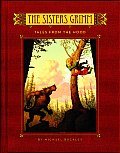
The Sisters Grimm: Tales from the Hood

I’m not sure if any of you are still following along, but things have gotten pretty grim for the Grimm sisters. Mr. Canis was arrested by Ferryport Landing’s sham of a cop and mayor and is being put on trial for the murder of Red Riding Hood’s grandmother. It’s up to the sisters, of course, and their grandmother to prove Mr. Canis’s innocence and keep him alive.

I didn’t like this one as much as I’ve liked the past two, but it wasn’t bad. For all of Buckley’s verboseness, he did come up with some clever plot twists and action points, and a decent ending, the “to be continued” notwithstanding. I thought his re-telling and manipulation of the Red Riding Hood tale was pretty clever, giving the story a whole new interpretation.

But that’s about it. I do have to say that I’m honestly glad that this is the last one for a while. Though, both M and C really loved the series.

Superheroes and E-zines…

from Big A little a…

First, because we all want to be a super hero:

You are Spider-Man

Spider-Man
85%
Robin
75%
Hulk
65%
Superman
45%
The Flash
45%
Supergirl
32%
Wonder Woman
32%
Green Lantern
20%
Iron Man
20%
Batman
15%
Catwoman
15%
You are intelligent, witty,
a bit geeky and have great
power and responsibility.


Click here to take the “Which Superhero are you?” quiz…

Next, the June The Edge of the Forest is up! You will find all this:

Okay, now here’s the scoop on the June issue:

Plus a myriad of reviews from me… I tried my hand at picture books (they’re harder to review than they seem!), plus one really good YA novel, and another decent fantasy one, and a fun little dinosaur adventure book. Whew. Enjoy!