November Jacket Flap-a-thon

It’s Cybils time around here at chez Book Nut, which means this is the Middle Grade edition of the Jacket Flap-a-thon. I haven’t forgotten about the drawing for the $25 gift card… you have until midnight (U. S. Central Standard Time) to enter. I’ll pick a winner tomorrow. Follow the link to enter.

And without further blathering, the best this month:

Born to Fly (Delacorte Press): “Ever since she can remember, Bird has loved dreamed of one thing: becoming a P-40 fighter pilot. The fact that she’s a girl has never seemed to matter. At least, not until the Japanese sneak attack on Pearl Harbor forces America into war and takes Bird’s dad, the one person who believes in her, far away. When a Japanese American boy named Kenji comes to school, everyone is sure he’s a spy or a traitor. But one night, after he saves her from drowning, Kenji and Bird accidentally discover a real spy in their town, one who’s plotting something deadly. No one believes their story, so Bird and her new friend are forced to try to stop the plot on their own. Their adventure will shake their town, test their friendship, and, if they fail, change the future o the war — and the world. This accomplished debut by Michael Ferrari, the winner of the Delacorte Yearling Price for a First Middle-Grade Novel, has everything: adventure, humor, a satisfying and nuanced portrayal of friendship, and a remarkable heroine who was born to fly.”

This one caught my eye because it makes the book sound adventurous and exciting. Good thing the book really is.

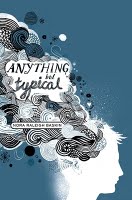
Anything But Typical (Simon and Schuster): “Jason Blake is an autistic 12 year old living in a neurotypical world. Most days it’s just a matter of time before something goes wrong. But Jason finds a glimmer of understanding when he comes across Phoenixbird, who posts stories to the same online site as he does. Jason can be himself when he writes, and he thinks that PhoenixBird — her name is Rebecca — could be his first real friend. But as desperate as Jason is to meet her, he’s terrified that if they do meet, Rebecca will only see his autism and not who Jason really is. By acclaimed writer Nora Raleigh Baskin, this is the breathtaking depiction of an autistic boy’s struggles — and a story anyone who has ever worried about fitting in.”

The best part about this jacket flap copy was that every sentence was written in a different font style and size. It’s disjointed and confusing, and I think works brilliantly, drawing the reader into this unique book.

The Brooklyn Nine (Dial Books): “1845: Felix Schneider, a 10-year-old immigrant from Germany, cheers the New York Knickerbockers as they play Three-Out, All-Out. 1864: Union soldier Louis Schneider plays baseball between battles in the Civil War. 1893: Arnold Schneider meets his hero King Kelly, one of professional baseball’s first big stars. 1908: Walter Snider, batboy for the Brooklyn Superbas, tries to sneak a black pitcher into the Majors by pretending he’s Native American. 1926: Numbers wiz Frankie Snider cons a con with the help of a fellow Brooklyn Robins fan. 1945: Kat Flint becomes a star for the Grand Rapids Chicks in the All-American Girls Baseball League. 1957: Ten-year-old Jimmy Flint thinks bullies and Sputnik are enough to worry about-until the Dodgers announce they’re leaving Brooklyn. 1981: Michael Flint finds himself pitching a perfect game during the Little League season at Prospect Park. 2002: Snider Flint tracks down the strange story of a bat that belonged to one of Brooklyn’s greatest baseball players. One family, nine generations. One city, nine innings of baseball.”

This one was difficult to write up, being a series of short stories. But I think the copy did an admirable job linking it all together. I especially like the two ending sentences.

Love, Aubrey (Wendy Lamb Books):I had everything I needed to run a household: a house, food, and a new family. From now on it would just be me and Sammy–the two of us, and no one else. A tragic accident has turned eleven-year-old Aubrey’s world upside down. Starting a new life all alone, Aubrey has everything she thinks she needs: Spaghetti Os and Sammy, her new pet fish. She cannot talk about what happened to her. Writing letters is the only thing that feels right to Aubrey, even if no one ever reads them. With the aid of her loving grandmother and new friends, Aubrey learns that she is not alone, and gradually, she finds the words to express feelings that once seemed impossible to describe. The healing powers of friendship, love, and memory help Aubrey take her first steps toward the future. Readers will care for Aubrey from page one and will watch her grow until the very end, when she has to make one of the biggest decisions of her life. Love, Aubreyis devastating, brave, honest, funny, and hopeful, and it introduces a remarkable new writer, Suzanne LaFleur. No matter how old you are, this book is not to be missed.”

There was a toss up between this one, Wild Things and Also Known as Harper. This one won, I think, not only because it was short, but also because it caught just the right tone for the book.

Other books read this month:
Joey Fly, Private Eye in Creepy Crawly Crime
Al Capone Does My Shirts
Neil Armstrong is My Uncle
Strawberry Hill
Models Don’t Eat Chocolate Cookies
A Season of Gifts
Oracle Bones
Also Known as Harper
Wild Things
Fifth Business
Black Angels
Cotillion
The Best Bad Luck I Ever Had

Love, Aubrey

by Suzanne LaFleur
ages: 10+
First sentence: “It was fun at first, playing house.”
Support your local independent bookstore, buy it there!

I’ve read about a lot of grief, trials, abandonment, and loss in the books this year for the Cybils. But few have touched me like Love, Aubrey did. Eleven-year-old Aubrey has suffered quite a bit in the past few months: her father and younger sister Savannah died in a car crash that left Aubrey and her mother alive, but scarred. And when, on a hot August day, her mother takes off and just doesn’t come back, Aubrey feels like it’s probably for the best. After all, if everyone’s going to leave, who needs them? Only, when her Grams comes — out of concern, since Aubrey’s not answering the phone — and discovers the situation, she whisks Aubrey back to Vermont, to real life, to friendship, to love, and eventually to the path of healing.

On the back of my copy there’s a quote by Sarah Weeks, author of So B. It, that says, “LaFleur has a rare gift — an authentic middle grade voice.” I have to completely agree. The dialogue doesn’t seem affected. The narrative — which is punctuated by heartfelt letters from Aubrey to various people — flows seamlessly. Aubrey grabs your attention in a way that’s unique and heart rendering. The pain she feels — at the loss of her beloved father and sister, and at the abandonment of her mother — is palpable. It’s a beautiful book.

But, it’s not a sad one. Yes, it deals with death and abandonment, but most of all it’s about love and healing and hope. Which is difficult for an author to get across without being preachy. LaFleur does so admirably: the adult characters — aside from the mother, which becomes forgivable, or at least understandable, by the end of the book — are present, anchors in Aubrey’s world, and yet it’s Aubrey who is propelling the action of the story, pulling the readers into her world.

In short: a perfect gem.

(Just for the record: because this is a Cybils nominee, I’ve been asked to make sure y’all know this is my opinion only, and not that of the panel.)

Cotillion

by Georgette Heyer
ages: adult
First sentence: “The Saloon, like every other room in Arnside House, was large and lofty, and had been furnished, possibly some twenty years earlier, in what had then been the first style of elegance.”
Support your independent bookstore: buy it there!

Now this is quintessential Georgette Heyer. Silly, fun, captivating, and all-around good times: the Georgette Heyer that I would happily recommend to everyone.

Kitty is the ward of a grumpy, miserly old man, who has bequeathed his fortune to her under one condition: that she marry one of his grand-nephews. It doesn’t sound like a bad deal — Kitty thinks she’s in love with one of them already — except that the one that Kitty likes doesn’t show up at his uncle’s command to offer for her. She attempts to run away, and then runs into Freddy — another grand-nephew — and talks him into offering for her, mostly because she wants to visit London. Freddy — an all-around good guy, and plain hilarious in the book — agrees, they both away to London, where all sorts of adventures, misadventures and happenings, well, happen.

I did this one as a buddy read with Corinne at The Book Nest and we chatted a bit about it.

Melissa: A bit of background: I noticed that Corinne had had a less-than-positive experience with a Georgette Heyer book (as did I recently), and I thought it’d be fun — since I was reading one for my in-person book group — to see if we could both have a better experience with Heyer. We searched our collective libraries for a common book, and decided upon Cotillion (which I think was recommended to me by Heather at A High and Hidden Place). So… what did you think overall?

Corinne: OH HO HO!! I can now see why people are thrilled with Heyer this was a complete gem. Full of frivolity and love and match-making and characters that made me laugh out loud. Really, out-loud laughing.

Melissa: I totally agree! There were parts that just had me in tears… and I absolutely LOVED Freddy. He killed me. I loved the way he talked, though it occurred to me when I finished that he was a bit more 1920s than 1820: he reminded me of Bertie Wooster! (I dog-eared this quote as quintessential Freddy: “Dash it, Jack!” said Freddy, stung. “Any girl would rather marry me than Dolph or Hugh! No use saying Dolph’s an Earl: he’s run off his legs, besides being dicked in the nob! As for Hugh–lord!”)

Corinne: I didn’t think of Bertie, but of course! I totally agree. It slayed me every time he said someone was “touched in the upper works,” or “buffle-headed.” And of course, there ARE those characters that actually were “touched” – as Freddy says – Heyer’s characters felt perfectly caricatured and yet…NOT annoyingly predictable. At first I worried that Kitty would be too simpering for me – but what a lovely surprise to have her be so scheming and forthright!

Melissa: That’s a great point. They are pretty caricatured — the innocent girl, the annoying rector, the simpering Earl, the frivolous lady, the cad (ooh, we must talk about Jack!). But I loved them all. And I loved how they interact with each other, too. There were some great character dynamics going on in the book. Did you have a favorite character?

Corinne: Freddy – to be sure, for reasons already mentioned. He’s a riot, but deeper than you’d think. And to be honest, Uncle Matthew was also a favorite. Maybe I just have a soft spot in my heart for crabby and penny-pinching old uncles, but lines like this: ‘Man’s an idiot!’ said Mr. Penicuik. ‘Small fire be damned! Not when I’m going to sit here myself, clodpole!” We didn’t get to see him much in the book, but I enjoyed our time with that guy. So, what did you think of Dolph, though? And Jack? Can you imagine a more opposite pair of cousins?

Melissa: No, I can’t! I felt sorry for Dolph, being pushed around by his mother so much. And maybe he was a bit “dicked in the nob” but he was sweet, and he meant well. And, Jack, well… actually, I was surprised at what a cad he was. One of the things I find interesting about Heyer (as opposed to, say, Jane Austen) is her willingness to delve into the seamier side of Edwardian society. The fact that it was well known that Jack was a, um, libertine, was pretty surprising to me. Aren’t they supposed all supposed to be pure and unsullied?

Be sure to check out her blog for the second half of the conversation!

The Best Bad Luck I Ever Had

by Kristin Levine
ages: 10+
First sentence: “I’ve been wrong before.”
Support your local independent bookstore, buy it there!

It’s 1917, Moundville, Alabama and Dit is not quite 13 years old. He’s also the sixth of ten children, and tends to get lost in the crowd. All Dit wants to do is play baseball and earn enough money for the Fourth Hunt and do well at both, so his Daddy will notice him and not think he’s just another one of the kids. Then Emma moves in next door — her father’s the new postmaster — and Dit’s life completely changes. Emma’s the opposite of Dit: smart, bookish, an only child, and African-American. And yet, the two of them form a friendship that will last.

It’s a remarkable book, from the voice — Levine gets the Southern drawl without using dialect, and Dit’s voice is so spot-on I could just picture him in my mind — to the tackling of issues — in this case race and racism in the South during the Jim Crow days — without being heavy handed. The characters were incredibly sympathetic, from Dit’s desire to just be noticed and Emma’s desire to just be accepted in this backwater Southern town. It feels like a series of vignettes, though they are sewn together in a way that works toward a plot. And Levine wrote Dit’s growth and acceptance of Emma as a friend, and the conflict that their friendship makes in this small town, in such a way to keep the reader involved and interested. There’s also a sub-plot, again involving the conflict between black and white, which does get a bit melodramatic towards the end, but not so much that it derails the book. And, I have to admit, the end made me tear up.

Because, in the end, it’s all about friendship and how — no matter how different we seem — friends make our lives better. And what can be better than that?

(Just for the record: because this is a Cybils nominee, I’ve been asked to make sure y’all know this is my opinion only, and not that of the panel.)

Black Angels

by Linda Beatrice Brown
ages: 10+
First sentence: “Luke took the key out of the sideboard drawer in the dining room, took a rifle and put the key back very carefully.”
Review copy provided by the publisher.
Support your local independent bookstore, buy it there!

Fiction about children during wartime is pretty overdone, in my humble opinion. Do we really need another book that illustrates the horrors of war, the trials that the children go through, the pain of separation? Probably not. But in this case, I’ll make an exception: Brown’s book takes the generic child-in-war story and moves it beyond the cliche to something else. Something more gripping, more lyrical, more — dare I say it? — poignant.

Luke is twelve years old. He hates his master, he hats the South, and he is running away to join the Union and fight to end slavery and free his people. Daylily is ten. She’s been freed by her master, but in the journey north with her Gramma and Buttercup (whom we never really find out much about), the two are brutally murdered. We’re never quite sure if they’re murdered by Union or Confederate soldiers, but the fact of their murder renders Daylily silent and bruised. She’s lucky to be left with her life, and she knows it. Caswell is seven, and he’s the son of a wealthy landowner who’s off fighting for the Confederacy. He’s lost in the woods, trying to find a neighbor’s house and his Mamadear who was carted away in the night because she was in labor.

The three manage to meet in the woods, going north, and make an unlikely trio. Yet dire circumstances make strange bedfellows. And when they meet Betty Strong Feet, things get even more unusual. The three children learn about survival, and working together, but most of all about love and friendship in the face of adversity.

The plot arc is huge: not only do we follow the children through the few months during their time in the woods and with Betty, but we follow their paths for the ten years after they got separated. This didn’t quite work for me: I felt that the book got preachy and too altruistic near the end; on the one hand, it was important to see how the children had changed because of their experiences together, but — on the other hand — perhaps it would have been nice to leave that to the imagination.

Minor quibble with the ending aside, the book was lyrical, descriptive and quite powerful. A fresh look at a overdone subject.

(Just for the record: because this is a Cybils nominee, I’ve been asked to make sure y’all know this is my opinion only, and not that of the panel.)

Book to Movie Friday: New Moon

Happy Black Friday, everyone! You didn’t think I’d pass up this opportunity to talk about this particular movie, did you? Admittedly, it has been a while since I’ve seen a movie based on a book, so I’m a bit out of practice… but giving it a good go.

If you recall (you probably don’t, which is why I’m going to link to it), I didn’t particularly like the book New Moon. But, it’s been nearly three years since I read the book, and I honestly didn’t remember much more than the basic plot overview.

Which is a good thing, technically, because I found that the movie worked on it’s own terms, as a movie. It wasn’t just highlights from the book; it actually followed its own plot arc (whether or not it was close to the book is really beyond my memory, but then I don’t think it matters much).

That said, my reaction to the movie was much like my reaction to the book. I thought they did Bella’s heartbreak when Edward left exceptionally well; you could really get a sense of her despair and depression, as well as the length of time it took her to begin to snap out of it. The best part of the movie was the Jacob part; Bella was more natural and less angsty around Jacob. He’s still my favorite character, and even though he’s 12, Taylor Lautner is quite nice to look at. I got ticked off when Bella began putting herself in danger for the sake of conjuring up visions of Edward, and told M (who went too) that if she ever does that for the sake of True Love I was going to pummel her. 🙂

Like Twilight, the best part was the supporting characters. Alice is fun and intriguing and has an awesome wardrobe; it’s good thing she’s in this one more). I missed more of Carlisle; he was one of the better parts of Twilight. And Charlie was still lovable as Bella’s goofy, clueless day. Edward is sufficiently sparkly and gothy and more irritating than I found him to be in Twilight. (Oh I love you Bella…. no wait! I don’t want you… I’m going to kill myself… bleh!) The Volturi were intriguing; Michael Sheen was brilliant as Aro, and Dakota Fanning looked like she had a ball playing Jane. I think the director could have made the Volturi even more menacing, but I loved the underlying tension between charisma and repulsion.

It was an okay escape, not as fun as some other movies, but not a bad outing either.

Verdict: Better than the book. Which isn’t saying much, IMHO.

Library Loot #46

Happy Thanksgiving to all the Americans out there. I managed to squeeze in another small trip to the library amid the cleaning and the visiting and the baking.

You didn’t think I’d miss a week did you?

For A/K:
Goldilicious, by Victoria Kann
Katy Did It!, by Lorianne Siomades
A Book, by Mordicai Gerstein
Robot Zot!, by Jon Scieszka/Illus. by David Shannon**

For me:
Umbrella Summer, by Lisa Graff
Road to Tater Hill, by Edith M. Hemingway
Love, Aubrey, by Suzanne LaFleur
The Wine-Dark Sea , by Leonardo Sciascia
The Heretic’s Daughter: A Novel, by Kathleen Kent

The roundup is either at Reading Adventures or A Striped Armchair. Obligatory FTC note: the links are provided through my Amazon Associates account. If you click through and actually purchase one of these books, I’ll get a teeny, tiny payment. But, since no one ever does, and it’s SO much easier using the associates account to put up these links, I’m going to keep doing it.

*Ones that M eventually read.
**Picture books we really liked.

The Brooklyn Nine

by Alan Gratz
ages: 10+
First sentence: “Nine months ago, Felix Schneider was the fastest boy in Bremen, Germany.”
Support your local independent bookstore: buy it there!

This book is one of the more unique ones I’ve read recently. It’s not that it’s tackling something different or controversial. Rather, it’s quite the opposite: it’s a sweeping portrait of a family, a game, a nation. Quiet in its execution, yet grand in its ambition, Gratz pulls off something I didn’t think was possible: this book is a slice of Americana through and through.

The format is clever, too: it’s a series of short stories, told in nine “innings”, that travel through the years. Beginning in 1845, with a German immigrant, Felix Schneider, and going until present, the stories offer up a picture of how baseball — and America — has evolved over the last 160 years. Gratz touches on all the major highlights of Americana: there’s a Civil War soldier, Vaudeville, gangsters, racism and the Negro League, the All-American Girls Baseball league, and the Cold War. As in the case of all short story collections, some of the stories work better than others: in my case, the further back in time, the better the story; the final two more modern stories felt a bit cliched to me. But, even with its unevenness, it’s a fabulous undertaking. This is probably sounding like a sports book, and in some ways it is — I think there are many baseball-minded boys out there who would love the book — but, it’s so grounded in history and in family that baseball becomes more a character in the story than just a game that people played. That, and the stories — and especially the authors notes in the back, which I flipped to and read after every chapter — make the game itself sound quite fascinating.

At one point, I thought that it would have been nice to read these stories backward, beginning with the present day, and working back to 1840s. But, that’s just me being particular. This book really is a wonderful little story.

(Just for the record: because this is a Cybils nominee, I’ve been asked to make sure y’all know this is my opinion only, and not that of the panel.)