A Wrinkle in Time

by Madeline L’Engle
ages: 9+
First sentence: “It was a dark and stormy night.”
Support your local independent bookstore: buy it there!

I thought, as I started this deceptively small novel, what was it that captivated me about this book when I was a child? See, I have the copy I originally got — was it a gift? did I buy it with my own money? — and it’s well-loved. I remember reading it over and over again, though I stopped sometime in high school, and honestly haven’t picked it up (or thought much about it) before I cracked it open last week.

When I finished, though, I knew exactly what I loved about it. See, I was Meg. I was geeky, awkward, kind of smart (but not in everything), and felt I was unable to quite fit in. The idea that someone like me — that Meg, of all the characters — would be the one to save the day, would be the one with the answers, and (most importantly to my 11 year old self) would be the one to find love, gave me immense hope.

Going back to this book as an adult, one thing really surprised me: it’s an incredibly religious work. Not in the same way that, say, Narnia is — it’s more blatant than that. There’s the good-versus-evil element, of course, though L’Engle’s vision of evil is more subtle than I remembered (Evil is sameness? I can see that…), but it’s also the the references to Mrs. Whatsit, Mrs. Who and Mrs. Which as Guardian Angels. It’s sometimes small little things throughout, but it’s also the big things, like this quote from Mrs. Who:

The foolishness of God is wiser than men; and the weakness of God is stronger than men. For ye see your calling, brethren, how that not many wise men after the flesh, not many mighty, not many noble, are called, but God hath chosen the foolish things of the world to confound the wise; and God has chosen the weak things of the world to confound the things which are mighty. And base things of the world, and things which are despised, hath God chosen, yea, and things which are not, to bring naught things that are.

Religious aspects aside, I still love the story. It’s Meg’s story, of course, and her growth and coming into her own. That still captivated me. I loved the Mrs.es, adored Charles Wallace, and enjoyed the story, though it wasn’t as unputdownable as I remember it being when I was a child. Still, I’m glad I took the time to revisit the world and the Murrys.

Sunday Salon: Writer’s Block

I have found, since probably sometime in January, that writing reviews aren’t coming as easily as they have in the past. (Or at least I remember them coming in the past.) I can safely exclude the idea of blog burnout in this problem; I’m still like blogging, and I want to write the reviews. It’s just that when I sit down to type up my thoughts, I find that I either 1) can’t gather them up sufficiently (maybe they’re on hiatus?) or 2) find myself typing the same old limpid platitudes (Oh, I have wanted to use that phrase for a while now. Who’d of thunk it’d be in reference to my own reviews?!) over and over again. Yes, we all know the book was compelling, engaging, thrilling, exciting, fantastic, fabulous, boring, . Find some new words, Melissa.

So, I ask you, my fellow book bloggy friends, what do you do when you have writer’s/reviewer’s block? Keep writing, even if the reviews come out sounding blah (at least to you)? Give up? Go on hiatus? Use the thesaurus more?

An an additional question: how do you go about writing your reviews? Is there something you do to make sure they end up sounding as good as they possibly can?

The Year My Son and I Were Born

A Story of Down Syndrome, Motherhood, and Self-Discovery
by Kathryn Lynard Soper
ages: adult
First sentence: “No. Oh, no.”
Review copy sent to me by the author.
Support your local independent bookstore, buy it there!

Some books can just be summed up in a few words. The words for this one: Honest. Brave. Beautiful.

I’ve been working on this review for two days now, and I am still at a loss how to adequately sum up this book. It’s a story of a mother learning to accept her newborn son’s diagnosis of Down Syndrome. It’s a story of a woman who’s dealing with depression. It’s a story of a person who has been dealt an unexpected set of cards trying to come to terms with her faith and her community.

It’s not the story that makes this book compelling, though it’s a compelling story. What drew me in, and kept me there even though I thought I couldn’t relate, was the writing. There’s always a self-indulgent aspect to memoirs: one has to think they’re unique or important enough to write a memoir in the first place. But Soper takes an incredibly unflinching, honest tone, and uses spare, beautiful writing. Both of these combine to give the book an emotional wallop, making Soper’s journey not only captivating, but accessible and understandable to those who haven’t had the same journey. We come to care about Soper and her family. We become emotionally invested in them and their lives.

It’s also an unexpected story, which gives it a raw edge. Soper doesn’t take everything just fine. There are ups and downs, both emotionally and medically. It’s a hopeful ending — I almost wished for an epilogue; how is her son, Thomas now? — but it’s not a pat ending. There will be bumps down the road; Thomas will have medical problems, there will be discrimination, there will be trials. But, by the end, Soper (and the reader) have come to a new enlightened state, where everything is, if not happy, then at peace.

I do have one more word: remarkable.

Book to Movie Friday: Stranger than Fiction

I haven’t done one of these in a while (again); blame it on the Cybils. I’ve hardly watched any movies for a while. But, last weekend, one of my favorite movies of all time (I know: I’m not especially picky) came up on my Netflix queue, and I figured I’d write about it, even if though it’s not based on a book.

Adore it.

It makes me undeniably happy, mostly because it’s a very literary movie. Sure, it’s terrifically funny, and Will Farrell is amazing as the down-and-out Harold Crick, as is Emma Thompson as the weird-but-brilliant author, Karen Eiffel. (Not to mention Dustin Hoffman’s and Queen Latifah’s supporting characters.) But, you boil down this well-written, well-acted movie to is bare bones, and it’s all about how fiction intersects with and affects our real life.

And I find that both amazing and wonderfully life-affirming.

I’m not sure exactly why, except that I love the idea of our lives being stories. I love that, while there may (or may not, depending on your beliefs) be an ultimate narrator and writer to our lives, that we have the opportunity to change the story, to convince that person otherwise. I love how each of our stories intersect with one another, and — this has been a theme with me, personally for a while now — how they affect each other for good or ill.

Throw all that in a movie that makes me think, makes me smile, and makes me want to go out and live, and you’ve got a perfect little movie.

Verdict: if you haven’t seen it, you really should.


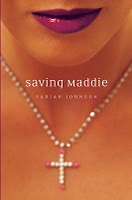
Saving Maddie

by Varian Johnson

ages: 14+
First sentence: “‘Hurry up,’ she yelled, dust blowing in her wake as she ran down the dirt trail.”
Review copy given to me by the author.
Support your local independent bookstore: buy it there!
Release date: March 9, 2010

Joshua Wynn is a good guy. He doesn’t drink, he doesn’t smoke, he doesn’t party, he doesn’t have sex. He chooses leading his church’s youth group over playing on the school basketball team. Granted, he’s the preacher’s kid, and there’s an enormous amount of pressure on Joshua to be good. And Joshua’s mostly okay with that.

That is, until Maddie Smith — his best childhood friend who moved away when she was 13 — moves back into town. She’s 18 now, and she’s not what Joshua remembers. For starters, she’s not a believer any more, and Joshua (sort-of) decides that it’s up to him to “save” her. Except, he’s falling for her as well.

This is an incredibly thoughtful novel; Johnson maintains a fine balance between those who take their faith incredibly seriously, and those who don’t, managing (for the most part) never to take sides as to which is better. He also avoids making Joshua a caricature, someone who is easily dismissed. Joshua is a complex character — desires, insecurities, hangups, and all.

Which brings me to something else I found admirable about Saving Maggie: Johnson doesn’t write down to teens (it reminded me a lot of John Green’s books, and that’s a compliment!). It’s a strikingly honest book: honest about belief, faith and following. Honest about the conflict between desire and duty. And all this makes Joshua’s struggle to find his own way — as opposed to the way he’s always just gone because that’s what he was taught — more powerful.

I also appreciated the ending (and you know how important endings are!) because it’s not the traditional happy ending and because there’s hope. It’s an immensely hopeful book, one that asks the reader to look beyond appearances to the person inside.

But, most of all, it’s a book that will make you think, about belief, about decisions and about others. And a book like that is always worth reading.

LIbrary Loot 2010-02

Storytime started today. I’m such a kid: I LOVE storytime. And not just because I get to spend time with K… no… I love the stories and the finger plays and the songs.

Good thing I get to go once a week, huh?

This week’s loot:

Picture books:
Patricia Von Pleasantsquirrel, by James Proimos
Prudence and Moxie: A Tale of Mismatched Friends, by Debroah Noyes/Illus. by AnnaLaura Cantone
Freckleface Strawberry and the Dodgeball Bully, by Julianne Moore/Illus. by LeUyen Pham (eek! How did this get here?!)
Love That Puppy!: The Story of a Boy Who Wanted to be a Dog, by Jeff Jarka
I Can Do It Myself!, by Diane Adams/Illus. by Nancy Hayashi
The Tiptoe Guide to Tracking Fairies, by Ammi-Joan Paquette/Illus. by Christa Unzer

Middle Grade books:
Day of the Scarab: Book Three of The Oracle Prophecies, by Catherine Fisher
Troll Fell, by Katherine Langrish
Troll Mill, by Katherine Langrish
Troll Bell, by Katherine Langrish
The Stoneheart Trilogy, Book One: Stoneheart , by Charlie Fletcher
The Stoneheart Trilogy, Book Two: Ironhand, by Charlie Fletcher
11 Birthdays, by Wendy Mass
Max Quigley, Technically Not a Bully, by James Roy
Westmark, by Lloyd Alexander
The Illyrian Adventure, by Lloyd Alexander

YA books:
Carter Finally Gets It, by Brent Crawford

The roundup is either at Reading Adventures or A Striped Armchair. Obligatory FTC note: the links are provided through my Amazon Associates account. If you click through and actually purchase one of these books, I’ll get a teeny, tiny payment. But, since no one ever does, and it’s SO much easier using the associates account to put up these links, I’m going to keep doing it.

Odd and the Frost Giants

by Neil Gaiman

ages: 8-12

First sentence: “There was a boy called Odd, and there was nothing strange or unusual about that, not in that time or place.”

Support your local independent bookstore: buy it there!

Let me just get this off my chest: I have learned, over the past couple of years, to adore Neil Gaiman. Really. The more I read by this man, the more I love his writing.

If you’re looking for a good place to start reading some of his work, Odd and the Frost Giants is really about as accessible as Gaiman gets. Funny, yet slightly (but not too much), well, odd, there’s a little bit of everything for everyone: some honest-to-goodness coming of age in there, a bit of mythology, a bit of adventure. In short, it’s everything Gaiman usually delivers, just this time in a slim 117-page packet.

Odd is a boy who’s a bit down on his luck. His father died trying to save a pony after a Viking raid. Odd tried to fill his place, but a tree fell on his leg, smashing it to where it was nearly unusable. His mother eventually remarried, but his step-father (who already has a bundle of kids of his own) isn’t very kind to Odd. Then, the winter that doesn’t want to let go, Odd decides to leave. Once he reaches the forest, he meets a fox, who leads him to a bear and an eagle — strange companions, sure, but with an even stranger story.

That’s when Odd finds himself on a journey he never expected to take: a journey to save Asgard, city of the gods, from the Frost Giants. There’s no doubt that he’ll succeed, but how he succeeds is ultimately quite surprising. (And satisfying.)

I couldn’t put the book down, and when I closed it, my first thought was, “That was just about perfect.” And, really, you can’t say much more than that.

Bloggiesta Wrap Up

It was a short trip, and I was a bit hampered by the lack of a laptop (it’s in the shop… again…), but I had a grand time with Bloggiesta.

What I did get done:

I got rid of the blogroll, inserted recent comments feature. It’s not quite the way I’d like it… I’d really like it if the link with the commentor’s name would go to the commentor’s blog, but I’m not sure that’s available on Blogger. If anyone knows how to do that, I’d love to fix it. I think, in the long run, that it’ll be a better way to go than a blogroll.

I didn’t get rid of my master lists that were over on the side (they’re still there, under the label “master lists”!), but I decided that I needed some more versatility in the blog. Hence, blog labels! I even managed to put up a few genre-specific ones.

And I have a spiffy new blog header. The picture’s from Powell’s, on a trip I took last summer. I’m still not sure I absolutely love it, but it’ll do, for now.

The only thing I didn’t get to was cleaning up my feed reader. (I actually expanded it with some of the blogs from my blogroll.) I think I’m okay with that.

At any rate, I had a grand time Bloggiesta-ing!

Catching the Late Train (and other news)

Okay… since I found myself hanging out on Twitter yesterday, and being interested in all the tweaking that was going on, I’ve decided to climb on board and join Bloggiesta. The laptop’s decided to crash today and so is off to the shop, so I don’t know how much I’ll actually get done, but I’m going to put a bit of effort into it anyway.

So, what I’d like to get done:

  • clean up the layout of my page — got rid of the blogroll, inserted recent comments feature
  • decide if I want to get rid of my long master lists of books and go to labels on the sidebar, or some combination of both… took the plunge, and put up a labels, which includes a link to my master lists.
  • add genre tags to my blog (in addition to age-level tags) — I added a few. Maybe I’ll add more later.
  • change the blog header/colors (I’ve had this one for at least 6 months — maybe a year — and it’s time to move on) — done
  • clean up my feed reader

Other than that, I’ll see what else I’m inspired by you all on Twitter to do.

Other news: I’ve also signed up for Mother Reader/Lee Wind’s Comment Challenge 2010. My goal (other than at least 5 comments a day) is to visit at least one new blog and leave a comment there. I’m going to be picky about adding them to my feed reader, though.

And one last bit of news… I meant to share this earlier this week, when I found out, but Betsy at Fuse #8 is doing a Top 100 Fictional Chapter Books Poll. I’ve already sent my list in (which I stressed over… but what about?! and I forgot?! I wish I could send in two!), but you have until January 31st to come up with your top 10 and send it in.

Okay, I think that’s about it… I’ll continue to update this post with bloggiesta items throughout the day/weekend.

The Street of a Thousand Blossoms

by Gail Tsukiyama
ages: adult
First sentence: “A white light seeped through the shoji windows and into the room, along with the morning chill.”
Support your local independent bookstore: buy it there!

The thing that kept coming to mind as I was reading this sweeping novel, was that this book is much like a picture album. The pictures go together because they’re of the same family, and because they tell a story of the passing years. But, each individual picture has a story. Sometimes those stories are interesting, sometimes they’re a little boring. Much like this book.

Tsukiyama tells the story of two brothers — Hiroshi and Kenji — over the course of nearly 30 years. When we first meet them, it’s 1939, and they are orphans living with their grandparents (their parents died in a freak boating accident). The book follows them as they grow up: through the horrors of the war years; Hiroshi’s rise as a sumotori and Kenji’s discovery and mastery of the art of theater mask making; as both brothers find (and lose) love. It’s more than a slice of life, it’s history.

But, even though it’s quite lyrical and beautifully written and incorporates Japanese incredibly seamlessly, I found myself going back and forth on this one. Some of the snapshots were fascinating. Some of the people I cared immensely about. But, sometimes I found myself unable to get into the language, or drifting off because the plot, such as it was, wasn’t grabbing me.

That said, one of the things that Tsukiyama does beautifully is give us a slice of Japan. More than the people, it was the way Tsukiyama described the land, the culture, and the people, as well as the push and pull between tradition and modernity. For that alone, the book is worth reading.