Wildwood

by Colin Meloy/Illustrated by Carson Ellis
agest: 10+
First sentence: “How five crows managed to lift a twenty-pound baby boy into the air was beyond Prue, but that was certainly the least of her worries.”
Support your local independent bookstore: buy it there!

What if, across the river from a small community outside of Portland lay an Impassable Wilderness? And what if, a 12-year-old girl, Prue, and her friend, Curtis, were able to get past into the Impassable Wilderness because that’s the direction they saw the crow’s fly with Prue’s baby brother? And what if, when they got into the Impassable Wilderness they discovered an entire community: one with talking animals, and Dowager Governesses and a civil war looming? And what if, they got caught in the middle of it?

What then?

On paper, this book has everything it needs to be a grand middle-grade fantasy. Talking animals both good an evil? Check. Bandits in the forest?  Check. An evil queen/governess who vaguely reminded me of the White Witch in Narnia? Check. Golden eagles big enough to carry a person? Check. A baby kidnapping, and a subsequent sacrifice for evil gain? Check. A winning hero and heroine who manage to Figure Things Out (and on the other hand, Completely Dopey Parents who are Utterly Clueless)? Check.

So, why didn’t I like this one more than I did?

I think it’s primarily because it was too. long. Unfortunately, a side effect of Harry Potter is that fantasy writers think they need 540 pages to tell a 250 page story. Really? I don’t need all the extra stuff: the inner monologues, the extended prison scenes, the tender asides. Perhaps the world was too big for one book (well, yeah: there’s a sequel), but even so, I think Meloy spent too much time on building the huge world and not enough on tightening up the plot to give me what I wanted — in this case, for Prue to rescue her brother — without all the extra stuff. (I really am spoiled when it comes to reading. I just don’t have the patience.)

That said, it definitely works as a “mood” book. I did feel like I was in Portland in the fall: it’s a rainy and dire world that the children have found their way into. The pen-and-ink illustrations reminded me of the ones Jon Klassen did for the Incorrigible Children of Ashton Place series, and they were scattered throughout the book providing a needed break from the endless prose.

I guess what I’m really saying is that I think this is one of those books that adults think kids should like. And maybe some will. But, as an adult, I sure didn’t like it all that much.
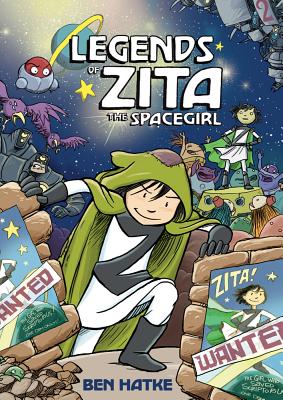
Legends of Zita the Spacegirl

by Ben Hatke
ages: 9+
First sentence: “Zita the Spacegirl!”
Support your local independent bookstore: buy it there!
Others in the series: Zita the Spacegirl

Picking up right where the first installment left off…

Ever since saving the planet from the asteroid (sorry, mild spoiler there), Zita has rocketed to Fame. She’s flying with Piper and her robot friends from planet to planet, signing autographs, looking for a jump crystal so she can return home.

Then, on one far-reaching planet, she discovers a robot that is such a big fan that it dresses up like her. Then it really kind of looks like her. Then, while Zita and Mouse are off enjoying the circus, it takes her place, leaving her stranded yet again. She steals (well, “borrows”) a spaceship, which puts her on the wrong side of the law, and manages to get rescued by non other than Pipers ex (girlfriend? wife?), who helps Zita catch up with Piper and the impostor robot on a planet that needs saving from the Space Hearts.

A pause right here: the Space Hearts? So very clever. Evil hearts (yes, really) that attack a planet until its completely devastated, controlled by a Queen Heart. Too cool for words.

Like Zita, this one is colorful, creative and a whole lot of fun to read, from the oldest person in my house (yes, Hubby did pick it up) down to the youngest. Zita’s a great heroine, and there are some surprising twists and turns as we follow her adventure and her ultimate quest to get home. Another quick side note: I didn’t pick up the first before diving into this one — I know: silly — but I didn’t need to. Hatke got me up to speed quite quickly, and I was able to take off and enjoy this story.

But much like the Amulet series, the next one can’t come out fast enough for me.

The Peculiar

by Stefan Bachmann
ages: 10+
First sentence: “Feathers fell from the sky.”
Support your local independent bookstore: buy it there!

Imagine a world in which faeries came through a portal, waging war against the humans, destroying most of England, including the entire city of Bath.

Imagine that the cost of this is that the faeries are trapped in our world, for hundreds of years.

Imagine a world in which half-breeds (half human, half faerie) are despised and hanged.

Imagine a half-breed boy, Bartholomew, who lives in hiding with his sister in the city of New Bath, scraping by an existence while his mother (his faerie father left years ago) tries to make ends meet.

Imagine a faerie so desperate to return to the “other world” that he’s willing to kill half-breeds to make it happen.

Imagine a man, without ambition or direction, who manages to get caught up in all this, and ends up hanging on for dear life.

And you will pretty much have imagined “The Peculiar.”

I have to admit that the cover was underwhelming. It kind of looks like clockwork chickens, or something of that sort. But a woman at work read it and liked it enough that I picked it up, just to see what it’s about. And honestly? Steampunk fairies equals win. You have traditional Victorian steampunk (hence the mechanical bird, which makes more sense after reading the book), crossed with some pretty spooky faerie stories; a hero that’s both accidental and intentional — he’s out to save his sister from her nasty fate; and a bumbling adult who’s more endearing than annoying. I couldn’t put this one down. Sure, the plot’s probably a bit confusing — especially near the end — and maybe even a bit predictable (okay, it’s not hard to figure out who the bad guy is), but there are some nice surprises, and an ending that both resolves the plot as well as leaving a thread for a sequel to follow.

I probably would have been turned off if I had read the author bio before reading the book: Bachmann is one of those wonderkids (he’s 18) who comes off as insufferably pretentious in his author bio. But, you know what? This worked. It’s an original idea (at least that I know of), and it’s a well-written story.

Which makes me wonder just what this kid will come out with next.

(Just for the record: because this is a Cybils nominee, I’ve been asked to make sure y’all know this is my opinion only, and not that of the panel.)  

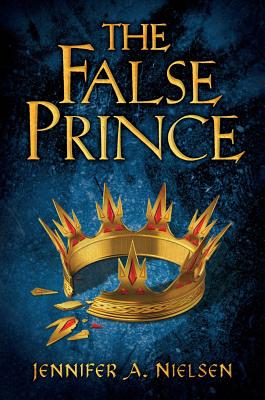
The False Prince

by Jennifer A. Nielsen
ages: 10+
First sentence: “If I had to do it all over again, I would not have chosen this life.”
Support your local independent bookstore: buy it there!

Sage is a 15-year-old orphan in a small Carthyan city. He’s got a reputation for mischievousness, not to mention pickpocketing and general thievery, but generally he tries to fly under the radar.

That is until a minor noble, Bevin Conner, plucks him (along with three other boys) out of the mire and decides that one of them will be the one to put his Grand Plan in motion.

What is that Grand Plan, you say? Well, it turns out that someone has murdered the entire royal family, except for the prince — Jaron — who was killed by pirates four years before. What Conner wants to do is train these boys up and the put one of them on the throne as the False Prince: a puppet to fool the regency just long enough for Conner to be named the grand regent, and essentially take over.

Mwahahahaha.

I felt like doing that a lot while reading the book. It needed a good evil laugh to accompany all of Conner’s posturing. And he postured a LOT. Not that I didn’t enjoy the book well enough; there was much that I found enjoyable. Sage was a good thief/rogue-with-a-heart-of-gold character, one who was both winning and interesting. The plot was an interesting idea, rife with politics, murder, backstabbing, and a wee bit of romance (but not enough to turn off the romance-shy boys.)

The problem is that it’s all been done before, and better. See, it’s a similar plot to Megan Whalen Turner’s The Thief, who did it all richer, grander, and, well, better. Sage is no Gen, and Nielsen doesn’t handle the twists and turns the plot demands nearly as elegantly as Turner does. That said, I think this will be an issue for only MWT fans, because on the surface False Prince is a lot of fun. There’s enough adventure, and the twist really is delightful (if you don’t see it coming), and there’s some nice retribution in the end. In addition, Nielsen wraps up this story quite well, while leaving things open for the sure-to-come sequels. (Which is always the best way to do a series, in my humble opinion.)

Bottom line: if you haven’t read The Thief (or didn’t like it all that much — I’m thinking of C here; she tried and just didn’t like it), then this one will be new and surprising and exciting.

(Just for the record: because this is a Cybils nominee, I’ve been asked to make sure y’all know this is my opinion only, and not that of the panel.) 

Need Help Figuring out What to Nominate?

So, the Cybils nominations opened up Monday, bright and early, and even if you weren’t obsessive like me (or not; I didn’t get up at some ungodly hour to nominate)… you still can help out.

I don’t have any suggestions off the top of my head, but thankfully, there are people who have! Also, thankfully, Cybils blog has a list of places to go, so I don’t have to work so hard. And Great Kid Books have a list of book apps that deserve to be nominated as well. 

So, even if your favorite book has already been nominated, there are still many, many more that deserve attention. (And besides, you really want to make us round 1 panel types work, right?)

Get out and nominate! (Please.)

3 Below

by Patrick Carman
ages: 9+
First sentence: “Four blocks over and twenty-one blocks down from the Whippet Hotel, there was a crumbling neighborhood of mostly empty buildings.”
Support your local independent bookstore: buy it there!
Others in the series: Floors

It seems, to me at least, that Merganzer Whippet was not cut out to be a businessman. And that if he’s having 12 year old boys run his hotel for him, he really needs to have something checked. Granted, that hotel is a whimsical, fabulous place, but still.  Merganzer owes $7million in back taxes (the man needs an accountant!), and since his nemesis, Ms. Sparks, is still out there, desiring to turn the hotel into something, well, respectable and income-generating, Merganzer needs Leo and Remi to go down into the depths of the hotel (there are three sub-floors) to get what he needs in order to salvage the hotel.

Reading this, I was just “meh” about it. Sure,  it was fun and whimsical, but as I pointed out in my review for the first one: this really didn’t need to be written. The “universe” that Carman has created doesn’t really support extended stories, and while I didn’t mind Leo and Remi’s adventure the first time, it was kind of a stretch for me to care about them this time around.

Writing this up, I found myself asking questions like: Why does the kid of color have to be the pudgy one? How come the big baddie is a woman? Are boys the sole proprietors of whimsicalness? Sure, this is meant to be a book for boys, but still.  It seems that Carman has just come up with a formula, and is just plugging in the numbers, not really taking the time to develop characters or their motivations, but rather just going from cool room to cool room just because it sounded, well, cool.

And, while I think kids would like this, I would also like to think that maybe we can expect more from them and from the authors writing for this age group.

Is that too much to ask?

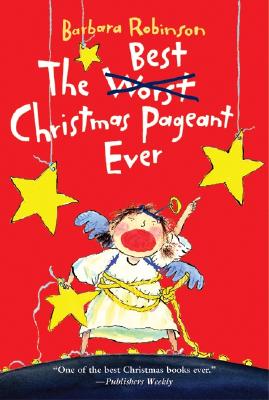
The Best Christmas Pageant Ever

by Barbara Robinson, Illustrated by Judith Gwyn Brown
ages: 7+
First sentence: “The Herdmans were absolutely the worst kids in the history of the world.”
Support your local independent bookstore: buy it there!

I know, I know: it’s October, and here I am, putting up a review of a Christmas book. I’m sorry. (At least it’s October and not July.)

I remember reading this one as a kid, and I think I thought it was kind of fun, but in no way did I think it was a classic. It was silly, I was voyeuristic about the Herdmans (I didn’t know ANYONE that Shocking. Piercing ears with an ice pick! Smoking cigars in the bathroom! Heathens!), but I really didn’t see any Deeper Meaning in it.

I really didn’t think it’d be one of those books that gets read every year, beloved among many.

As an adult, I get the Deeper Meaning — and it’s a sweet message — but I still don’t see why it’s a classic. The writing is, well, simplistic, and the illustrations aren’t that great.  But it does have a great last line — “Hey! Unto you a child is born!”  — so maybe that’s why.

I can take it or leave it.

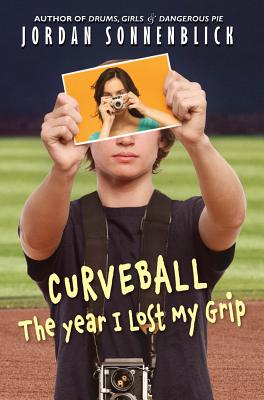
Curveball: The Year I Lost My Grip

by Jordan Sonnenblick
ages: 12+
First sentence: “The very first thing I can remember is this: I am really, really mad at my mom for some reason.”
Support your local independent bookstore: buy it there!

Peter Friedman lives for baseball. He’s a pitcher who loves the game. No, more than that: he works super hard at it, and is planning on making it his life. And so, what is he going to do now that an injury to his elbow puts him completely out of commission.

Not “out of commission” as in when he heals, he will pitch again. No: he will never play the game again. Ever.

Aimless, he finds himself in an upper class photography class with another freshman, Angelika. And he finds himself not only wanting to spend more time with her, but with photography.

One of the things I really like about Sonenblick’s writing is that he does guys well. They’re guy-y (yes, that is a word), and real, and yet there’s an intelligence about them that suggests maybe sports and guys and all that aren’t nearly as cavemanish as we women seem to make them out to be.

I enjoyed Peter struggling with school and how to tell his best friend AJ that he won’t ever be playing baseball. And I really enjoyed the whole photography framework.

There was a second storyline, where Peter’s grandfather develops Alzheimer’s, that didn’t work quite as well. I guess Sonnenblick felt he needed something Deep in the book, and he needed to have some conflict between Peter and his Grandpa (since they were Best Buds), but I thought it was a bit unfair to place the burden of the grandfather’s deteriorating condition on Peter’s shoulders. Again, I understand the reality of this — what kid who loves and is close to their grandparent won’t feel some of the burden of their declining health — but it didn’t work as well as a storytelling device for me.

But that’s a small quibble in an otherwise good novel.

My Random Musings about KidLitCon 2012

I have to confess, up front, that I did not utilize my camera as much as in years past. Which really makes me kind of sad. Maybe I ought to think about getting one of those smartphones with a camera on it…

So. The conference. And my thoughts.

  • I should have done the pre-con. I heard the publishers previews were cool and that Grace Lin was a good dinner speaker. But, I went to NYC not only for KidlitCon, but to see a very dear friend whom I haven’t spent any time with in years, and she took precedence.
  • I happen to really like trains/subways, so the hour and a half from my friend’s house into and out of the city was quite wonderful. I also like walking around big cities, so getting mildly misplaced with Charlotte and Sondra was quite enjoyable. 
  • I went to the Graphic Novels panel, and enjoyed it immensely. I don’t know if I got what I needed — to know HOW to write about the art; I may need an art class for that — out of it, but I thoroughly enjoyed the discussion about the relevance of GNs (comics!) and the rising acceptance of it. I especially appreciated the list of must-read graphic novels at the end.
  • My second panel was about talking outside the echo chamber, and while it wasn’t anything I hadn’t heard before, it was actually a great refresher. The biggest thing I need to do? USE HASHTAGS on Twitter. (And that hashtags are searchable? Didn’t know that!) I have also come to realize that posting the same review on several sites (which I do out of laziness) is basically shooting myself in the foot. Must. Take. The. Time. To. Write. Different. Reviews. #notime
  • It’s a good thing I wasn’t really craving burgers, because I ended up being 0 for 2 over the weekend. Shake Shack sounded good, too! That said, I really enjoyed having lunch with the group of people I ended up with. I can’t remember all their names (I know Cecelia was one of them, but hers is the only one I remember. Help?) but I loved sitting in Bryant park chatting with them.
  • Speaking of people: Betsy Bird talks exactly like she writes, which I think is quite awesome. And it was really cool to meet Leila, though  I did wonder if she got kind of embarrassed being the belle of the ball…we all gushed and oohed and worshiped her (me included). Though, admittedly, it’s gotta be just a bit cool to have Maureen Johnson say your blog is one of the ones she takes the time to read…
  • After lunch was my favorite session, the one on “nice” reviews vs. critical reviews vs. negative reviews. There’s a lovely recap of it over at the School Library Journal. Props to Liz B. for saying what was on my mind, at least: “Critical” does NOT mean “negative”. My least favorite phrase in a review? “I love, love, loved it!” Ugh.
  • The last panel was the one that I got the least out of, unfortunately. It was on the relationship between the author and reader in the age of social media, and I wanted… something. Not quite sure what. I did sit next to a nice publishing rep from Toronto, however (man I was bad at names this time around!) and I chatted with Alysa (we sat next to each other in the GN panel, just to confuse the presenters. :-D) for a while as well, so that’s good.
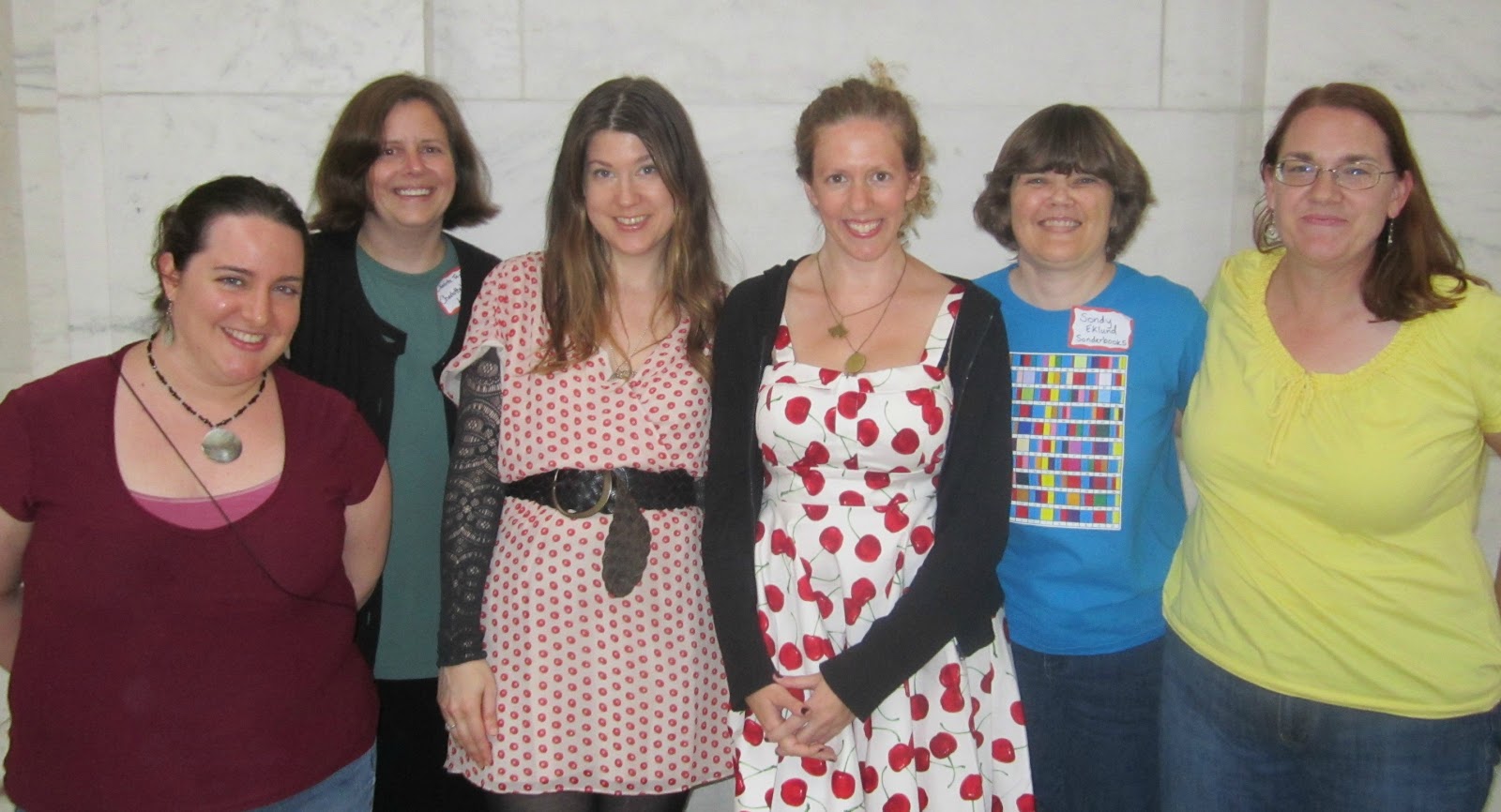
  • Maureen Johnson is a hoot, even if she did just phone it in. No presentation, just opting for a Q&A discussion with her and Robin Wasserman (need to read something by her now). It was intriguing, though maybe I would have rather had something grand and thoughtful (like last year), but MJ is funny enough, smart enough, and interesting enough to make a casual thing work just fine. Besides, some of us hung around after (I’d made a goal to talk to her and not sound like a crazy Twitter stalker woman, though I wouldn’t have without Maureen‘s prodding), and managed to get a picture with MJ and Robin. Cool.

 (That’s my sole picture.)

  • The one downside, while I’m thinking about it, to having this in a library (aside from not having munchies in the back of the room), is that I felt like it lacked the chattiness and community that the other ones I’ve been to had. Granted, this may have been my choice: I chose this trip to be as much about being with my friend, and so I didn’t stay with anyone, or even in the city. Maybe that sense was there, and I just missed it. 
  • The drink night was fun. I talked to Pam for a long time (missed you Jen!) as well as a few others before heading out. 

Overall: a great time! Seriously.  And next year, there’s rumors that it’ll be in my neck of the woods, which makes me happy. Then again, this conference always makes me happy. Oh! And you can find all the recaps here, if you’re interested.

Are You There God? It’s Me, Margaret.

by Judy Blume
ages: 10+
First sentence: “Are you there God?”
Support your local independent bookstore, buy it there.

I read this one, as probably did most girls my age, when I was eleven years old. I have a vague memory of hiding it from my parents, some vague sense that they’d disapprove of this. I’m not sure if it was because there is God in the title, or because it was about things that a polite person just doesn’t talk about: periods, breasts, and growing up.

I’m not quite sure how I reacted to it. I wasn’t terribly interested in growing up (my mother dragged me kicking and screaming to buy my first bra), and so a whole book about girls obsessing about boys and breasts probably didn’t appeal to me. And I wasn’t exactly questioning my religion, either, so that part of the book probably bored me as well.

I don’t remember if M ever read it, but I know C did for a book group several months back (I skipped the book because I’d miss the discussion; it’s only fair that I got assigned this book to review now…), and she was put off by it. She though the girls were dumb and stupid for obsessing, and had to struggle to finish the book.

I’m not sure if that’s because of the type of person she is, or because of the way I’m raising her.

See: those subjects aren’t taboo in our house. Mostly because I have four daughters, they’re pretty common subjects. And I’d rather it be that way. I’d rather my girls come to me with their questions and problems, rather than trying to find solace and comfort in books. Because I do understand the need for this book (even today): it’s a place where tween girls can go to realize that they’re not alone, they really are normal in their questions and their concerns and their problems. And even if the book is a little dated (the sensibilities of the adults are really very early 1960s!), it’s still relevant.

Even if I still didn’t like it very much.