SLJ Battle of the (Kids’) Books, Week 1

I’m going to TRY (emphasis on try, since next week is spring break, and I’m on vacation), to comment on the BoB matches every Saturday during the rounds. We’ll see what happens.

A side note: in the midst of all this, Roger Sutton at Horn Book is critiquing the judges themselves. It’s quite a fascinating (and fun) supplement to this battle.

Round 1, Match 1: Bomb vs. Wonder (my pick: Bomb)
What I liked that Kenneth Oppel said about Wonder:

“Interestingly, no adults are given voices in the novel: not Mom or Dad or Auggie’s principal. But Palacio knows that in a kids’ world, grown ups can provide occassional back-up, but aren’t there on the front lines.”

“While Palacio doesn’t shy away from showing us the cruelty that kids are capable of, the mood of the novel is faultlessly kind-hearted, optimistic, almost utopian. My only general quibble is that Wonder’s characters are all perhaps a little too wise and noble, and exude so much emotion that I felt relatively little of my own.”

And what he said about Bomb:

“Best of all, Sheinkin’s book is filled with all those small details that are the lifeblood of the best stories — and the details that novelists kill for when creating fiction!”

” Fascinating subject matter, and swift vital writing make Bomb a joy to read.”

His decision? Bomb. Do I agree? Of course. Mostly because while I liked Wonder well enough, Bomb was edge-of-the-seat gripping for me. Spies! Science! And written in such a way that made both accessible and interesting. Even with it’s Issues and Good Message, Wonder just couldn’t hold a candle to that.

Round 1, Match 2: Code Name Verity vs. Titanic (my pick: Code Name Verity)
I couldn’t find a really stand-out quote by Margarita Engle about Code Name Verity,  but she did say this:

“By contrast, Code Name Verity does not make an organized impression. The rambling style is one more commonly found in adult novels than those meant for young people.  It is a first person story, but the identity of the narrator keeps changing, as she writes a long, baffling confession (or accusation, or diversionary puzzle, or secret code—we’re never sure which).”

But, for me, her description of Titanic really made me want to read it (I haven’t yet, even though it’s on my TBR pile):

“Hopkinson writes like a gentle encyclopedia, presenting so much information in such an incredibly organized fashion that at times it is actually possible to forget that there will not be a hopeful ending for most of the endearing real-life characters who are described, quoted, or portrayed through vignettes of specific moments:  the arrival on deck, reading a book at bedtime, or bailing icy water out of an overcrowded lifeboat.  My favorite aspect of this book is the emotional impact of all the combined bits and pieces.”

Her decision? Code Name Verity. Do I agree? Of course. If you haven’t read this one yet, you ought to.

Round 1, Match 3: Endangered vs. Three Times Lucky (my pick: Three Times Lucky)
What Kathi Appelt said about Endangered:

“It doesn’t happen very often, but once in a while, I enter a book on page one, and when I exit that book, I feel like I’ve come to see something about the world that I didn’t know, or I didn’t think I knew.  It feels like I’ve trued something that needed truing.  Endangered was one of those books. “

And the reason I adore Three Times Lucky (I wish I could get more people to read this book!):

“When I read the lines out loud in Mo’s story, my heart sang.  I loved the cadences, the idiomatic speech, the lyricism embedded throughout this story.  It was like sitting at dinner with my great aunts.”

Her choice? Endangered. Do I agree? I don’t know. While I adore Three Times, I’d probably be able to tell better if I’d read the winner first. Which is something I’m going to do before round 2.

Round 1, Match 4: The Fault in Our Stars vs. Temple Grandin (my pick: TFIOS)
What Deb Caletti had to say about Temple Grandin:

 Lush full-page images of up-close cowhide bookend the story, bringing the animals themselves right to the reader in a way that’s smart and downright cow-cool. You want to stroke the pages.
 

And about TFIOS:

“Yeah, I liked the snap-crack dialogue, sure, but it wasn’t even that. What worked for me as a writer, but even more as a reader, were the truths of the small moments.”

Her pick? TFIOS. Do I agree? Of course. Though I also agree with Jonathan’s assessment: “THE FAULT IN OUR STARS has the ability to make a deep run in this tournament, but at some point I hope that our judges will weigh in on the success of Van Houten’s reappearance at the end of the novel—as that point seemed to dominate the conversation on the Printz blog.” It’ll be interesting to see how it fares throughout the tournament.

On to the second half of round 1!

Prophecy

by Ellen Oh
ages: 10+
First sentence: “People feared Kira.”
Support your local independent bookstore: buy it there!

In the seven kingdoms on this peninsula, there are two problems: first is the force of the Yamato nation to the south: greedy and powerful, they are looking to conquer the nations to the north. Second, is trickier: the demons who kill and then possess people, infiltrating armies and families in order to take over the world.

While Kira, even though she’s the daughter of the Hansong kingdom general and niece to its queen, can’t do much about the first problem, she’s the only defense the people have against the second. She can sense — through smell and sight — demons, knowing exactly whom to attack and how to kill them. Except, the only people who know truly what she does are her father and the king. The rest of the populace think she’s some sort of demon herself, ostracizing her.

Then the unthinkable happens: a traitor kills the royal family, and lets in the Yamato soldiers (and a few demons). Kira, her brother, a trusted monk, and some loyal soldiers are on the run, solely responsible for the young prince’s safety. She’s lost her parents in the attack, she’s on the run, she’s responsible for her cousin, and on top of that, there’s this Prophecy about the Dragon Musado that’s hanging over everyone’s head. What’s a girl to do.

I have to give props to Oh for creating a brilliant world. I liked the Korean influence in the world, from the land through to the various Korean words (with a glossary!) sprinkled throughout. I thought she handled the whole prophecy thing pretty well; it wasn’t a Chosen One exactly, and because the prophecy was old enough and vague enough, there wasn’t a set List of Hoops she had to jump through over the course of the story. I did like her family loyalty, and the fact that her parents believed in her capabilities. (Which is why, sadly, they had to go.)

However, the book fell flat for me. Some of it was the writing: too much telling (“Kira hid her disappointment.” “Kira was puzzled.” “She pondered her father’s words, profoundly affected by his confidence in her.”) and not nearly enough showing. Which made the book choppy. Especially choppy was the attempt at romance. Kira’s been betrothed to a horrid man, and she doesn’t like him. But he goes around preening that she will love him, and that he can’t wait to get married. All the while, she’s developing a friendship with another young man, and it’s a nice enough relationship, until Kira starts having “feelings” that she doesn’t know what to do with. It’s not enough to make this uninteresting to a MG reader, but it is enough to wonder why Oh felt it necessary to include. The story was fine without it.

So, it’s a mixed bag. While I am happy there’s a Korean-inspired fantasy out there, I’m not sure this was enough to make me interested in keeping up on the series.

Audiobook: Pride and Prejudice

by Jane Austen

read by Josephine Bailey
ages: adult
Support your local independent bookstore: buy it there!

I’ve already reviewed Pride and Prejudice here on the blog, so I’m not going to do that again. (Though, looking back, my review really isn’t much of a review.) I picked this one up again because I was inspired to do a reread of all of Austen’s works by A Jane Austen Education.  But, I decided to do something different: listen to it on audio book. (In fact, between that and listening to To Kill a Mockingbird, I’ve decided that I’ll try to listen to classics this year. We’ll see how that goes.)

So. Thoughts.

The narrator was good. Though her Lady Catherine and Mr. Darcy were wrong. I mentioned that to M, and she said that’s because I’ve watched the A&E movie too many times and Colin Firth will always be Mr. Darcy, and no one else will do. She’s right, you know.

I know some of the lines well enough that I can say them right along.

The humor came out really well when I was listening. I catch it when I read, but I actually laughed aloud when listening and that’s something I don’t usually do when I read it.

One of the themes I caught this time was how much appearance matters. They’re always talking about the way people look — whether they give off a good impression, whether they have “goodness” in their “countenance” — and that sat uneasily with me. I try very hard not to judge on my first impression, though I do have to admit that it’s a human trait: we all do it. Even if we think we don’t. The more I think about it, the more I think the original title of this one — First Impressions — is almost more accurate. There’s a lot in here about judging and being judged for they way people (not only yourself, but your family) acts in public. And the sad thing is that it’s still applicable.

It’s still a delightful read, after 200 years and multiple rereads (on my part, anyway). It doesn’t get much better than that.

Tell the Wolves I’m home

by Carol Rifka Brunt
ages: adult
First sentence: “My sister, Greta, and I were having our portrait painted by our uncle Finn that afternoon because he knew he was dying.”
Support your local independent bookstore: buy it there!

It’s 1987, and June is 14 years old. Her uncle Finn has recently died AIDS, something which (as I well remember) is new and Scary in 1987. Finn and June had a special bond, they shared interests and outings, but it was more than that: to June, Finn was the only one who really Understood her. And to say his passing has really upset her is an understatement.

Little does she know there is a balm for her wound (sorry: too much Jane Austen lately): Toby, Finn’s boyfriend, whom the family shuns, reaches out to June for help and healing. Together these two people who cared immensely for Finn, and whom Finn cared for as well, might just figure out how to go on living without him.

While I enjoyed this novel, and I understood June’s connection with her uncle, a couple things bothered me. First, I’m not really sure it needed to be in 1987. Perhaps it was just so the family could be so deeply homophobic (they’re okay with Finn being gay, he’s just not allowed to have a relationship, so he keeps Toby under wraps). Maybe it was so that June could run around the forest behind her school or into NYC on a whim, because as we all know, parenting in the 1980s was much more permissive than it is today. But it disappointed me that there wasn’t much done with the whole AIDS scare. There were brief mentions of it here and there, but I didn’t feel anything substantial was achieved by it.

What I did like, however, was the exploration of June’s relationships. Not only with her uncle and his boyfriend, but also with her mother and sister as well. June’s perceptions of all those relationships were — partially because she’s 14 — off, sometimes drastically. And it’s a growing process for her to realize that everything isn’t quite how she perceives, that the truth of everything is multilayered and complex. For me, the true draw of the novel, the true heartache, was watching June grow up.

Not bad. Not bad at all.

State of the TBR Pile 14: March 2013

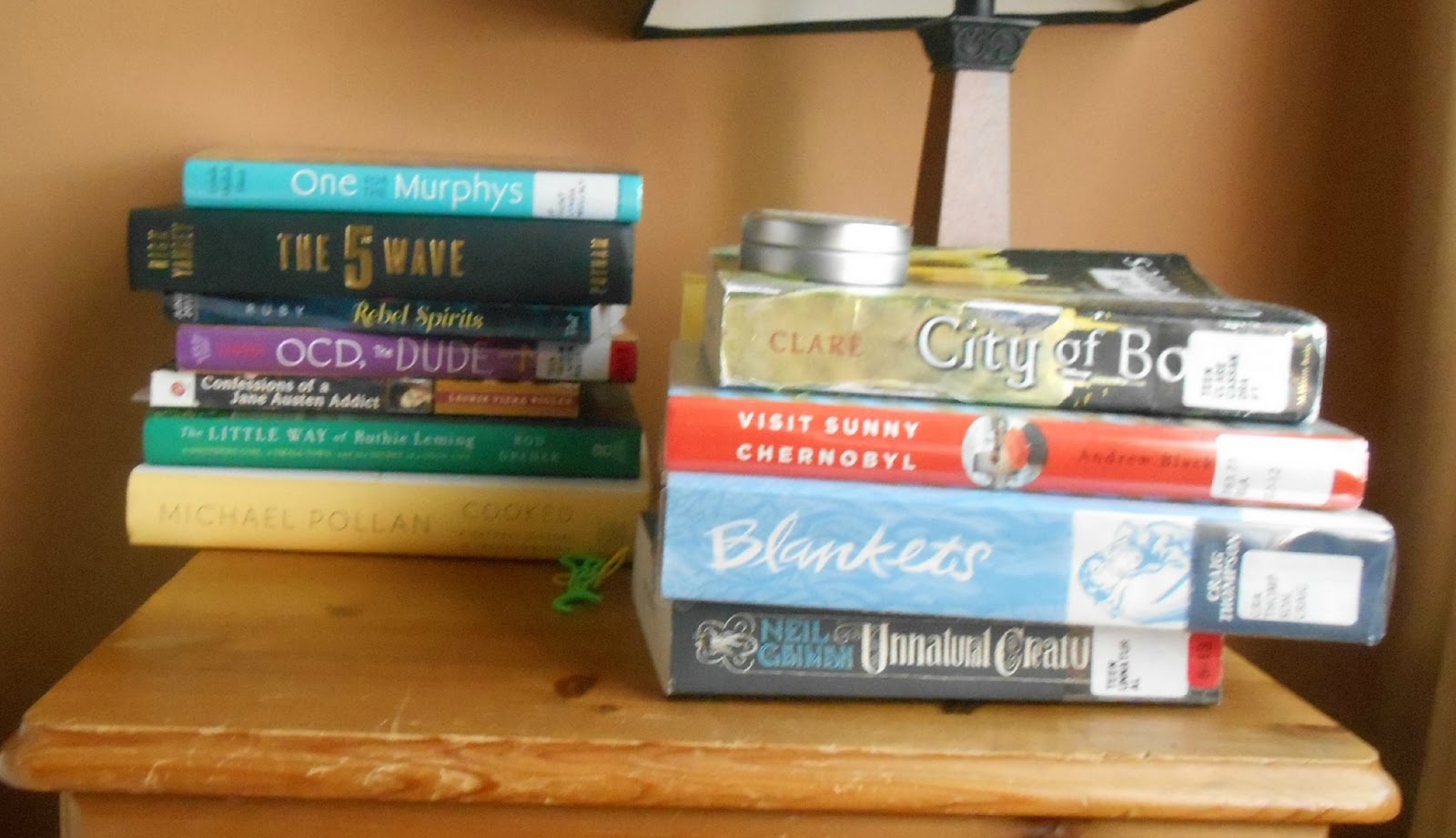
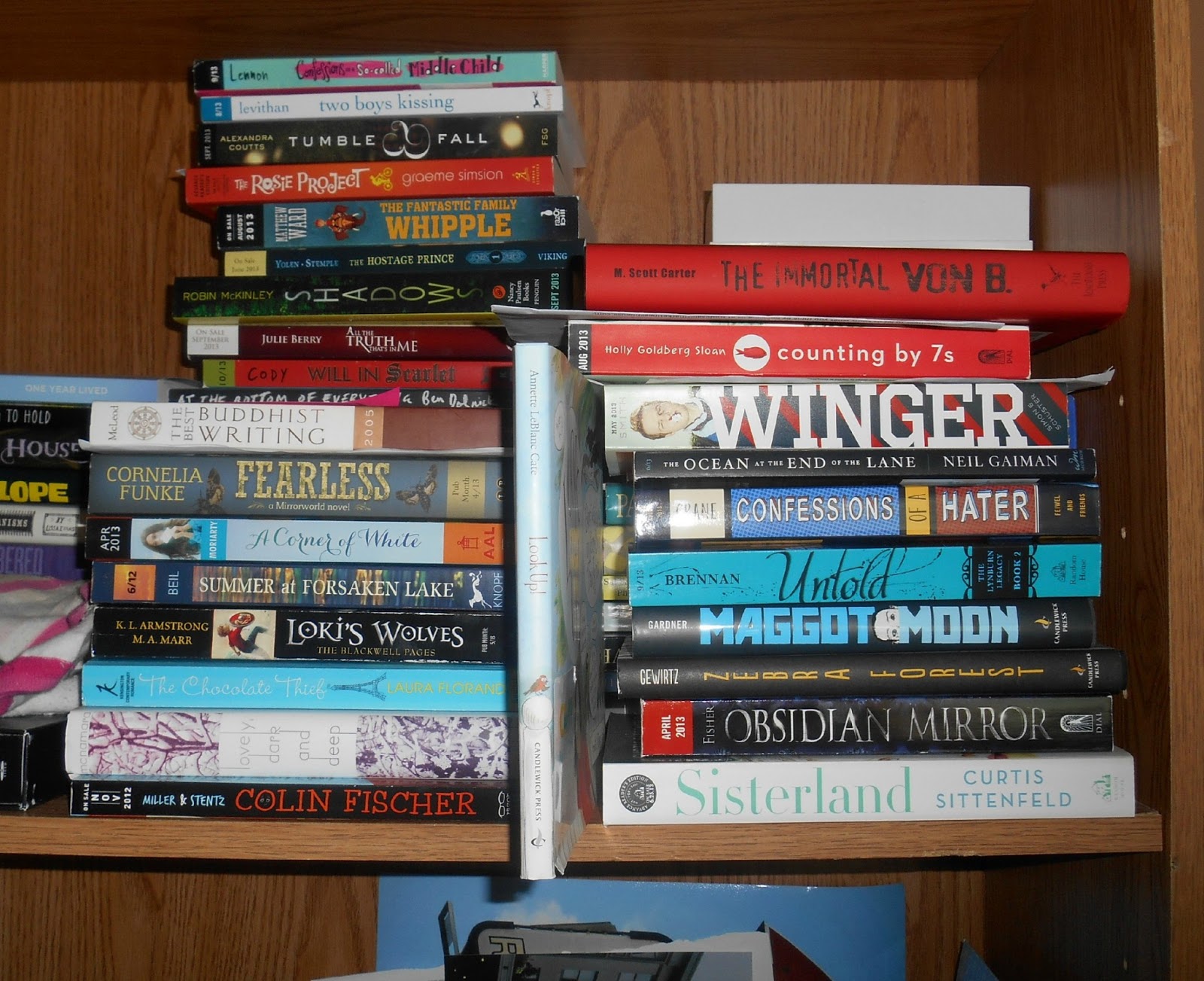
Look! It’s not terribly out of control this month. That said, I didn’t take a picture of my ARC shelf. That is out of control. What I’m thinking I’ll get to sometime soonish rather than later:

One for the Money, by Janet Evanovich (lent to me by a member of my in-person book group)
What Would Barbara Do?, by Emma Brockes (for my online bookgroup)
Last Days of Summer, by Steve Kluger (Because I adore My Most Excellent Year)
Tiger Lily, by Jodi Lynn Anderson (This month’s YAckers pick)
Jinx, by Sage Blackwood (Because both Charlotte and Sondy liked it.)
The Blind Side, by Michael Lewis (this was initially for the library winter challenge, but I didn’t get to it in time. I’m still interested in it, though.)
Endangered, by Eliot Schrefer (SLJ BoB book)
Shadow and Bone, by Leigh Bardugo (because I got the ARC of Siege and Storm, and need to read this first!)

Revolution 19, by Gregg Rosenblum (seeing if this is any different from all the other dystopians out there)

Moonbird, by Phillip M. Hoose  (SLJ BoB book)

What’s on your TBR pile?

Nathan Hale’s Hazardous Tales: One Dead Spy

by Nathan Hale
ages: 9+
Support your local independent bookstore: buy it there!

I suppose if your name is Nathan Hale and you are an illustrator, it’s probably inevitable that you do a graphic novel series on American History. And,  as part of that, do one on the Revolutionary War spy, Nathan Hale.

On the one hand, I found this graphic history to be highly entertaining. Hale framed the story around the execution of Revolutionary Hale, allowing him to tell his story to the hangman and a lone British soldier. They weave in and out with commentary and gallows humor (har har), but get all the basic historical facts in there. It’s history and at times it’s entertaining.

On the other hand, though, it’s cluttered. It’s not laid out very well — chapters would sometimes start in the middle or near the end of the page. I found it really hard, visually, to get into the story, to keep track of each of the players. Half the time, I didn’t know whether or not Hale was even a part of the action. It didn’t draw me into the story, and it sure didn’t often keep me there.

It’s a good idea, telling history in graphic novel form, making it more accessible to the younger kids that way. I just wish it could have engaged me more.

Temple Grandin

How the Girl Who Loved Cows Embraced Autism and Changed the World
by Sy Montgomery
ages: 9+
First sentence: “Throughout my career, I have worked to improve the treatment of farm animals because we owe it to domestic animals to give them a decent life.”
Support your local independent bookstore: buy it there!

I didn’t really know what to expect heading into this one. I knew it was a biography for middle readers, and I knew autism had something to do with it. But, I must have been living under a rock for a while, because I had no idea who Temple Grandin is.

Wow. What an amazing woman. For those of you under the rock with me, she was born in 1947, with autism. She wasn’t like “normal” kids, and her father (per the times) wanted to put her in a mental institution. However, Temple had an AMAZING mother, who advocated for her daughter. She found a school that would accept her and work with her quirkiness, and even though Temple encountered bullying and hardships along the way, her life was so much better than if her father had gotten his way.

And, it’s incredible what she’s done with her life. How she’s channeled her condition (I don’t want to call it a disability, because it’s not. It’s just a different normal) into something amazing, helping change the domestic animal industry little by little. And every little bit counts, especially when the healthy, happy lifestyle of animals we eat are on the line.

My only complaint was one that is inherent in the book: I wanted more detail, more information. I found it too simplistic, but the book was aimed at 9-12 year olds, so it’s appropriate for that age. As for me, Temple Grandin has written her own biography, so I can read that one as well.

The Runaway King

by Jennifer Nielsen
ages: 10+
First sentence: “I had arrived early for my own assassination.”
Support your local independent bookstore: buy it there!
Others in the series: The False Prince
ARC brought back from ABA Winter Institute for me by my co-workers.

Obviously, there will be spoilers for The False Prince. If you haven’t read that yet, you should. 

Sage — now King Jaron — has had a month to settle into his new life. To be frank about it: it’s not going well. His regents don’t really like or trust him (the feeling’s mutual), he’s not really getting along with the princess he’s supposed to marry, and his chief captain is not exactly helpful. Things just come to a head on the night of his family’s funeral with a (failed) assassination attempt  by the pirates.

Which leaves Jaron — who is convinced war is coming, even if his regents refuse to see it — with one option: go to the pirates and deal with them head-on.

And, because he’s Sage, that means things won’t go exactly as planned. (Not that there was a plan to begin with, mind you.)

I didn’t reread The False Prince first, so I was a little worried I wouldn’t remember enough to keep up with this story. Thankfully, that wasn’t the case: I immediately fell back into Neilsen’s world was thoroughly taken with Jaron/Sage’s story. There’s a lot of action and adventure here as Jaron tries to keep his kingdom from thoroughly collapsing, from the thief camp to the pirate camp and back again. One of the things I liked most about this was the way Nielsen kept Sage/Jaron’s personality pretty much the same (from what I remembered) as in the False Prince, enabling the book to have a sense of levity to it, while giving him the weight necessary to be a good ruler. (Yes, he still reminds me of Gen.)

On the other hand, there is also a lot of posturing by the minor characters (how many times to they have to say “Don’t do that” before they realize he’s just NOT going to listen!), not to mention all the growling of the Big Baddies. (Especially the pirate king. He was just a bit too stereotypical thuggish.) And I do have to admit that Roden’s motivations weren’t always consistent or clear, both of  which did get a wee bit annoying.

But not enough for me to dislike the book. For the most part, I found myself immersed in the book, not willing to put it down, wanting to know just how Jaron was going to make everything work for him.

The Madness Underneath

by Maureen Johnson
ages: 13+
First sentence: “Charlie Strong liked his customers — you don’t run a pub for twenty-one years if you don’t like your customers — but there was something about the quiet in the morning that pleased him to no end.
Support your local independent bookstore: buy it there!
Others in the series: Name of the Star

A short story about this first. I had put this one on preorder MONTHS ago at the store, and I knew the release date (because I obsessively follow Maureen Johnson on Twitter) and so when the UPS guy came on Monday, I knew, just KNEW my book was in there. But it was snowing (yet again), and we closed the store early, and the managers were in Kansas City for Winter Institute, and I couldn’t get my book on Monday. So, when Tuesday rolled around, I practically accosted the person responsible for receiving the books into the system, and after paying his bribe of one tall peppermint hot cocoa, I walked out after work a happy woman. I had my MJ.

The initial question here is this: does is live up to the awesomeness that was Name of the Star? The short answer: no. It’s not as good as the first one. It really is a middle book in a series: even though the book starts with a murder, the action really doesn’t get going until page 240 or so. After the Ripper events of Name of the Star, Rory is, understandably, doing a lot of soul searching. To say she’s behind in school is an understatement; in fact, her parents don’t even want her to go back. Her relationship with Jerome is suffering, her connection to Wexford is tentative. In fact, the only thing keeping her going is her place in the ghost squad, and even that’s not at its most healthy. If it wasn’t for the constant humor and — to be truly honest — brilliance in MJ’s writing, the story wouldn’t have been as interesting as it was.

Does that mean it’s not worth reading? Oh, heavens no. IT’S MAUREEN JOHNSON, people. And everything I love about her writing is in there: it’s funny, it’s observant, it’s intelligent, it’s a wee bit swoony, and the ending will catch you completely off guard. In fact, the book is worth reading for the last quarter alone, the set up for the next book that had be both flabergasted, crying “NOT FAIR” on Twitter, and wishing I could pick up the next book right now.

While it’s not the most gripping story, it’s a good middle book. Here’s hoping the next one blows the socks off of me. Then again, it’s MJ. No need to be anxious. 

First Sunday Daughter Reviews: March 2013

I had a Grand Plan to make a vlog for this, but then it SNOWED (and I should have done it then) and we got off our schedule, and yeah… it just Didn’t Happen. Here’s their thoughts on what what they’ve been reading.

K: Recently finished reading The Adventures of Nanny Piggins with her dad, and fell in love. She still can’t stop talking about it. She thought it was Hilarious, and loved Boris the ballerina bear the best. She’s become a Nanny Piggins evangelist, begging her older sisters (and me; though I read — and liked — the sequel) to read it, too.

A: Read the ARC of Rump, by Leisl Shurtliff, because C recommended it to her. She liked it, but was annoyed it took too long for the main character to figure out his name. That said: it kept her interested until the end.

C: Snagged the ARC of Rachel Hawkins’ new one, School Spirits. Probably the best way to describe her reaction is through this series of tweets:

(Click to embiggen)

 M: Finished both Finnikin of the Rock and the ARC for Dark Triumph, the next in His Fair Assassins. The short version about both? Everything else — including the mounting physics homework — went by the wayside because she couldn’t finish them fast enough. (Finnikin was slow going at first, but I told her to stick with it and she did. And she was REALLY glad, too.) Great books, both of them.

Maybe next month I’ll get that vlog up.