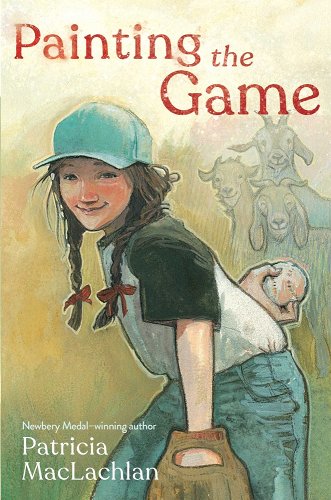
Painting the Game

by Patricia MacLachlan
First sentence: “I am young, four years old, when it first happens.”
Support your local independent bookstore: buy it there!
Content: It’s a slim book with lots of white space. It’s in the Middle Grade (grades 3-5) section of the bookstore, but I could see it going younger.

Lucy’s dad is a minor league baseball pitcher, hoping to be called up to the majors. She’s always been into baseball, but never had enough courage to pitch in her after-school games. But she has been practicing in the mornings, and maybe she’ll be able to pitch a game. And then, maybe she’ll be able to perfect her father’s specialty: the knuckleball.

There’s a couple of side plots with her parents: her mother opens up an art show, and her dad comes back from where he lives while he’s playing, but mostly it’s about Lucy’s determination to become a pitcher.

I don’t mind a low-stakes middle grade book. There’s not much to this one, either with plot or with words, but that’s okay. Lucy has a goal, she works toward it, and she succeeds at pitching a game as well as pitching a knuckleball. It’s nice. But that’s really all it is. Nice. The thing about nice books is that they really don’t have means to soar. There’s no real conflict so that the resolution doesn’t feel earned. But that’s okay: there’s some girl out there who wants to be a baseball player and she will find this book, and it will make her happy.

And that’s all that really matters.

Brightly Shining

by Ingvild Rishøi (Author,  Caroline Waight (Translator)
First sentence: “Sometimes I think about Toyen.”
Support your local independent bookstore: buy it there!
Release date: November 19, 2024
Content: There are four instances of the f-bomb, and some very bad parenting. It will be in the Christmas section of the bookstore.

Melissa and Ronja’s father can’t seem to hold a job. When he’s sober, things are going well, but all too often, he falls off the wagon and into the bottle again. This time, after he gets a job at a Christmas tree lot and ends up drinking again, Melissa decides to take matters into her own hands. She bargains with the miserly lot owner to take on her father’s job for him (and work off the big advance he took). That leaves Ronja alone, but she’s unhappy that way. So, she joins Melissa at the lot. Everything goes well… until it doesn’t.

Much like the Hans Christian Andersen tale “The Little Match Girl”, this one is hopelessly sad. It’s a reminder that not everyone gets magical Christmases and that there are those for whom the holiday is not wonderful. (And that some of those people are children.) There are brief moments of hope, and Ronja narrating the book helps, but it’s really just… sad.

The writing is gorgeous, though, and Rishoi knows how to be evocative. But, mostly, this was a bleak Christmas tale. Maybe it’s a reminder to be thankful you’re not spending your Christmas Eve under a tree in a tree lot, in the middle of a storm, with a drunk father who doesn’t even bother to come and find you.

So very sad.