

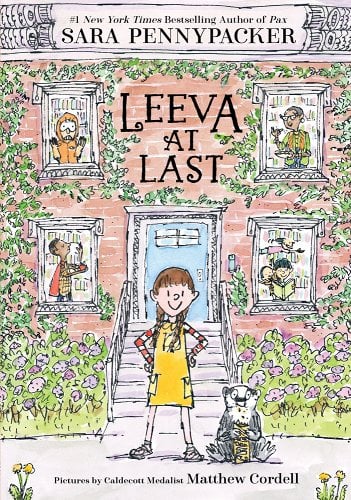
by Sarah Pennypacker
First sentence: “Leeva Thornblossom flew outside the instant she heard the Nutsmore Weekly thunk against the door.”
Support your local independent bookstore: buy it there!
Content: There is some exceptionally bad parentingbordering on neglect and abuse, but if you’re reading Roald Dahl, this one will be fine. It’s in the Middle Grade (grades 3-5) section of the bookstore.
Last week my 17-year-old daughter and I watched the movie version of Matilda again. It had been a while since we had seen it, and we were in the mood for something fun and familiar. We talked the whole way through – about how horrible the Wormwoods were (and how much fun Danny DeVito and Rhea Pearlman were having playing them) and how despicable Miss Trunchbull was. We talked about how Dahl loved to write terrible adults and sometimes terrible children, but how there’s always one good adult to help the good children through.
I know it sounds odd to begin a review about Pennypacker’s book this way, but that’s what I thought about quite a lot while reading Leeva at Last. Leeva Thornblossom is the good child, self-educated (not magical though), smart, and kind with absoutely despicable parents. Her parents are obsessed with Fame and Money, so much so that they make Leeva do everything else. Her mother is the mayor of the town, and is practically a facist dictator. Her father is the town treasurer, and is embezzling money (or rather, having Leeva do it becuase she’s Good at Math) becasue he’s obsessed with having it (yes, he is storing it all in boxes in the attic). One day, though, Leeva sneaks out through the hedge, discovers the libary and the kind librarian and her nephew, and her life changes for the better.
I kept comparing it to Matilda because it felt so much like it, from the plot and the characters to the illustrations done by Matthew Cordell (which felt very Quentin Blake-y). It evoked the spirit of Roald Dahl, and yet… I’m not sure it quite succeeded. Dahl is not a kind writer. He is not a sweet writer, and he doesn’t pull any punches. Miss Trunchbull is, simply put, evil. And the children in Charlie and the Chocolate Factory are atrocious. There is nothing redeemable about them, and there is something quite terrrifying. Pennypacker got the unredeemable bits about Leeva’s parents – in the end, while they don’t get their comuppance, they are not redeemed – but they’re not terrifying. They’re just silly. And kind of annoying. Which, if you’re trying to channel Dahl, kind of misses the mark.
Even so, Leeva was a fun little book, and I think it’s admirable that Pennypacker attempted to write something that tried to be like Dahl. I’m sure there will be many people over the years who come to thoroughly love this one.
 The Book Nut