

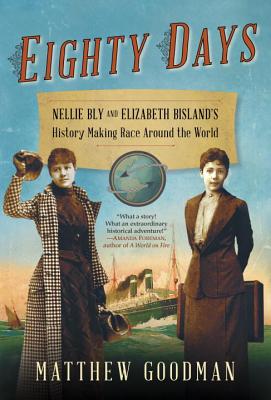
Nelly Bly and Elizabeth Bisland’s History-Making Race Around the World
by Matthew Goodman
ages: adult
First sentence: “She was a young woman in a plaid coat and cap, neither tall nor short, dark nor fair, not quite pretty enough to turn a head: the sort of woman, who could, if necessary, lose herself in a crowd.”
Support your local independent bookstore: buy it there!
Review copy received from my place of employment.
I think I’d heard of Nelly Bly before reading Matt Phelan’s Around the World, but I’m not sure where or why I knew of her. I do remember that I was interested in her story after finishing that graphic novel, so when I chanced upon this ARC at work, I picked it up, curious to know more about Bly and her trip around the world.
It turns out that Bly wasn’t the only one traveling around the world. A competitor of her sponsoring newspaper sent their own reporter — Elizabeth Bislund, who in many ways was the opposite of Bly: elegant, refined, pretty, literary — on a trip in the opposite direction, making it a race not only against time, but against each other.
The thing I liked most about this book, I think, was that Goodman not only thoroughly examined these two women, and their histories and how they became to be newspaper women, but the history of the time. He gave me, as a reader, a sense of this time of anticipation, sitting on the cusp of the modern world. And the fact that both Bly and Bisland could do something like travel around the world in less than 80 days, by themselves.
I found myself rooting for one or the other (I honestly didn’t know, though I could guess, which one won), finding myself liking one or the other at any given time during the book. Bly was more plucky, for lack of a better world, going around the world with one suitcase, and whole lot more drive than Bisland. She was, on the other hand, extremely patriotic — she viewed the world through a U.S.-colored lens, and found everything else lacking, something which grated on me. Bisland was the more open-minded traveler, less determined to “win” and more willing to look at the world on its own terms (which were, admittedly, decidedly British in the 1880s). For that, I think she was the better off.
Perhaps, most revealing, was the epilogue, where Goodman sketched out the rest of these women’s lives. There is a price for fame, fleeting as it is, and Bly paid it.
It’s an interesting work of history, engaging and well-written, and I thoroughly enjoyed spending time learning about both this remarkable time and these fascinating women.
 The Book Nut
I saw this one featured in my local newspaper, and it looked really interesting. Glad you liked it!
LikeLike
I have this to read. I just have to do so! Glad it was good!
LikeLike