February Jacket Flap-a-Thon

It’s the end of February, and much like the short, but dreary, month, we have a short but dreary jacket flap-a-thon. Nothing seemed to jump out at me this month, and though the following were adequate, they weren’t stellar.
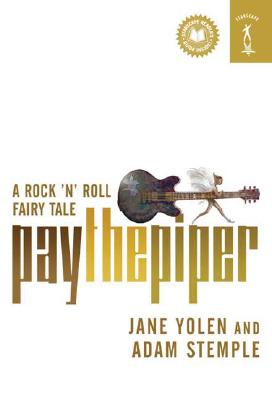
Pay the Piper (Starscape): “A rock ‘n’ roll band to die for…. When fourteen year old Callie McCallan scores a backstage pass to interview the lead singer of the famous band Brass Rat, she’s thrilled. Peter Gringras is so cool. When he plays his flute, it’s as if he has some kind of hypnotic power. But there is something strange about him, something Callie can’t quite put her finger on. Then, on Halloween night, Callie’s little brother Nicky disappears, along with all the other children in town. It’s crazy, but Callie thinks she knows where the children have gone–and who took them. To prove it, and to rescue Nicky and the other children, Callie must journey to a mythical world filled with fantastical creatures. A world from which there may be no return….”

The writers did something amazing: made the book sound a lot more interesting than it really was. There’s something about those three little dots…

Daughter of the Forest (Tor Books): “Lovely Sorcha is the seventh child and only daughter of Lord Colum of Sevenwaters. Bereft of a mother, she is comforted by her six brothers who love and protect her. Sorcha is the light in their lives, they are determined that she know only contentment. But Sorcha’s joy is shattered when her father is bewitched by his new wife, an evil enchantress who binds her brothers with a terrible spell, a spell which only Sorcha can lift-by staying silent. If she speaks before she completes the quest set to her by the Fair Folk and their queen, the Lady of the Forest, she will lose her brothers forever. When Sorcha is kidnapped by the enemies of Sevenwaters and taken to a foreign land, she is torn between the desire to save her beloved brothers, and a love that comes only once. Sorcha despairs at ever being able to complete her task, but the magic of the Fair Folk knows no boundaries, and love is the strongest magic of them all…”

Good; it gives you the basic plot, enough to know it’s a fairy tale adaptation, without coming out and saying so. And yet, doesn’t give you so much that you’ve basically got the whole plot, which leaves you wondering why read the book.

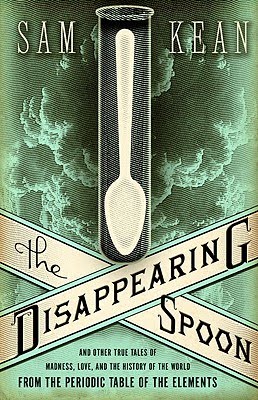
The Disappearing Spoon (Little, Brown and Company): “The Periodic Table is one of man’s crowning scientific achievements. But it’s also a treasure trove of stories of passion, adventure, betrayal, and obsession. The infectious tales and astounding details in THE DISAPPEARING SPOON follow carbon, neon, silicon, and gold as they play out their parts in human history, finance, mythology, war, the arts, poison, and the lives of the (frequently) mad scientists who discovered them. We learn that Marie Curie used to provoke jealousy in colleagues’ wives when she’d invite them into closets to see her glow-in-the-dark experiments. And that Lewis and Clark swallowed mercury capsules across the country and their campsites are still detectable by the poison in the ground. Why did Gandhi hate iodine? Why did the Japanese kill Godzilla with missiles made of cadmium? And why did tellurium lead to the most bizarre gold rush in history? From the Big Bang to the end of time, it’s all in THE DISAPPEARING SPOON.”

This is the best of the lot. It says “Look, fascinating science facts, but written in such a way that’s not for just science geeks.” Total win.

Other books read:
Guys Read: Funny Business
The Magician’s Elephant
The Lincolns
I’d Tell You I Love You, But Then I’d Have to Kill You
The True Meaning of Smekday
In a Heartbeat
King of Bollywood

King of Bollywood

Shah Rukh Khan and the Seductive World of Indian Cinema
by Anupama Chopra
ages: adult
First sentence: “Dreams come true in Dalton.”
Support your local independent bookstore: buy it there!

First off, a disclaimer: four years ago, when I saw this on the shelves, I took a look and said, “Hmm… could be interesting.” But, since my older two girls and I have been on an Indian Cinema bender lately (don’t ask how many movies we’ve watched in the last month…), I put a hold on this one. M read it in one sitting, devouring information about Shah Rukh. I took it a bit slower.

It’s basically one of those Hollywood tell-all biographies; Chopra did sit down an interview Shah Rukh and those closest to him, so it’s an “authorized” version. Reading it reminded me why I prefer memoirs over biographies: I like hearing the stories by the person themselves, rather than being interpreted through someone else. That, and questions I had (like: why is his name Shah Rukh Khan when his dad’s last name was Mohammed? Why did he change it? When did he change it?) weren’t really answered.

That said, even with the meandering and slightly clunky writing style, it was a fascinating look into Indian cinema. To explain how Shah Rukh became the massive superstar he is, Chopra felt it necessary to explain the history of Hindi film, and with that, a bit of Indian history as well. Some really interesting stuff. That’s not to say that Shah Rukh isn’t fascinating: the amount of naked ambition he has is boggling. And yet, he’s an incredibly down-to-earth individual (or at least Chopra made him seem so). Additionally, he’s a halfway decent actor, if a bit on the goofy side. Other than that, there isn’t much to say about this book.

Good for those who are slightly obsessed with Indian cinema.

In a Heartbeat

by Lortetta Ellsworth
ages: 12+
First sentence: “I’m fatalistic.”
Support your local independent bookstore: buy it there!
Review copy sent to me by the publisher

Eagan is a dedicated figure skater. She’s given her whole life over to the sport, living and breathing it. Much of the reason is because her mother pressures her to do so, and when Eagan finds a boyfriend, her mom goes ballistic.

Amelia is a dying fourteen-year-old. Her heart is slowly giving out on her, and she doesn’t have much longer to live. She’s on the heart donor list, but it doesn’t look too hopeful. She’s slowly wasting away, dreaming about living.

Then, the worst happens: Eagan dies in a freak accident.

And the best happens: Amelia gets her heart.

Alternating chapters between Eagan’s and Amelia’s points of view, the book tells their stories, and how, after Amelia gets Eagan’s heart, the transplant changes both Amelia’s life and Eagan’s death. (Yeah, well, go with it.)

It sounds like an interesting idea. Or at least a not-terrible idea. And yet, it never got of the ground floor for me. It may have been because it was trying to tell two stories, and I never connected with either. I understood what Ellsworth was trying to get at, trying to find a connection in a tragedy, but it never really got there for me. I never particularly cared for the characters, and it all seemed overly melodramatic for me. It wasn’t laughably bad or cringe-worthy, but it wasn’t really exciting or even interesting either. It occupied that gray netherworld of just “meh.”

Unfortunately.

The Disappearing Spoon

Madness, Love, and the HIstory of the World from the Periodic Table of the Elements
by Sam Kean
ages: adult
First sentence: “As a child in teh early 1980s, I tended to talk with things in my mouth — food dentist’s tubes, balloons that would fly away, whatever — and if no one else was around, I’d talk anyway.”
Support your local independent bookstore: buy it there!

Me and science aren’t exactly friends. (Or is it science and I? Bad grammar day.) I’ve taken a few science classes, and while I think I liked chemistry the best (who doesn’t like blowing things up in a beaker?), I really haven’t given science (or it’s application) much thought over the years. In fact, save visits to hands-on science museums (my favorite), I haven’t given it any thought.

Enter Sam Kean and this book. It’s perfect for people like me: those who kind of like science (especially chemistry) in a passing sort of way, but aren’t scientists by any stretch of the imagination. It’s a sweeping book, one that explains basic chemistry as well as looking at the history of how different elements were discovered, the periodic table was put together, and about the scientists behind both. All the famous people are there: Einstein, Pierre and Marie Curie, and… that’s all I can think of off the top of my head. But, he goes beyond the famous people, and delves into the all the stories. One I loved was how x-rays were discovered. Or about the kid who decided he needed to help the world break its oil addiction and built a nuclear reactor in his mother’s backyard. Or how elements influenced pen making. Or the politics of Nobel Prizes and naming elements. Or this throw-away line: “Still, chefs and chemists tended to distrust one another, chemists seeing cooks as undisciplined and unscientific, cooks seeing chemists as sterile killjoys.”

It’s got everything, and yet, it’s an incredibly balanced book. It’s amazingly accessible (a must), and even though I think I only understood maybe a third of what Kean was explaining, I found I was never bored. Kean knows how to talk science to unsciency people, so that even if we didn’t understand all the technicalities, we still can thoroughly enjoyed the book.

And that’s a feat unto itself.

Daughter of the Forest

by Juliet Marillier
ages: adult
First sentence: “Three children lay on the rocks at the water’s edge.”
Support your local independent bookstore: buy it there!

Sorcha is the seventh child and only daughter of Lord Colum of Sevenwaters. She’s led an idyllic childhood, for the most part (aside from her mother’s death with Sorcha’s birth, and her father’s unwillingness to show any affection towards her after that), in ancient Erin, playing and exploring with her brothers in the forest behind their home. Then, as she hits the cusp of adulthood, her father remarries an enchantress who, for various reasons, becomes jealous of Sorcha and her brothers. When, in a moment of spite she turns the brothers into swans, Sorcha is devastated. And, even more so when she finds out the only way to break the curse is to sew shirts of a thistle plant without speaking until she’s done. It’s not an easy task, and only the love she has for her brothers can see it through.

A grand, sweeping retelling of the Brother’s Grimm tale, The Six Swans, it has a little bit of everything: magic, faeries, and, of course, romance. It’s set in ancient Britain/Ireland, which allows Marillier to explore the tension between the old ways and the newer religion. A grand book.

When Kelly suggested this as a buddy read, I jumped at the chance. She has the first part of our conversation at her blog; come back and read the rest when you’re done!

—————

Melissa: I agree: when it’s done well, it’s a joy to read. And I thought Mariller balanced the fantasy and the history quite well. Have you read anything else by her?

Kelly: I have read Wildwood Dancing, which is a young adult novel that is also a fairy tale retelling. I quite liked it, so I am happy to have finally read something else by her. All of her books look really good, actually, and I even ‘collected’ her for a while because I just figured I was going to like her. I don’t have everything by her, obviously, because I have only actually read one book by her until this one. I think she is going to continue to be an author I enjoy. What do you think?

Melissa: I also read Wildwood Dancing, but I loathed it. Seriously. Which, I suppose, was part of my subconscious hesitation to read this one. But, I‘m glad I gave her a second chance; I liked this one a lot better. (And it’s unusual for me to like an adult book better than a YA one!) What did you think about the brothers, and the love triangle (of sorts)? Did it work for you?

Kelly: Really? I really like fairy tale re-tellings… They are one of my favourite parts of fantasy, so it is hard for me to find one I don’t like. I actually read a couple in the last few years that share the same fairy tale with Wildwood Dancing. Anyway, I really liked Connor. There was something compelling about him, but there were times near the end of the book where I was a bit shaken in that liking. Then, there was one conversation that he had with Sorcha and it made him appear better in my eyes again. I think that all of the brothers added something to the story and to their family. Do you mean Sorcha and her brothers as the triangle or Sorcha and the other two brothers?

Melissa: I generally like fairy tale re-tellings; I just had issues with Wildwood Dancing in particular. I liked Conor as well, though I’m not sure he was my favorite brother. I agree: there was a time near the end of the book when I wondered what he was doing. He was very out of character, and I’m not sure I quite bought the reasoning for it. I liked Sorcha’s relationship with Finbar at the beginning, and I found it interesting how the enchantment affected him. I liked Liam, as well; I felt he was a good eldest brother, fair and firm and yet loving. And I meant the love triangle with the British brothers. Did it work for you?

Kelly: I am not sure which brother was my favourite… Finbar was for a while in the beginning, but then he changed and I was never entirely sure what to make of him. He was a very brooding character. There were times where I felt really bad for him. As to the love triangle, I am not really sure. When it all played out, it seemed to make sense… And, I liked Red more than Simon. I think if the triangle wasn’t there it would have been a very different book and then I am not sure exactly how it would work out. I suppose it made sense for me and really, it was more the Fair Folk than the people themselves for a while there. Speaking of the Fair Folk, do you think the step-mother and the woman that constantly appeared to Sorcha really were the same people?

Melissa: Wow, I never even thought about that. Two sides of the same coin? I didn’t get that vibe, though I did feel like the step-mother was a part of the Fair Folk. I really liked Simon, for what it’s worth, though I can see the appeal of Red. I agree about it being a different book, though, without the love triangle. In this case, it made the book a better one. Anything else?

Kelly: I think the Fair Folk and her step-mother will be explained more in the second book. Then we will know if our thoughts are correct. See, I liked Red better. I knew that Simon would be upset, but Red was a more interesting character. Simon might have been, too, if the circumstances were different and we got to know him a bit better, but it is hard to say. I think that is most of the story covered without giving too much away. It was fun, though. I am glad we read this book together because otherwise I may never have got through it!

Melissa: Me, too; it’s always good to have extra motivation.

Sunday Salon: Fun Stuff

I have realized, thanks in part to my on-line book groups, that I really want to read non-fiction this year. I usually like to read to escape, and I still want some of that — how else to explain my curiosity about Heat Wave and Naked Heat or my desire to read Rick Riordan’s Tres Navarre series; I usually don’t go in for mysteries, either! — but, I think I’m going to try and read more non-fiction. Maybe I’ll even learn something.

In other news, it’s time for two of my favorite bloggy events. First is Nerds Heart YA: the celebration of unsung and unmainstream (I know: not a word) YA books. The nomination form is up and running. Click through for guidelines, etc., but please nominate something. The more, the merrier.

And last, but definitely not least, the Undead Poll for the Battle of the Kids Books is open. The point is to vote for the book that is likely to die in an early round so it can be judged alongside the other two finalists. The problem, for me at least: I’m horrid at predicting these sorts of things! Do I vote for a book I love? Or do I get strategic (bad idea, really) and try and figure out what will get eliminated but which deserves to be considered? And should I lobby (Bartimaeus! Gen!) for a particular book? Decisions, decisions. You have until March 6th to vote.

Additionally, the judges will be announced on Tuesday; I’ve always found that the most fun part of this whole “competition” is reading what the judges have to say about the books. It will most definitely prove to be tons of fun.

Happy Sunday!

Audiobook: The True Meaning of Smekday

by Adam Rex
Read by Bahni Turpin
ages: 8+ (though my 4 1/2 year old loved it, too)
Support your local independent bookstore: buy it there!

I’ve enjoyed audiobooks in the past, but I think it’s a rare occasion when I listen to an audio book and then realize that I probably would have not liked the book as much if I had read it. (The last time that happened was with The Tale of Despereaux quite a few years ago.) This was one of those books. Although there were a few moments when I wished I had the book to browse through, Bahni Turpin did such an amazing job with the narration, that I know if I had read the book I would not have had as good of an experience with it.

But, the audiobook? I loved it. (As did all the girls, for the record. And they didn’t even hear the whole thing. We need to go on a nine hour roadtrip so they can all hear all of it. Amanda, you want some visitors??)

The story begins with a school assignment. Gratuity Tucci (“my friends call me Tip”) is assigned to write, for the National Time Capsule contest, an essay answering the question: What is the true meaning of Smekday. See, a year earlier, aliens called the Boov invaded Earth, which they renamed Smekland, on Christmas (henceforth known as Smekday). Gratuity has an interesting story: her mother was kidnapped by the Boov, and Gratuity with her cat (named Pig), set off to Florida (where all the humans were being relocated) to find her mom. Along the way, she falls in with a renegade Boov named J.Lo, who has made a bit of a mistake of his own. The long and short of it is that because of J.Lo’s mistake, and because of Gratuity’s determination, it ends up being their job to save the world.

It’s hilarious, especially as read by Turpin. The voices she picks for the Boov, were at first annoying, but by the end of the book became endearing. You could tell the personalities of the people from the voices she chose. And the book was so funny — I wish I had a copy here to pull out one liners — from the pokes at pop culture to the Boov massacring English, it had us all in stitches. But that’s not to say it’s all fun-and-games; Rex pairs the funny with a darker undertone: there’s strains of Manifest Destiny and imperialism going on. Aren’t the Boov doing to us what we did to the Native Americans, or what the British did to so many other countries? I’m sure my younger kids didn’t pick up on that, but I found it interesting. There’s also themes of prejudice and stereotyping, and going beyond first impressions to find the truth of a person, race or species. It’s fascinating.

I also discovered that listening to the story, for me at least, ramped up the suspense. I couldn’t flip to the back of the book to find out how it ended (confession: yes, I do that). I was forced to listen, to wonder where the HECK was he going with the story, and how in Smekland was it all going to turn out?

Highly, highly recommended.

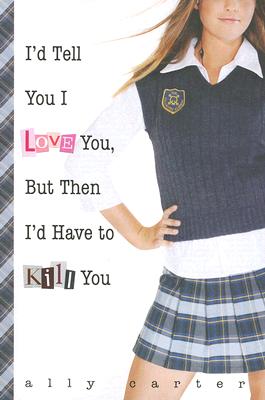
I’d Tell You I Love You, But Then I’d Have to Kill You

by Ally Carter
ages: 12+
First sentence: “I suppose a lot of teenage girls feel invisible sometimes, like they just disappear.”
Support your local independent bookstore: buy it there!

This is fluff. There’s no beating around the bush on that one. Pure, unadulterated fluff. In fact, I’m not sure it can get much fluffier than this.

Cammie goes to an all-girls school. One for exceptional girls. Though the general public doesn’t know how exceptional: The Gallagher Academy girls are training to be spies. Which means they are not your normal, average, run-of-the-mill girls. What happens, then, when one of these girls (well, Cammie, specifically) meets an average, everyday boy and kind of falls for him? Well, for starters, she can’t let him know who she really is, which creates all sorts of problems.

As far as fluff goes, it’s fun fluff. It didn’t really grip me, and it wasn’t as fun as Heist Society, which was more complex and exciting, but it as far as straightforward spy/romance books go, it held its own. The characters were fun, the asides were amusing, and Ghallager Academy itself was a fascinating place. I wasn’t head over heels in love with the book by the end, but M says the second book in the series is better, so I’ll probably give that a try. Eventually.

Drumroll Please….

It’s February, the month of Big Events. There’s the Superbowl, the Oscars (both of which I really like watching), and The Cybils. Okay, so they’re not as well known as the other two, but for me, at least, they are just as important.

It’s also a much better way to spend Valentine’s Day than stressing out about what to get your valentine. (A book! Preferably a Cybils book!)

And so, without further ado, the winner of the category I’m most invested in (and have actually read the entire shortlist…) is (the blurb is from the blog):

Yoda The Strange Case of Origami Yoda
By Tom Angleberger
Amulet
Nominated by: Sarah Stevenson

Ultra-nerd Dwight wears a small finger puppet and uses a funny voice. But oddly enough, his Origami Yoda doles out advice that seems much wiser that Dwight. “The big question: is Origami Yoda real?” Tommy has a lot riding on the question: he’s desperate to know if he can trust Yoda’s advice about a certain girl. So he and his friends set out in search of scientific evidence, gathering anecdotes from everyone who’s ever consulted the paper oracle.

Angleberger deftly pens authentic voices, and depicts the humorous way middle schoolers become hooked on a weird idea, build on it, believe it and talk about it endlessly. This story is, in essence, about kids trying to figure out how to be social. We love the creative premise, the clever dialogue and the surprising way it unfolds. But in the end, it’s the humor and the heart of this book that make it so great.

Oh, yay for Origami Yoda! If you’re curious, you can go here to find out the rest.

10 Questions for Rob Buyea

Today, I’m spotlighting another amazing Cybils-nominated author (the winners are going to be announced tomorrow! I can’t wait!), this time the author of the amazing Because of Mr. Terupt. Teacher, wrestling coach, father of daughters, and all-around nice guy, Rob Buyea (pronounced Boo-yeah) was kind enough to take time out of his busy schedule and answer a few questions for me.

MF: First off, the blurb on your book by one of my husband’s favorite authors, John Irving, got me wondering. How did that come about?
RB: John and I first met in the wrestling room at Northfield Mount Hermon School. I coach the team there, and at the time, John’s youngest son was attending NMH. We talked whenever was saw each other on campus over the next year. After I started to get serious interest from editors about Mr. Terupt, I told John that I was a writer. He asked to see my story, read it, and loved it. I’m very lucky to have such a great person in my corner.

MF: Very cool! That is amazing. Can you tell us a little bit about the process (from inception to publication) for the novel?
RB: I was working on a different manuscript when some of the voices first began talking to me. Peter, Jessica, and Luke started in on me first. I tried not to listen to them because as I said, I was working on something else. They didn’t leave me alone, so I began to put their voices on paper. I shared the beginning with some writing colleagues, and then I knew I was on to something. I attended a conference hosted by the SCBWI where there was a first pages panel. Peter’s voice was read and critiqued on the spot. Everyone loved it. I worked to finish the story and sent it out.

MF: Did you always mean to write for a middle grade audience, or did it just happen?
RB:I knew I was writing for a middle grade audience. In fact, I imagined being the teacher standing and reading aloud to his classroom as I wrote the story. I used to love to do that. Many teachers that have used Mr. Terupt as a read-aloud have sent me wonderful emails.

MF: I agree: it would make a great read aloud. Why did you decide to write the story of Mr. Terupt and his classroom from the point of view of several different people rather than a single narrator?
RB: I had finished reading Bat 6 by Virginia Wolff not long before I began Mr. Terupt. I think that had an influence, though I didn’t consciously think about it. Imagine saying to a student, “Tell me about school today.” You’d get twenty different responses from a class of twenty. I had seven kids that wanted to tell you about that year with Mr. Terupt. Naturally, they all had something to say.

MF: I think the different narratives added to the story; it was one of my favorite things about the book. Do you have a favorite character or scene in the book?
RB: No and No. I could never pick a favorite character. One week I’m really thinking about Peter, and then the next it’s Anna, etc. And there are a lot of parts I really liked writing. I had a lot of fun with the dollar words and the scene where you see the principal’s underwear. I liked writing the snowball scene, the hospital scene with Lexie and the other girls, and James with Peter. I also really liked writing about Danielle’s grandmother. She’s important to me.

MF: Is there anything you would like (or hope) your readers take away from reading your book?
RB: I hope it prompts thought and brings laughter. I hope my readers realize there’s much more to their classmates than just what they see in the classroom. I hope my readers have many connections—to self, to classmates, and if they’re lucky, to their own “Mr. Terupt.”

MF: It did remind me of my 5th grade teacher; she was absolutely amazing. How do your experiences as a teacher help you with your writing?
RB: I had lots of students and experiences that spark my imagination.

MF: Is there some one or something that inspires you to write?
RB: I was inspired, not by my own “Mr. Terupt,” but rather by the students I taught. They were amazing—in so many ways. I began writing because of them. Turns out that writing has also filled a void in my life. I trained as a very dedicated wrestler all my life. Once I graduated college and was no longer competing, I felt like something was missing because I wasn’t training. Writing has taken that place. The mental toughness and endurance that went into wrestling now goes into my writing. I love it.

MF: What’s the last book you’ve read and loved (and why)?
Hope Was Here, by Joan Bauer. I read it because it was on Jessica’s mind while I was working on the sequel.

MF: If you don’t mind telling us, what can we expect next from you?
RB: Mr. Terupt Falls Again. Scheduled for a Fall 2012 release.

MF: Thanks, Rob, for your time!