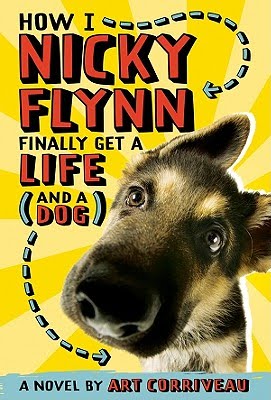
How I, Nicky Flynn, Finally Get a Life (And a Dog)

by Art Corriveau
ages: 11+
First sentence: “We have this dog now.”
Support your local independent bookstore: buy it there!

Nicky Flynn is not a happy camper. He’s not quite 12 years old, but his life the last few months has been turned completely and totally upside down. His parents split up, his mom dragged him away from his comfortable house, his good school, and landed in Charlestown, a not-so-prosperous area of Boston. She’s unreliable, completely worn out from her job as a secretary, and Nicky suspects that she’s not letting him see his dad. To top it off, on a whim she brought home this German Shepard, Reggie, who was a former seeing eye dog. Since his mother isn’t showing any interest in taking care of the dog, it’s just another thing Nicky has to do.

And yet, as Nicky starts walking Reggie around, he discovers that Reggie has a past, and that that past is as bit of a mystery, and through a lot of bumps and scrapes, figures out that maybe, just maybe, Reggie is the only living being he can count on in this life. Sometimes, really, the dog is your best friend. If you can only realize it in time.

It’s one of those books where the majority of adults are complete basket cases. Nicky’s not terribly sympathetic, either: he’s angry and has a temper as well as a bit of a lying problem. And yet, because the adults are so much worse, it’s quite easy to sympathize with Nicky: he is that way just because everything around him is falling apart. It’s a therapeutic book, one that looks at the aftermath of a messy divorce and sees not the roses but the thorns for most of the story. And yet, it’s depressing: there’s a lot of hope in the book (Hooray for a dog book where the dog doesn’t die!), and the relationship between Nicky and Reggie is quite wonderful (as far as dog-human relationships go).

In the end, in spite of the adults I wanted to scream at, an enjoyable book.

(Just for the record: because this is a Cybils nominee, I’ve been asked to make sure y’all know this is my opinion only, and not that of the panel.)

What Happened on Fox Street

by Tricia Springstubb
ages: 10+
First sentence: “Fox Street was a dead end.”
Support your local independent bookstore: buy it there!

Mo Wren loves her street. She’s lived there her whole life, and it’s her whole world. She has everything she needs: people to cut hair, tutor, watch after her and her little sister Dottie, her best friend comes to visit there every summer, and even the boy down the street is beginning to look interesting. Except things are starting to change. And Mo doesn’t like that.

First bad news is that her best friend, Mercedes, says that it might be her last summer on Fox Street since her mother’s marriage to a man who’s “comfortable” (ie, not rich, but much better off than they used to be) is changing things. They might also take Mercedes’ grandmother, Da, to come live with them, too. And Mo’s dad, who hates his job as a city water and sewer employee and has just been scraping by in the years since her mom’s sudden death, is thinking about selling out to a developer to go after his dream of owning a sports bar/restaurant. Her little sister, Dottie, is a wild child without discipline, taken to wandering the neighborhood adding to her bottle collection; what else can you expect from a girl without a mother?

Somehow, though this quiet (though sometimes tumultuous), yet heartfelt story, Mo figures out that not all change is bad, that she is strong enough to make the changes necessary. And that it will probably all work out for the best. A very hopeful, charming little book.

(Just for the record: because this is a Cybils nominee, I’ve been asked to make sure y’all know this is my opinion only, and not that of the panel.)

Library Loot 2010-41

Why, yes, I did put all of the middle grade books on hold. Why do you ask?

Picture Books:
How Santa Got His Job, by Stephen Krensky/Illus. by S. D. Schindler
Night City, by Monica Wellington
If You Take a Mouse to the Movies, by Laura Numeroff/Illus. by Felicia Bond
Maisie Moo and Invisible Lucy, by Christ McKimmie
Octopus Opposites, by Shelia Blackstone and Stephanie Bauer
Shape by Shape, by Suse Macdonald
Little Beauty, by Anthony Browne

Middle Grade:
The Seventh Level, by Jody Feldman
Mockingbird, by Kathryn Erskine
Twenty Gold Falcons, by Amy Gordon
The Case of the Crooked Carnival, by Michele Torrey/Illus. by Barabara Johansen Newman
RatfinkRatfink, by Marcia Thornton Jones
The Fantastic Secret of Owen Jester, by Barbara O’Connor
It’s Raining Cupcakes, by Lisa Schroeder
My Best Frenemy (Friends for Keeps), by Julie Bowe
Noonie’s Masterpiece, by Lisa Railsback/art by Sarajo Frieden
Yours Truly, Lucy B. Parker: Girl vs. Superstar, by Robin Palmer
Mary Mae and the Gospel Truth, by Sandra Dutton
Finding Family, by Tonya Bolden
Crunch, by Leslie Connor
The Reinvention of Moxie Roosevelt, by Elizabeth Cody Kimmel
The Case of the Gypsy Goodbye: An Enola Holmes Mystery, by Nancy Springer
Tortilla Sun, by Jennifer Cervantes

Young Adult:
Bartimaeus: The Ring of Solomon, by Jonathan Stroud

The roundup is either at Adventures of an Intrepid Reader or The Captive Reader. Obligatory FTC note: the links are provided through my Amazon Associates account. If you click through and actually purchase one of these books, I’ll get a teeny, tiny payment. But, since no one ever does, and it’s SO much easier using the associates account to put up these links, I’m going to keep doing it.

The Lost Hero

Heroes of Olympus, book 1
by Rick Riordan
ages: 10+
First sentence: “Even before he got electrocuted, Jason was having a rotten day.”
Support your local independent bookstore: buy it there!

I’m of two minds about this book. On the one hand, it’s not Percy Jackson. It wasn’t as funny (I missed the chapter titles!), it wasn’t as tight (I kept wondering: was all 553 pages necessary), it wasn’t as fun. I feel bad for Riordan, having everything being compared back to Percy. It’s just that those books are so good, so clever, so well done, that it’s hard to top them.

And yet.

We’re given a new trio of heroes to root for: Jason, son of Jupiter (aka Zeus), who doesn’t remember anything about where he came from or who he is, and why he ended up with these other guys; Leo, tinkerer, mechanic, builder, and fire-wielder, and he makes nice with a really cool mechanical dragon; and Piper, angst-ridden daughter of a movie star, who has a gift for convincing people to give her things. They’re an unlikely trio, and when they set off to free Hera, of all gods, from an unseen rising force, you wonder how it’s all going to turn out.

I don’t really want to give away much more than that, because, in spite of its length, Riordan has the gift for making you turn pages. You want to know what’s happening, you want to know how the puzzle pieces fit together, and yes, while he doesn’t end with “to be continued” he does give us a nice lead-in to the next book in the series. He keeps you wondering what’s going to happen next, and for that, we’ll give him enormous credit. He’s working his way through Greek mythology, weaving lesser-known stories (though there are a couple of well-known ones as well) through the book. It’s not deep, and yes it’s much of the same sort of clever that Riordan’s known for.

But you know what? It’s fun. And for this, that counts a whole lot.

Darius Bell and the Glitter Pool

by Odo Hirsch
ages: 10+
First sentence: “Darius Bell walked through the grass.”
Support your local independent bookstore: buy it there!
Review copy provided by the publisher.

The Bell ancestors were showered with gifts for various heroic (and other) deeds. In return, once a generation they are required to present the town with a Gift. It doesn’t have to be spectacular, but they always are: a statue, a fountain, stained glass. However, it’s time again, and this time the Bells are broke. See, after all the inheritance, no one bothered to work. And while they have a situation with their land and mansion — people who live there and agree to do some upkeep and housekeeping and cooking in exchange for room and board — they have no money left for a gift.

Enter Darius. He’s just a kid, and his parents and older brother seem to think that he really doesn’t need to be a part of the whole gift thing. But after a random earthquake, he discovers something wonderful (not useful or even worth anything) that would be absolutely perfect for the gift. And all it takes is a little coordination to get it done.

It’s a perfectly sweet little book. Nothing grand or great or horrid or earth shattering. It’s a pleasant story, in a pleasant little town, and although there are worries, they are Overcome in a pleasant little way. It’s a reminder to enjoy the simple things in life, and to look beyond the Grand and the Great. And that not-so-big people can do big things, too.

All served with a smile and a slice of cake.

(Just for the record: because this is a Cybils nominee, I’ve been asked to make sure y’all know this is my opinion only, and not that of the panel.)

More Christmas Goodness

Coming on the heels of the Book Blogger Holiday Swap (last day to sign up!) is the Virtual Advent Tour. YAY!!!

From the blog:

Each day anyone who wants to participate takes turns sharing a treat with our friends here in blogland. For example it could be something about your family traditions, recipes, your country’s holiday traditions, or a favourite Christmas memory, movie, book, song…anything you like. Even if you don’t celebrate Christmas we would like to hear about what your family does during the holiday season, whether it be celebrating Hanukkah or Kwanzaa or whatever it is that you do during this time.

I’ve participated all four years (I think), and it’s been a blast. The only trick is coming up with something new to talk about this year…

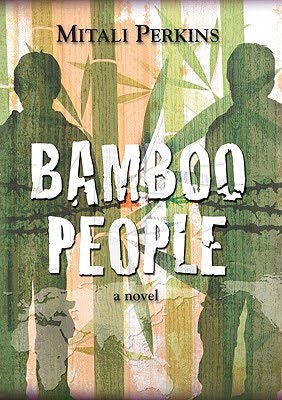
Bamboo People

by Mitali Perkins
ages: 12+
First sentence: “Teachers wanted.”
Support your local independent bookstore: buy it there!

The senselessness of war. The brutality of commanders and oppressive governments. The lives of the soldiers — willing or not — that are caught up in political games. The propaganda that confuses and misleads. The families that are torn apart. It could be any war; in fact there are many books like this that exist about the Civil War, World War II, and Vietnam. But, it’s almost too easy to dismiss those as history, as irrelevant. But, Mitali Perkins brings the same themes to the current day, with the conflict in Burma. This is not history, people.

We follow the story of Chiko, the son of a political prisoner, and someone whose only aspirations in life are to be a teacher. He’s not cut out for being a soldier, and does what he can to avoid being captured and drafted. Unfortunately, that doesn’t last; the government tricks him by advertising for teachers, and then pulls a bait-and-switch. The camp where he’s being trained to be a soldier is not a pretty or nice place; the commander in charge is one of the worst kinds of despots: an insecure bully. It’s only through the wits of a street boy, Tai, that Chiko befriends that Chiko is even able to survive. It’s harsh and brutal to read about the inhumanities that men perform on boys; even as watered down as this is (it could have been much worse), it still makes one flinch. How can people treat others this way?

He does find uses for his talents, though: he becomes a scribe for one of the seconds in command, and teaches Tai and some of the other soldiers to read. He even secures a spot with the army back in the city where his mother is. However, once the commander finds out, he threatens to send Tai off on a dangerous mission as punishment. Chiko, noble person that he is, offers to trade spots with Tai; he’ll go on the mission and Tai will go to the city. Your heart bleeds for Chiko; there’s a definite sense of foreboding, and you know that the mission won’t go well. It’s war, after all, and there are casualties.

Enter Tu Reh, a Karenni refugee who cannot forgive the Burmese army for the way they’ve oppressed his people. He finds Chiko wounded in the jungle, and — understandably — wants to leave him to die. Or at least perform a mercy killing. And yet, something in him is moved by the Burmese boy, and he carries him to a nearby healers hut, and eventually to the refugee camp, saving Chiko’s life. A friendship slowly develops, and perhaps even a little, perspectives are softened, and minds are changed.

It’s difficult to juggle two perspectives, and give each their due, but Perkins balances this admirably. You understand and empathize with Chiko’s position and you can feel Tu Reh’s anger and uncertainty. It’s a friendship that develops slowly, one that surpasses political borders and ideas, one that reminds us all that no matter what we are, where we sit, or even really what we believe, we are human beings and should be treated with respect. It’s a book of hope: if only people could make such friendships then maybe, just maybe, the world could be at peace.

The only sad thing is that the people who really need to read this probably never will.

Zora and Me

by Victoria Bond and T.R. Simon
ages: 11+
First sentence: “It’s funny how you can be in a story but not realize until the end you were in one.”
Support your local independent bookstore, buy it there!
Review copy sent to me by the publisher

It’s an interesting idea: take a famous, respected novelist — in this case, Zora Neale Hurston — who had a unique childhood — in this case, living in the all-black town of Eatonville, Florida in the early 1900s — and turn it into a middle grade mystery. The “me” part of the title, is one of Zora’s fictional friends, Carrie (the other being Tom) and we see Zora and the adventures through her eyes.

It all begins one night when Carrie and Zora see a giant alligator maul a local man. The alligator disappears, and Zora — who was always one to spin a story — decides that another man, this one a bit of a recluse — is actually the Gator King, half-man, half-alligator, and can morph between the two. It’s a bit far-fetched, but in pursuit of the story, they inadvertently stumble upon something deeper and darker in their town.

It’s a story about the power of stories, and belief in stories. But it’s also a story of race, and acceptance, and — to a much lesser extent — justice. As far as historical fiction goes, the book captures you and sweeps you away to a town where, on the surface, it doesn’t matter what color you are. But as the layers are peeled away, it’s much less rosy. My only real quibble comes with the use of the n-word: on the one hand, that it’s in the book at all speaks towards historical accuracy. It is the early 1900s, after all. But, the first time it was used, I did a double-take and chalked it up to historical fiction. The fourth and fifth times, however, I went searching for an authors note explaining the use. There was none. This really bothered me: I feel that that word, especially, should not be used lightly, or in passing, without some sort of explanation or disclaimer. I found it disturbing, and it took away from the enjoyment I had reading the book.

The mystery was interesting, the use of Zora Neale Hurston as a character was clever. The racial issues, however, overran the book, and while there was resolution at the end, there was a bitter taste left over. Perhaps this is what the authors intended when writing, or perhaps I’m overreacting. Either way, I was left torn: I liked the book, but I didn’t feel I could recommend it.

It’s amazing what one little word can do.

(Just for the record: because this is a Cybils nominee, I’ve been asked to make sure y’all know this is my opinion only, and not that of the panel.)

Library Loot 2010-40

The number of books on hold for me today? Nine. I suppose it could be worse. But I’m sure the librarians are glad they have this new system where I have to get the holds off the shelf myself, instead of them hauling out the stack to me.

The question is: will any of them be good??

(Oh, and yes, there’s Christmas books in the pile. Don’t shoot me; I’m feeling Christmasy already.)

Picture Books:
The Little Drummer Boy, Illus. by Kristina Rodanas
It’s Christmas, David!, by David Shannon
Boo Cow, by Patricia Baehr and Margot Apple
Too Busy Marco, by Roz Chast
Crash Bang Donkey!, by Jill Newton

Middle Grade:
Jellaby, Volume 1, by Kean Soo
Moon Over Manifest, by Clare Vanderpool
Out of My Mind, by Sharon M. Draper
The Summer Before (Baby-Sitter’s Club), by Ann M. Martin
What Happened on Fox Street, by Tricia Springstubb
How I, Nicky Flynn, Finally Get a Life (and a Dog), by Art Corriveau
President of the Whole Fifth Grade, by Sherri Winston
Milo: Sticky Notes and Brain Freeze, by Alan Silberberg
Betti on the High Wire, by Lisa Railsback

The roundup is either at Adventures of an Intrepid Reader or The Captive Reader. Obligatory FTC note: the links are provided through my Amazon Associates account. If you click through and actually purchase one of these books, I’ll get a teeny, tiny payment. But, since no one ever does, and it’s SO much easier using the associates account to put up these links, I’m going to keep doing it.

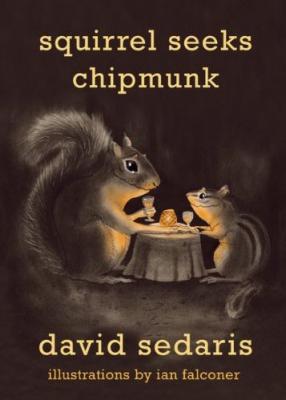
Squirrel Seeks Chipmunk

A Modest Bestiary
by David Sedaris
ages: adult
First sentence: “The cat had a party to attend, and went to the baboon to get herself groomed.”
Support your local independent bookstore: buy it there!

The number one rule in reviewing is never start a review saying you don’t like the genre. You do that and people will discredit everything you say after. Except… it’s really true in this case. Satire and I, we don’t get along. I am not a fan of the literary technique, I usually don’t “get it”, and I rarely find it funny.

And yet. I “got” this book, or at least most of it. It helps that Sedaris — again, whom I’ve had a bit of a rocky relationship with; I find him hilarious in person, but I don’t think his humor translates in writing for me — is poking fun at people we all know: hairdressers, complainers, obsessive parents, liberals, conservatives, intellectuals, vigilantes; no one is safe from the Sedaris’s caricaturization.

That’s not to say that every story works equally well, and truthfully, that may have been me. I really liked the ones I “got”, especially “The Cat and the Baboon,” “The Toad, the Turtle, and the Duck,” “The Parenting Storks” (an excerpt of which I heard on NPR, which led me to pick up the book in the first place), and “The Grieving Owl”. Each of these I found hilarious in their own way; possibly because the are the most accessible, and possibly because I found them funny, knowing people like that (though don’t we all).

Sedaris also balances between humanizing these animals and keeping them in the animal world: nothing really has a happily ever after, and the viciousness is often due to the nature of the animal: a baby stork falls from its nest presumably to its death, a bear is captured and forced to be a part of a circus, the crow eats the baby lamb’s eyeballs. It’s a reminder that, no matter how pretty we try to make it, nature is a cruel, vicious place. And the moral? Nobody’s exempt, no matter what you think.

It’s a weird little collection of stories, and not for everyone. But as far as satire goes, it’s quite good.