Happyface

by Stephen Edmond
ages: 14+
First sentence: “Write what you see and draw what you feel.”
Support your local independent bookstore: buy it there!

Meet Happyface. He’s attempting to reinvent himself in the wake of some pretty traumatic events. His family used to be “typical”: mom, dad, two sons, but events, and bad choices caused that to fall apart. Will that stop Happyface? No! Formerly a shy, artistic, computer-game and comic geek, he’s using the move to a new town (into an apartment with his mother) as a chance to start over.

First off: get new friends.

Happyface is the nickname that the object of his idolization, Gretchen, gave him. He’s trying so hard to be happy, to be friendly, to be likable, that she dubs him “happyface”, and it sticks. In fact, as the book unfolds, we learn a lot about Gretchen, her friends Karma and Misty Moon, her ex-boyfriend Trevor, and even about Happyface’s ex-BFF, Chloe, but not much about Happyface himself (including his name). He’s a mystery, keeping everything close to his chest and away from both the other characters as well as the reader. The conflict comes from this reluctance to reveal anything: because he’s not willing to talk about what happened in his family or his past, it ends up sabotaging his friendships. Captivating in its style — journal entries that include both prose and art — your heart aches for this boy, muddling through trying to make it all work, even as you can see it falling apart around him.

(Is it wrong that I just wanted to send them all to therapy?)
Countdown

by Deborah Wiles
ages: 10+
First sentence: “I am eleven years old and I am invisible.”
Support your local independent bookstore: buy it there!

It’s the fall of 1962, and there’s tension in the air. Fifth-grader Franny Chapman is not quite sure what’s going on with her best friend; her Uncle Otts seems to be not quite there anymore, instead spending more and more time fighting an old war in his head. Her mother is distracted, her father is gone, her older sister is choosing to spend time with her college friends and leaving Franny behind. Even her teacher has skipped her every single time when it’s her turn to read aloud in school.

On top of all that, the president — John F. Kennedy, for those of us who didn’t do well in history — has just informed the country that the Soviet Union is sending missiles to Cuba that have the potential to blow the entire country up. Franny only wants to be worried about going to her first boy-girl party, not whether or not she’s going to live to see tomorrow.

This book is billed as a “documentary novel”; the narrative is interspersed with pictures and quotes and clippings (there’s a Fallout Shelter Instruction Manual!), presumably to give the reader (who, we assume, didn’t do well in history either) some frame of reference. And taken separately, both the non-fiction parts and the fiction parts were interesting. I kind of liked Franny, and her struggles. I wanted to smack her mom, and I kind of felt that Wiles was playing up an early-60s mom stereotype: the bridge-playing, cigarette-smoking, mostly absent mom who was a very strict disciplinarian when she was around, and yet somehow had a soft heart for her children, though her son saw it more. (We’ve come a long way, baby.) And I liked the non-fiction parts as well. The quotes, the bios of notable people, the pictures were all fascinating to look at.

I just think this book tried to do too much in combining both. The narrative felt interrupted to me, and I didn’t get the sense of foreboding about the Cuban Missile Crisis that I think the author wanted us to get. In some ways, I think this would have worked better as a straight-up non-fiction book, like Marching for Freedom or Claudette Colvin. Combined with quotes and interviews, this could have been a compelling book. (I’d love to see one done from a Cuban perspective, personally.) But as it is, the book fell short in many ways for me. It tried to do too much (there’s even a faint subplot about the race issues in the country at the time, but it was never developed enough to do much with), and because of that, it didn’t do enough.

Which is just too bad.

(Just for the record: because this is a Cybils nominee, I’ve been asked to make sure y’all know this is my opinion only, and not that of the panel.)

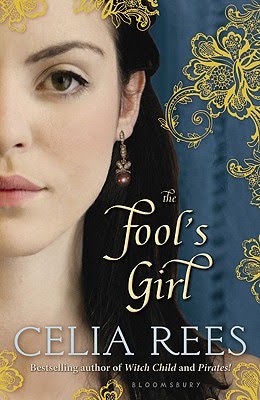
The Fool’s Girl

by Celia Rees
ages: 14+
First sentence: “Have you seen a city under sack?”
Support your local independent bookstore: buy it there!
Review copy sent to me by the publisher.

Ever wonder what happens after the end of Twelfth Night? You know, how everyone is happily married, how the “bad” guy conveniently disappears? What happens next? Is it really happily ever after?

Well, not exactly. Celia Rees takes the ending of Twelfth Night — the play conveniently summed up for those of us who are unfamiliar with it — and spins it out. It’s no longer a comedy; even though Feste is still around, he’s not the comic relief. In fact, there isn’t any comic relief. Violetta, Viola’s daughter, is in exile from Ilyria after her mother’s disappearance and the country is overrun, and her father killed, because of the coup her uncle Sebastian and Malvolio directed. She makes her way to London, where she runs into
a certain playwright, Will Shakespeare, and enlists his help in finding Malvolio and restoring her to her country.

It’s an interesting idea; I’ve wondered about Shakespeare’s comedies in the past, especially since so many of them are only comedies by the slimmest margin. A turn of the hand, and everything falls into tragedy. And yet, this book didn’t grab me. I picked it up and put it down a few times, trying to get into the story. Once I pushed past chapter three, the story picked up a bit. Shakespeare came into play — Rees’s take on Shakespeare was intriguing; he was a gentleman and a hard-working genius, not a scoundrel or a fraud as I have seen him portrayed elsewhere — and the pace picked up a bit.

Except that scoundrels and frauds are more interesting. That’s the biggest problem with this book: everyone’s bland. Shakespeare’s only mildly interesting, Feste’s annoying. Violetta’s bland, there’s no chemistry between her and the love of her life, Stephano. In fact, with about 70 pages to go, I decided I Just. Didn’t. Care. and abandoned it. (Yeah, I read the ending first, so I’m counting it as a finish.) I like what-ifs, and I like adventure, and I like mystery. But it all has to be pretty spectacular in order to get me past characters who don’t grab my attention.

And this one just didn’t.

Library Loot 2010-36

Two reasons why this is so long this week. One: it’s Cybils season (only a couple more days to put in your nominations…), so the middle grade section is a list of books I need to read sooner rather than later. And secondly, I started volunteering at the public library (finally, yay!). I thoroughly enjoy this, but… I see a book, I WANT the book, and because it’s the library, I take home the book. The question is: when am I going to find time to READ the book???

Picture Books:
Elsie’s Bird, by Jane Yolen/Illus. by David Small
Creak! Said the Bed, by Phyllis Root/Illus. by Regan Dunnick
The Little Green Goose, by Adele Sansone/Illus. by Anke Faust
Muddy As a Duck Puddle and Other American Similes, by Laurie Lawlor/Illus. by Ethan Long
Hey, Rabbit!, by Sergio Ruzzier
Alfie Runs Away, by Kenneth M. Cadow/Illus. by Lauren Castillo

Middle Grade:
Year of the Tiger, by Alison Lloyd
The Red Umbrella, by Christinaq Diaz Gonzalez
Touch Blue, by Cynthia Lord

Young Adult:
The Princess and the Snowbird, by Mette Ivie Harrision
Castle in the Air, by Diana Wynne Jones
Evermore: The Immortals, by Alyson Noel
Behemoth, by Scott Westerfeld

The roundup is either at Adventures of an Intrepid Reader or The Captive Reader. Obligatory FTC note: the links are provided through my Amazon Associates account. If you click through and actually purchase one of these books, I’ll get a teeny, tiny payment. But, since no one ever does, and it’s SO much easier using the associates account to put up these links, I’m going to keep doing it.

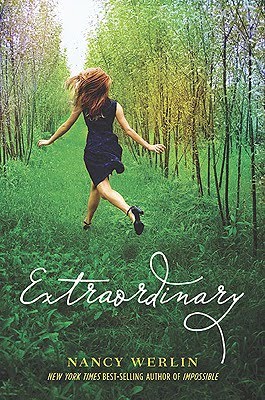
Extraordinary

by Nancy Werlin
ages: 13+
First sentence: “You are ready for your mission, then, little one?”
Support your local independent bookstore: buy it there!
Review copy sent to me by the publisher.

At first glance, this book has a fascinating premise. What if the faeries made a bargain with a human, one that they felt sure they would be able to cash in on. And yet, because of the confidence of his descendants, the faeries have found that the bargain wasn’t as easy to fill as they thought it would be. They’re slowly dying, and they need to find an ordinary girl. And if they can’t find her, they need to make her ordinary, as soon as possible.

Enter Phoebe Rothschild.

She’s the daughter of the powerful Catherine Rothschild, and feels like she’s just average. Especially next to her beautiful friend, Mallory. Sure, when Phoebe first met Mallory, she was an awkward 7th grader. But she has blossomed into a beautiful, confident young woman, and Phoebe feels… ordinary next to her. Enter Mallory’s older brother Ryland, suave, sophisticated, and interested in Phoebe. How can he be since she’s so ordinary? Little does she know that it’s all a trap, and that it will take all of her ordinariness to get her out of it, and save those who truly love her.

It’s an interesting premise, sure. And it would even could have worked: you find out about the faerie’s plan and what led them to such desperate measures slowly, over the course of the book. And because you know more than Phoebe, there’s a certain fascination as you watch it all play out. The problem lies not in the idea, or even in the plotting, but in the writing. It’s clunky. The dialogue is clunky. The narrative is clunky. It’s so much more tell than show. Phoebe felt this way, and yet there was nothing to back it up. Phoebe was angry, and so ranted for several paragraphs, using periods the whole way. (“I am so mad.”) Phoebe couldn’t wrap her brain around that; and perhaps because I knew it was faerie glamor, I felt like smacking her. In short: I lost interest. By the time of the ultimate climax, one that was supposed to be Moving and Touching, I found I just didn’t care.

It sure is an interesting premise, though.

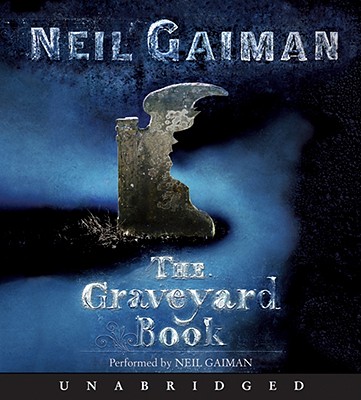
Audio Book: The Graveyard Book

by Neil Gaiman/read by Neil Gaiman
ages: 10+
First sentence: “There was a hand in the darkness and it held a knife.”
Support your local independent bookstore: buy it there!

This is a reread for me — my face-to-face book group is reading it this month, and I needed a brush up — but this time, I decided that I really wanted to hear Gaiman read it. I’d heard that he was a fabulous narrator, and that it’s a singular experience.

I was pretty wishy-washy about the book the first time around; I thought the illustrations didn’t add much, and that it wasn’t always as gripping as I’d have liked.

But listening to it? I kept the CDs in the car, to listen to while I drove around, and I kept finding excuses to go places. Gaiman’s a captivating storyteller. Absolutely, completely captivating. There’s something about his voice, and because he’s the author, he adds subtle nuances here and there that just make the story come alive. It was funnier that I remembered it being. The beginning and ending were still intense, but there was a different sort of intensity to it. And it all — from the Sleer to the Goul chapters — seemed to make more sense as Gaiman was reading it. I loved it so much more this time around.

A very highly recommended way to experience this book.

Geektastic

Stories from the Nerd Herd
edited by Holly Black and Cecil Castellucci
ages: 14+
First sentence: “I awake tangled up in scratchy sheets with my head pounding and the taste of cheap alcohol and Tabasco still in my mouth.”
Support your local independent bookstore: buy it there!

I was looking forward to this. I mean, it’s got stories from Scott Westerfeld, John Green, David Leviathan, Wendy Mass, Sarah Zarr and Lisa Yee. It has to be good right? I had heard rumors that it’s not all it’s cracked up to be, and yet I still held out hope.

But you know what? It’s not as good as it should have been.

It starts out with a bang: Holly Black and Cecil Castellucci combine for a wonderfully geeky story using cons and dressing up and the animosity (of sorts) between Star Trek and Star Wars. It’s a brilliantly fun story: engaging, entertaining, often hilarious. Perhaps they, as editors, should not have started off with that one, because it all went downhill from there.

Oh sure, there were some highlights in the mix: I particularly liked David Levithan’s quiz bowl geek story, Garth Nix’s live action role playing one, and Wendy Mass’s astronomy one. But, for the most part, they all seemed repetitive: take a geek (music, film, theater, dinosaurs, band) and let them fall in love. They all seemed, one way or another (notable exception being John Green’s and Sarah Zarr’s stories), to be about geeks falling in love. Which isn’t bad in itself: geeks fall in love as well as non-geeks, but it just seemed tiresome in story after story. I wanted something different after a while. Some other aspect of geekery. Something uniquely geeky, instead of just feeling like it was a normal story set in a geeky setting.

Not that I could have written one.

That said, I did like that they covered all aspects of geekery: there’s a story here for everyone. Multiplayer Online Games? Check. Majorettes in the marching band? Check. Theater geeks? Check. Rocky Horror Picture Show? Check. Buffy? Check. My favorite comic — the stories are interspersed with one-page comics — was “What Kind of Geek Are You?”. There are so many ways to be geeky, and it’s nice that the editors found a way to embrace them all.

And for that, Geektastic is truly fantastic. Perhaps it really is too much to expect it be fantastic in other ways, too.

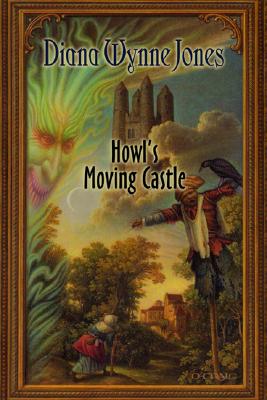
Howl’s Moving Castle

by Diana Wynne Jones
ages: 12+
First sentence: “In the land of Ingary, where such things as seven-league boots and cloaks of invisibility really exist, it is quite a misfortune to be born the eldest of three.”
Support your local independent bookstore: buy it there.

My third outing with Diana Wynne Jones, and I have to say that I understand why she’s beloved by many. The book was wonderful. Not in a gripping, suspenseful, exciting sort of way. But in a quiet, sweet, kind, yet somehow completely and totally amazing sort of way.

For those who have neither read the book or seen the movie, our main character, Sophie, is the eldest of three daughters. Which pretty much means she’s bound to fail. (As the stories go.) A daughter of a women’s hat shop owner, she’s pretty much resigned to staying there forever. Her sisters manage to get away in apprenticeships — one to a bakery, the other to a witch — but she believes that she’s forever stuck. That is until the Witch of the Waste comes in, has a conitpitoin fit and turns Sophie into an old woman. Sophie figures it’s not going to get much worse, and sets off to seek her fortune, in the form of making a bargain with the Wicked Wizard Howl. Only, she discovers, once inside his moving castle, that things aren’t quite what they seem, and she’s going to get a whole lot more than she bargained for.

I liked it because it was quiet. Everything unfolded properly in its due time, and while the foundation was there, it wasn’t necessarily obvious: I didn’t see the ending coming from a mile away, and yet it didn’t feel like a surprise either. Everything was as it should be. Sophie’s a fabulous main character: determined, if a bit stubborn. Fearless, if a bit pushy. Altogether winning and immanently likable.

The minor characters were thoroughly likable, too. From Sophie’s sisters, Martha and Lettie, to Michael, How’ls apprentice, to Calcifer, the fire demon who’s helping manage Howl’s castle: they were all developed in their own separate ways, adding depth and dimension to the story.

And, then there’s Howl. I have got to stop falling for fictional men, but seriously: I adored him. Sure, he’s a fop and a dandy, and he tries (so hard) to undervalue himself, and yet he’s so wonderfully awesome, in his own way. It all comes on so slowly, and the use of magic is relatively underrated (there’s one battle, near the end, but for the most part it’s just little things), that you don’t quite realize that you’re adoring Howl until it’s too late. Which is, I suppose, how it should be.

My only problem is that I’m a bit wary about watching the Miyazki movie. Should I be?

Library Loot 2010-35

Ta da! The holds came in. And now I have an excuse to pick up a TON of middle grade books, though I only picked up two. Now to find the time to read them all…

Picture Books:
Chalk, by Bill Thomson
Angelina’s Birthday , by Katharine Holabird/Illus. by Helen Craig
Flat Stanley, by Jeff Brown/Illus. by Scott Nash
Gumption!, by Elise Broach and Richard Egielski

Middle Grade:
Countdown, by Deborah Wiles
My Life with the Lincolns, by Gail Brandeis
Celtic Myths, by Sam McBratney/Illus. By Stephen Player

Young Adult:
Geektastic: Stories from the Nerd Herd, by Holly Black and Cecil Castellucci
Marcelo in the Real World, by Francisco X. Stork
Bamboo People, by Mitali Perkins
Chosen: A House of Night Novel, by P.C. Cast and Kristin Cast
Marked: A House of Night Novel, by P.C. Cast and Kristin Cast
Untamed (House of Night Novels), by P.C. Cast and Kristin Cast
Hunted (A House of Night Novel), by P.C. Cast and Kristin Cast
I Shall Wear Midnight, by Terry Pratchett

Audio Books:
The Graveyard Book CD, by Neil Gaiman

Adult Fiction:
Their Eyes Were Watching God, by Zola Neale Hurston

The roundup is either at Adventures of an Intrepid Reader or The Captive Reader. Obligatory FTC note: the links are provided through my Amazon Associates account. If you click through and actually purchase one of these books, I’ll get a teeny, tiny payment. But, since no one ever does, and it’s SO much easier using the associates account to put up these links, I’m going to keep doing it.

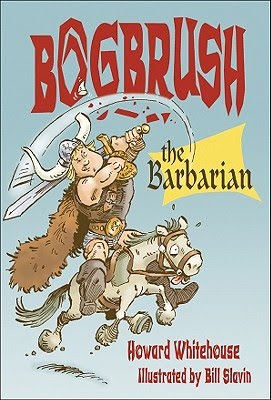
Bogbrush the Barbarian

by Howard Whitehouse (Illus. by Bill Slavin)
ages: 9+
First sentence: “The July snow was blowing sideways across the frozen plain toward the village.”
Support your local independent bookstore: buy it there!
Review copy sent to me by the author

Because I am not a 10-year-old boy, nor have I ever had a 10-year-old boy (or am likely to), I have completely missed out on the whole sub-genre of 10-year-old-boy books. You know them: Captain Underpants and the like. As a result, I’m not that versed in the world of fart and poop jokes. (Probably a good thing…) This book falls into that category (though it’s pretty light on the fart and poop jokes), and much to my surprise (or not, since I’ve loved other books by Howard Whitehouse) I thoroughly enjoyed it.

We follow the (mis)adventures of one Bogbrush (the Barbarian), who’s off to become a Hero. After a quick stop at the Temple of the Great Belch in order to become a Certified Barbarian, he sets off in search of a Quest. He bumps into Diphtheria and Sneaky, who are off to see if they can remove the Great Axe from the Stone and become the true king of Scrofula. Sounds like an adventure Bogbrush — who’s not too bright — can handle. Of course, they will run into a few other obstacles before they get to the Big City, and while things don’t really turn out happily-ever-after, they don’t turn out too badly either.

But, obviously, this book isn’t about the plot. It’s about the gags, the gimmicks, and Whitehouse (with able — and ample — assistance from Slavin’s illustrations) gives us that in abundance. My personal favorite was the parenthetical comments under the chapter headings; the author uses hands and toes to count up from one to twenty (well, chapter 9 reads, “This would be both hands raised if I had lost a finger like Uncle Bob who had that unfortunate accident with the bacon slicer.”); after twenty they become insanely hilarious, counting all over the map (21 gets used a few times, an Chapter 9 makes a reappearance). I found myself looking forward to a new chapter, just so I could see what was going to happen next in the parenthetical comments.

Additionally, the author gives us an “education”, with sidebars in every chapter explaining definitions of words and customs, as well as general “things to know”. And, since this is a humor book, they are (of course) only mostly serious.

Word of the Day: invoke — to call upon a god, as in “O great God of Homework, make that which I did on the bus this morning suffice for a passing grade.”

or

Vocabulary to Learn: Brigands, outlaws, footpads, and bandits are the same thing — groups of unpleasant criminals who hide in the wilds and jump out on honest passersby. And not just to say “Boo!” either.

It’s not deep, it’s not even a particularly compelling story, and it kind of just runs out of steam at the end. But it’s 10-year-old boy funny, and that’s really all that matters.