

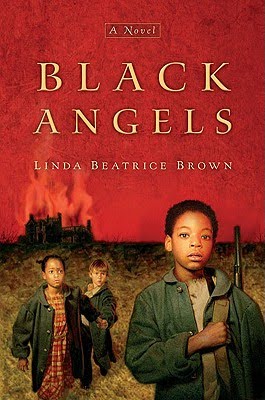
 by Linda Beatrice Brown
ages: 10+
First sentence: “Luke took the key out of the sideboard drawer in the dining room, took a rifle and put the key back very carefully.”
Review copy provided by the publisher.
Support your local independent bookstore, buy it there!
Fiction about children during wartime is pretty overdone, in my humble opinion. Do we really need another book that illustrates the horrors of war, the trials that the children go through, the pain of separation? Probably not. But in this case, I’ll make an exception: Brown’s book takes the generic child-in-war story and moves it beyond the cliche to something else. Something more gripping, more lyrical, more — dare I say it? — poignant.
Luke is twelve years old. He hates his master, he hats the South, and he is running away to join the Union and fight to end slavery and free his people. Daylily is ten. She’s been freed by her master, but in the journey north with her Gramma and Buttercup (whom we never really find out much about), the two are brutally murdered. We’re never quite sure if they’re murdered by Union or Confederate soldiers, but the fact of their murder renders Daylily silent and bruised. She’s lucky to be left with her life, and she knows it. Caswell is seven, and he’s the son of a wealthy landowner who’s off fighting for the Confederacy. He’s lost in the woods, trying to find a neighbor’s house and his Mamadear who was carted away in the night because she was in labor.
The three manage to meet in the woods, going north, and make an unlikely trio. Yet dire circumstances make strange bedfellows. And when they meet Betty Strong Feet, things get even more unusual. The three children learn about survival, and working together, but most of all about love and friendship in the face of adversity.
The plot arc is huge: not only do we follow the children through the few months during their time in the woods and with Betty, but we follow their paths for the ten years after they got separated. This didn’t quite work for me: I felt that the book got preachy and too altruistic near the end; on the one hand, it was important to see how the children had changed because of their experiences together, but — on the other hand — perhaps it would have been nice to leave that to the imagination.
Minor quibble with the ending aside, the book was lyrical, descriptive and quite powerful. A fresh look at a overdone subject.
(Just for the record: because this is a Cybils nominee, I’ve been asked to make sure y’all know this is my opinion only, and not that of the panel.)
 The Book Nut