Library Loot #38

There were Christmas books and movies out on display at the library today. Last time I checked, it’s not even October yet.

What is this world coming to?

Or, better yet: where has the year gone?

For A/K:
My Goldfish, Barroux
Miranda’s Beach Day, by Holly Keller
Hook, by Ed Young
Baby Baby Blah Blah Blah!, by Jonathan Shipton/Illus. by Francesca Chessa
Mrs. Muffly’s Monster, by Sarah Dyer**
The Bold Boy, by Malachy Doyle/Illus. by Jane Ray
Strega Nona: Her Story, by Tomie dePaola**
Big Wolf and Little Wolf, by Sharon Phillips Denslow/Illus. by Cahtie Felstead**
The Dumb Bunnies, by Sue Denim/Illus. by Dav Pilkey

For C:
She’s still working on OOTP, but I picked this one up for her, anyway.
Roman Diary: The Journal of Iliona of Mytilini: Captured and Sold as a Slave in Rome – AD 107, by Richard Platt and David Parkins

For M:
Brutal, by Michael Harmon
Prophecy of the Sisters, by Michelle Zink
The Amazing Maurice and His Educated Rodents, by Terry Pratchett
Shine, Coconut Moon, by Neesha Meminger*

For me:
Sweetness in the Belly, by Camilla Gibb
The roundup is either at Reading Adventures or A Striped Armchair.

*Ones that M eventually read.
**Picture books we really liked.

September Jacket Flap-a-thon

Just a quick reminder before we get into this month’s jacket flap-a-thon: the nominations for this year’s Cybils awards open tomorrow. Go make a nomination: the more, the merrier, and you know you don’t want your favorite book to be left out!

On to this month’s reading:

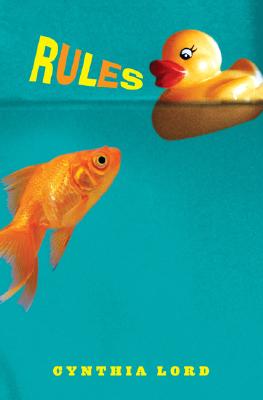
Rules (Scholastic): “No toys in the fish tank. Twelve-year-old Catherine just wants a normal life. Which is near impossible when you have a brother with autism and a family that revolves around his disability. She’s spent years trying to teach David the rules from “a peach is not a funny-looking apple” to “keep your pants on in public” — in order to head off David’s embarrassing behaviors. But the summer Catherine meets Jason, a surprising, new sort-of friend, and Kristi, the potential next-door friend she’s always wished for, it’s her own shocking behavior that turns everything upside down and forces her to ask: What is normal? Filled with humor and warmth, Cynthia Lord’s debut novel takes a candid and sensitive look at feeling different and finding acceptance — beyond the rules.”

I thought this captured the spirit of the book — humor and tenderness and all — while making it intriguing enough that someone would want to pick it up.

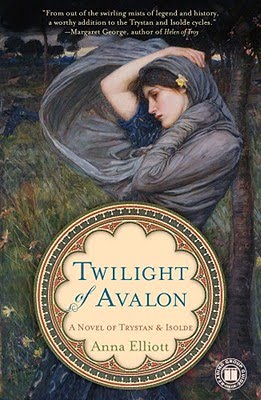
Twilight of Avalon (Touchstone): “Ancient grudges, old wounds, and the quest for power rule in the newly widowed Queen Isolde’s court. Hardly a generation after the downfall of Camelot, Isolde grieves for her slain husband, King Constantine, a man she secretly knows to have been murdered by the scheming Lord Marche — the man who has just assumed his title as High King. Though her skills as a healer are renowned throughout the kingdom, in the wake of Con’s death, accusations of witch craft and sorcery threaten her freedom and her ability to bring Marche to justice. Burdened by their suspicion and her own grief, Isolde must conquer the court’s distrust and superstition to protect her throne and the future of Britain. One of her few allies is Trystan, a prisoner with a lonely and troubled past. Neither Saxon nor Briton, he is unmoved by the political scheming, rumors, and accusations swirling around the fair queen. Together they escape, and as their companionship turns from friendship to love, they must find a way to prove what they know to be true — that Marche’s deceptions threaten not only their lives but the sovereignty of the British kingdom. In Twilight of Avalon, Anna Elliott returns to the roots of the legend of Trystan and Isolde to shape a very different story — one based in the earliest written versions of the Arthurian tales — a captivating epic brimming with historic authenticity, sweeping romance, and the powerful magic of legend.”

It’s a little misleading — it made me think it was more of a romance than it was — but otherwise, a good picture of the plot without giving too much away.

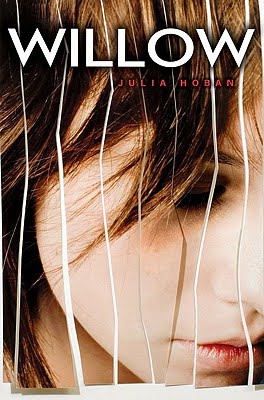
Willow (Dial Books): “Seven months ago on a rainy March night, Willow’s parents drank too much wine at dinner and asked her to drive them home. But they never made it — Willow lost control of the car, and both of her parents were killed. Now seventeen, Willow is living with her older bother, who can barely speak to her. She has left behind her old home, friends and school. But Willow has found a new way to survive, to numb the new reality of her life: She is secretly cutting herself. And then she meets Guy, a boy as sensitive and complicated as she is. When Guy discovers Willow’s secret, he pulls her out of the solitary world she’s created for herself, and into a difficult, intense, and potentially life-changing relationship. Julia Hoban has created an unflinching story about cutting, grieving, and starting anew. But above all, she has written an unforgettable tale of first love.”

I thought this was nearly perfect: captured the intensity and desperation, and the whole bit about it being unforgettable is spot-on.

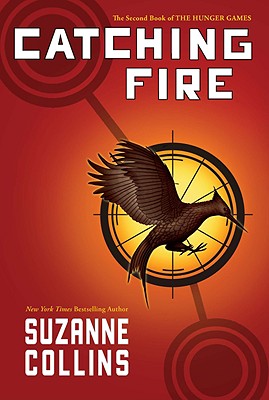
Catching Fire (Scholastic): “Sparks are igniting. Flames are spreading. And the Capitol wants revenge. Against all odds, Katniss has won the Hunger Games. She and fellow District 12 tribute Peeta Mellark are miraculously still alive. Katniss should be relieved, happy even. After all, she has returned to her family and her longtime friend, Gale. Yet nothing is the way Katniss wishes it to be. Gale holds her at an icy distance. Peeta has turned his back on her completely. And there are whispers of a rebellion against the Capitol — a rebellion that Katniss and Peeta may have helped create. Much to her shock, Katniss has fueled an unrest she’s afraid she cannot stop. And what scares her even more is that she’s not entirely convinced she should try. As time draws near for Katniss and Peeta to visit the districts on the Capitol’s cruel Victory Tour, the stakes are higher than ever. If they can’t prove, without a shadow of a doubt, that they are lost in their love for each other, the consequences will be horrifying. In Catching Fire, the second novel of the Hunger Games trilogy, Suzanne Collins continues the story of Katniss Everdeen, testing her more than ever before… and surprising readers at every turn.”

Had to include this one… how do you write a blurb about one of the most anticipated books of the year and not give anything away? This is how.

Other books I read this month:
Just Listen
Faith, Hope and Ivy June
Babymouse: Dragonslayer
The Beef Princess of Practical County
The Moonstone
Perfect Chemistry
From Cover to Cover
Dreaming Anastasia
The Great Stories and Poems of Edgar Allan Poe
A Finder’s Magic
The Princess and the Bear
My Life in Pink and Green
The Conch Bearer
The Purloined Boy (DNF)
Tess of the d’Urbervilles

2009 Challenge #4: Classics Challenge

I finished another challenge! (I have not had a good track record this year…) For the Classics Challenge, I read:

My Antonia, Willa Cather
The Woman in White, Wilkie Collins
Tess of the d’Ubervilles, Thomas Hardy
Anecdotes of Destiny and Ehrengard, Isak Dineson

And for the snack, I read Atonement, Ian McEwan

Out of them all, I think I liked the Willa Cather best, but it was good to delve into some headier books. I should read more classics more often. 🙂

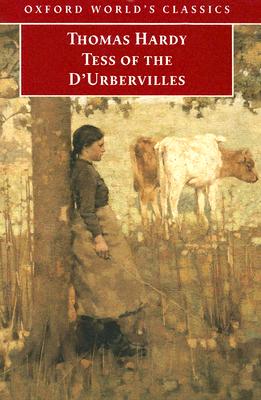
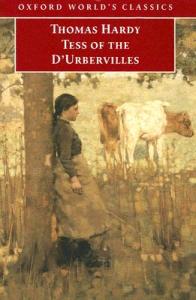
Tess of the D’Urbervilles

by Thomas Hardy
ages: adult
First sentence: “On an evening in the latter part of May a middle-aged man was walking homeward from Shaston to the village of Marlott, in the adjoining Vale of Blakemore or Blackmoor.”

Men are jerks.

Really.

That’s basically the bottom line that I got from this book, the one that I stomped around the house growling about, that I vented on the phone to a friend about, once I finished the book.

Men — all men, from fathers to lovers — are just basically going to take a woman’s innocence, their good hearts, their good will, and stomp. all. over. them.

Cheery, isn’t it?

For those who are unfamiliar with this classic, Tess Durbeyfield is part of the Victorian working poor — oldest daughter of a lackadaisical farmer. When her dad inadvertently finds out that he’s a decedent of a noble family — the d’Urbervilles — he decides (practically pushes out the door) to send his daughter to a branch of the family who lives in a nearby town in order to beg them for money.

Male jerk #1.

Tess, being the kind, good, loving daughter that she is, does her father’s (and mother’s — she’s not much better!) will, and heads out. There she meets Alec: pretty boy, ladies man, and who is completely and utterly smitten with his “coz”. (Because as these things go, Tess is not only pure, but beautiful as well.) He pursues her very aggressively, and while she’s able to withstand his advances for quite a while, eventually he rapes her. Or at least, that’s how I see it.

Male jerk #2.

A short while later, Tess up and leaves the house and ends up back at her parents’ place. She gives birth and while the baby dies shortly thereafter (a very touching, passionate scene with her desperately trying to get the baby baptized before it dies), she’s determined to move on with her life. Fast forward a couple of years, and she gets a job at a dairy farm where Angel Clare is working.

A bit about Angel — he’s a gentleman’s son, and an enlightened Soul. He was meant for the Church, but unable to commit because of a lack of faith. And so, he decides to be a gentleman farmer, setting about visiting farms to get training. He falls head over heels in love with Tess, because of her purity and earthiness. She tells him she’s no good for him, that it would be better for him to marry one of the other dairymaids. He persists, and eventually she gives in (either these guys were REALLY persistent, or she really didn’t have much of a backbone), agreeing to marry him. On the wedding night, they decide to be confessional (word of advice: the wedding night is not a good time to be confessional). Angel confesses to having a short affair, whereupon Tess gets hopeful: perhaps he will be sympathetic to her plight. So, she tells him about her past.

Male jerk #3.

Actually — at this point, I don’t know who I was more incensed at: Alec for abusing and using Tess for his own personal pleasure or Angel for being such a merciless hypocrite. I had to put the book down for quite a while (a day or so) before I could deal with the story again.

Tess is totally the victim here, and it’s very frustrating for me as a reader to experience that. Especially since Tess is really the only sympathetic character in the novel. All that said, Hardy is a brilliant writer; engaging, descriptive, gorgeous language. And able to span all the emotions — from love to hate to disgust; he’s a master. The rest of the book is totally downhill, of course. A criticism of Victorian society and norms and a portrait of good intentions gone horribly wrong couldn’t have a happy ending.

That said, I’m not sure I’m going to run out and get more Hardy any time soon. Unless someone can convince me that it’s not full of horrid men. Because, I’m not sure I can handle much more of that!

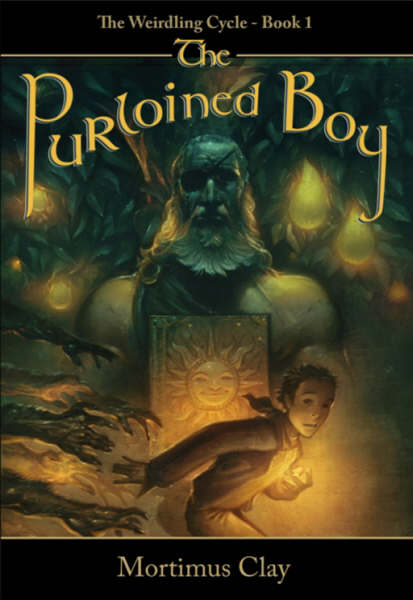
The Purloined Boy

by Mortimus Clay
ages: 9-12
First sentence: “All the doors were locked, all the windows were latched, and everything was perfectly secure the night the bogeyman came.”

The premise for this book is an interesting one: a boy, Trevor, lives in a world where bogeymen are real. They are your friends, they know what’s best for you. Except Trevor keeps having dreams about a time before, a time when he had parents, when he was truly happy. One day, he mentions this in class, and suddenly his world changes: he’s whisked away, and in order to avoid Certain Doom, he must find a way to escape.

And it sounded like it would have a Lemony Snicket feel to it, since the author — one Mortimus Clay — is “the most prolific author writing posthumously in the world today. The modest Clay is not given to sweeping generalizations, but he has this on the highest authority.” A dead author writing kids books? What’s not to love?

Well… lots.

I tried to read it. Really, I did. Picked it up and put it down at least a half-dozen times. And every time, I would look at the words, I would try to get into the story, but it eluded me. I tried to get past the stilted dialogue and the clunky sentences, and find the good story in there, but it eluded me, too.

So, about 100 pages into the nearly 250 page book, when nothing remarkable had happened (and yet, I was left with a feeling — that did not elude me — that something remarkable *should* have happened), I bailed.

Hopefully, since the author is dead, he won’t mind the negative review.

Sunday Salon: Double Booking

Look at me: participating in Sunday Salon!

It’s a dual thing this morning… a response in Suey’s recommendation that I blather more and a column in this morning’s paper about reading only one novel at a time. The author, Lisa McLendon, wrote about how she finds it difficult to read multiple books, commenting:

Confusion aside, reading multiple books at once seems to me to give short shrift to all of the books involved. You can’t give your undivided attention to a book if another book beckons from the coffee table, competing for your eyes. Plus, when a novel transports you to another place, placing you inside another person’s life, it feels almost like two-timing to delve just as deeply into something else.

She ends the piece by asking for responses: how do those of you who read multiple books do it?

I have to say that for many, many years I was on the same page as Lisa: I only read one book at a time, savoring it fully to its conclusion (whether it was good or bad) before moving on to another one. And, honestly: for the most part, I still do that. I’m not a serial double-booker (or triple-booker), I do feel like I should give each book its due; that the time the author put into writing it is deserving of the time I can put into reading it.

However… lately (meaning the last couple of years), that’s not always been the case. Partially, it’s due to book blogging: there are now so many more books I want to read and not enough hours in the day, that I feel almost compelled to double book. But I do it carefully. Take the last couple of weeks, for instance.

I decided to pluck Tess of the d’Urbervilles off my pile. I started reading, trying to get into the language and plot and characters of the dense Hardy novel. Then, I popped by the library and saw that this years’ big read was Edgar Allan Poe. I figured, what the heck, why not pick that up, to. Except that it was a 14-day check-out, as opposed to the usual four week. So, it got bumped to the top of the pile. I didn’t want to give up on Tess, and I needed to read Edgar… so I alternated. I’d read one story of Poe’s (or a couple of poems), and then a couple of chapters of Tess. Then, because all that 19th-century language (and depressing plots) was dragging me down, I complimented them both with a bunch of YA and Middle Grade novels.

So, my reading went like this: one Poe story, two or three chapters of Tess (I’m almost done with it!), half of a contemporary novel. Lather, rinse, repeat.

But how did I keep them all straight?

Partially it’s because when I double- (or triple, in this instance) book, I choose novels that are so far removed from each other they’re easy to keep straight. I’m not going to go confusing plots from a Poe story with the drama in Tess’s life with the middle-grade Indian fantasy. I think that’s crucial, actually: as Lisa pointed out in her piece, if you pick two books (they don’t have to be novels) that are similar in any way, then the tendency to get them confused will be stronger.

It would also help if I took notes on the book — I have noticed that when I double-book too closely, my posts are not as detailed (or as good) as when I only read one at a time.

But, until my reading list gets shorter, or someone invents a way to have 26 hours in a day (with the extra two devoted entirely to reading!), then double-booking is the only way I’m going to get through all the books I want to.

What about you? Do you double-book? If so, how do you manage it? If not, why not?

My Life in Pink and Green

by Lisa Greenwald
ages: 10+
First sentence: “Things can always be worse.”

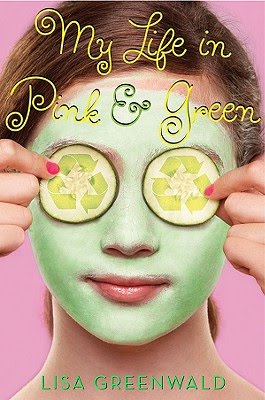
This looks like a very girly book. Pink background, face mask (or is it masque?), cucumber slices: you think it’s going to be frills and parties and giggles.

Except, it’s not.

Sure, Lucy Desberg loves makeup, and wants to be the next Laura Mercier (who, thanks to Google, I found out is a real person), but she’s no girly girl. She’s a smart 12-year-old who loves to help out at her family’s pharmacy — which is slowly failing due to a myriad of factors — and who becomes interested in going green. Sure, there’s seventh grade stuff: her best friend develops a crush on a boy and gets all weird about it, but really it’s about Lucy’s business sense and the fact that kids can Do Things To.

If only the stupid grownups will stop shouting at each other and listen to her.

It’s a cute enough plot, and Lucy and her friends are a likable enough characters (the book falls into the “parents are idiots” trap, which was distracting). Combining saving a business and saving the earth with makeup and beauty tips is a unique idea, though it kind of screamed: “Hey girls! You can be environmentally aware AND cute at the same time! See how easy it is?!” Overlying message: you CAN be smart, aware, AND be into makeup. They are not mutually exclusive. Which, I suppose, is a halfway decent message.

However, one does have to wonder how good a book really is if the favorite thing, when all is said and done, are the beauty and business tips at the beginning of each chapter. Those, I really liked (found myself wanting to write a couple down; what does this say about me?). Even though there wasn’t anything that really grabbed me about the book, it was a good debut novel. And I’m sure there are smart girls out there who are just dying to know that its okay to like makeup. (And vice versa.)

Okay, then. Off to paint my toenails.

The Conch Bearer

by Chitra Banerjee Divakaruni
ages: 10+
First sentence: ” Anand shivered as he carried a heavy load of dirty dishes from the tea stall to the roadside tap for washing.”

Once, Anand had everything he thought his heart could desire. He went to school, his family was happy living in Kolkata, India. Then his father lost his job, and headed to Dubai to get work. Eventually, the money stopped coming, and Anand and his mother were forced to take work. His sister slowly retreated into herself, until all three were just barely scraping by.

Then one day, Anand, in a fit of desperation, silently pleaded for someone — anyone! — to help him, and an old man showed up. Being the kind-hearted person he is, Anand helped the old man, and in return the old man — who is a Master in the mysterious Brotherhood — offered Anand the chance of a lifetime: to aid him in carrying the sacred conch shell back to the Silver Valley. There would, of course, be dangers along the way — a corrupt Healer named Surabhanu is after the shell’s power — and, of course, Anand would be tried and tested in ways he could never imagine.

There’s fantasy, and then there’s epic fantasy: the journey against incredible odds that our hero has to take, succumbing to temptations and betrayals, passing tests and trials, learning and growing until he becomes something greater than himself. Sure there’s magic (not the least of which is a “talking” conch shell) — though of a more mystical sort — and danger — natural and supernatural — and battles — which is to be expected — but mostly it’s about Anand and his growth and learning process.

All this gave the novel a formulaic feel, but perhaps because it was set in India or perhaps because Divakaruni is an intriguing storyteller, it rose above the fantasy cliches that were littered throughout and became an intriguing read.

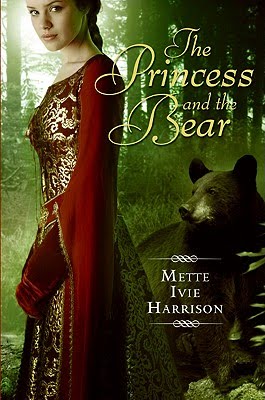
The Princess and the Bear

by Mette Ivie Harrison
ages: 12+
First sentence: “Long ago, there lived a wild cat that was the sleekest, fastest, and bravest of its kind.”

One of the things I like best about sequels and series, especially in fantasy books, is getting to visit the world the author imagined again. Especially when the world is as fascinating as the one that Mette Ivie Harrison has imagined.

The Princess and the Bear follows the story of the Hound and the Bear from the end of The Princess and the Hound. Told through alternating chapter narratives, the book tells the story of the two unlikely companions who find solace in their togetherness, until the spread of unmagic threatens to destroy their comfortable — if lonely — life. They journey to the wild man, the one person who can aid them in righting this horrible wrong. The wild man sends the Hound and the Bear back to a point in time when the magic is overly volatile, to deal with and stop the source of the unmagic. It also happens that this point in time is when the Bear was a human: King Richon, a spoiled brat of a king who was used and taken advantage of by his evil advisers. It’s up to him, with the aid of the Hound — now a human, Chala — to find the source of evil, right the wrongs that Richon did before spending 200 years as a human, in order to fix the future.

The best part of this novel, much like the first one, was the words. Harrison paints a gorgeous picture of the world she’s imagined. It’s also a thoughtful book, one in which the reader does not plow through, but instead lingers over the pages soaking in the atmosphere. Yet, for all its flowingness and thoughtfulness, Harrison is a writer for a particular sort of person, someone who is willing to take a slower, quieter pace and enjoy the words instead of the characterization and plot. There’s very little action, there’s very little romance (like the first book, it grows slowly, so much so that you almost miss it). There is a definite character arc, but, again, its something that will sneak up on you, almost without you knowing. It’s not exactly something that will keep you on the edge of your seat. The evil guys aren’t that scary, the action isn’t that captivating, the romance isn’t that swooning.

Yet, there is something magical in Harrison’s writing. And that’s just enough to draw the reader in and be completely captivating.

Library Loot #37

I’m starting to think I need to be more like Amanda, and ban myself from checking out books. It would make me sad, but I really can’t read them all. Why do I think I can?

For A/K:
Hobbledy-Clop, by Pat Brisson/Illus. by Maxie Chambliss
His Royal Buckliness, by Kevin Hawkes
A Visitor for Bear, by Bonny Becker/Illus. by Kady MacDonald Denton**
Peace Week in Miss Fox’s Class, by Eileen Spinelli/Illus. by Anne Kennedy
Tacky Goes to Camp, by Helen Lester/Illus. by Lynn Munsinger**
Henry’s Night, by D. B. Johnson and Linda Michelin
Pennies for Elephants, by Lita Judge
Itty Bitty, by Cece Bell**

For C:
She has decided to read (actually read) Harry Potter and The Order of the Phoenix. So she has requested no more books from the library for the time being. She, at least, has self-control.

For M:
Gifts, by Ursula K. LeGuin
The Key to the Golden Firebird, by Maureen Johnson (I’ll have to read this one, too. It’s the only one of hers — I think — that I haven’t read.)*
Rhiannon, by Vicki Grove
Tithe: A Modern Faerie Tale, by Holly Black*
Ironside: A Modern Faery’s Tale, by Holly Black*
Valiant: A Modern Tale of Faerie, by Holly Black (Score! All three books in this series were in. I couldn’t resist.)

For me:
The Princetta, by Anne-Laure Bondoux
Tender Morsels, by Margo Lanagan
Mission Control, This is Apollo: The Story of the First Voyages to the Moon, by Andrew Chaikin and Alan Bean

The roundup is either at Reading Adventures or A Striped Armchair.

*Ones that M eventually read.
**Picture books we really liked.