

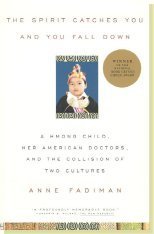
 by Anne Fadiman
ages: adult
First sentence: “If Lia Lee had been born in the highlands of northwest Laos, where her parents and twelve of her brothers and sisters were born, her mother would have squatted on the floor of the house that her father had build from ax-hewn planks attached with bamboo and grass.”

This book is incredibly complex, which makes it a difficult book to write about. It’s a medical tome — I now know more than I ever thought I would (not having any kids with epilepsy) about seizures and medical procedures of the early- to mid-80s. But it’s also a work of cultural observation — I now know more than I ever thought I would about Hmong history, religion, and culture. But what this book is, more than either of those things, is a testament to what happens when good intentions go bad because of cultural differences.
Lia Lee, daughter of Hmong immigrants, was eight months old when she first started seizing. Her parents (somewhat unusually for Hmong, who notoriously don’t trust American doctors), took her to the hospital. And there, her saga starts. There is time after time of misunderstanding, miscommunication (lack of interpreters only played a role in that), and tragedy after tragedy in the life of this little girl. What impressed me most (and this is something that I’ve heard often associated with this book) is that Friedman does an admirable job of portraying both sides — both the doctors’ and the parents’ attempts and efforts at helping Lia get better. I did feel, fairly often, that Friedman was more sympathetic to the Lees’s side of the story, but she does give the doctors (who often come off as arrogant jerks) equal time — both of her own in doing the research as well as in the book.
I often thought while reading it, too, that I was a bit of an outsider. That the people who really ought to be reading this are not lay readers, but rather doctors, social workers, adminstrators: people who could learn from the lessons that Friedman puts out in this book (not that I can’t learn about the Hmong — granted, I don’t know if there are any here in Wichita — but I’m not in a position to put that knowledge to use). It is a fascinating read, though (even if it was one of those dip in-dip out books — read a chapter or two, read a whole other book — types), and the lessons about respect for others’ culture, beliefs and traditions is a valid one.
 The Book Nut
I thought this book was just fantastic. I’m glad you found it a worthwhile read. 🙂
LikeLike
I’ve not heard of this book until your review. Sounds interesting!
LikeLike
I read this book a couple of years ago. I think it should be required reading for any health care professional.
LikeLike
I’m glad you liked it- I’ve read it a couple of times and think that it’s quite profound. Actually, it is required reading in some medical schools these days.
LikeLike
I’m glad to hear it’s required reading in some medical schools, Sarah. I do wonder how the medical professionals are taking it, though. She’s not exactly friendly to the US medical profession.
LikeLike
I just saw this book on the shelf at my brother’s house and was wondering whether I would like it or not. Interesting to hear what you thought.
LikeLike