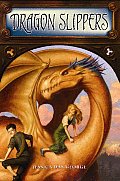
Dragon Slippers

I’ve heard the buzz on this for a while (as with many of my books), though I’m not quite sure what made it go from the TBR list, to the active “I’ve put a hold and am just waiting for it” pile. It’s been a while in coming; there’s a lot of Jessica Day George fans out there, and I’ve had to wait my turn.

I’m glad I finally got to bring it home.

It’s a lovely cross between Patricia Wrede’s Enchanted Chronicles series — spunky anti-heroine, who doesn’t need any rescuing and is more than willing to make friends with dragons, not to mention the plucky younger son of the king — and an Anne McCaffrey-like world creation. Dragons and humans are at odds, though not violent odds, due to a long-ago king using the dragons (against their will) to fight (and win) a war against a neighboring country. Throw in some Robin McKinley-esqe home-spun elegance (our anti-heroine, Creel, has a beautiful talent for embroidery), and you’ve pretty much got Dragon Slippers in a nutshell.

It’s not a deep or heavy book, though there are some tense moments, as well as a few ethical quandaries. Creel’s “enemies” were twits rather than malicious until near the end, so it was difficult to actually feel anything other than annoyance for them. Even when they betray Creel’s trusts. I think the reason I liked this book was for the world creation. I loved the dragons, their personalities (they don’t hoard gold — at least not all of them. They all have their individual “collections”), and the way they came to like and respect Creel. It wouldn’t have been enough to make a book work for me, though, if that’s all I liked. Creel was — like Cimorene in Enchanted Forest and Menolly in the Harper Hall triology — spunky enough and sympathetic enough to carry the book.

Which makes it a delightful way to spend an afternoon.
The Painted Drum

This is me exercising my right to give up on a book that I just am not enjoying.

This is me giving up on trying to enjoy Louise Erdrich’s books (this is the second one I’ve disliked).

This is me not writing what I really think about this book (though Hubby dared me to).

I had fairly high hopes for this one. I know I didn’t like Birchbark House, but I figured maybe it was that because Erdrich is usually an adult-fiction writer, that she just didn’t quite know how to write well for kids. It’s not that she doesn’t write well — some of her passages were quite beautiful. It’s just that there was nothing else. And after a while I lost interest in the whole first section — the story of Faye and how she came to have the drum. So, I skimmed to the second section, the story of how the drum came to be, hoping that it would be better. It was, but only marginally. And not enough for me to even care about the last two sections of the book. I wasn’t moved, I wasn’t touched, I wasn’t captivated.

So, I abandoned it. I’ve got better things to do with my time.

Cybils

Not exactly a new announcement (sorry, preschool was here today, and I spent the morning dealing with annoying active four year olds), especially for the kidlit bloggers. But for the rest of you: The winners of the Cybils (the awards nominated by readers and chosen by bloggers) were announced today. I’ve read two, heard of a few more, but only one really caught my attention: The Professor’s Daughter, which won for YA graphic novel. It sounds fascinating. At any rate, head over there and check them out.

The Sisters Grimm: The Fairy-Tale Detectives

After finishing Matilda, C — being swayed by M’s recent discovery of and enthusiasm for these books — begged to start the Sisters Grimm, by Michael Buckley. And we’re both glad we did; it was a whole lot of clever fun.

Sabrina, age 11, and Daphne, age 7, were orphaned a year and a half ago and have been bumping around foster homes ever since. Until they get sent to Ferryport Landing to live with their supposed grandmother, Relda Grimm. It’s there that they learn the truth: the Grimms are not collectors of tales, but rather historians of the true events that people call “fairy tales”. The characters are real. The events are real. Daphne buys into it right away, but it takes Granny Relda (and her companion, Mr. Canis) being kidnapped by a giant to convince Sabrina. There’s a daring rescue, betrayal, and a bunch of fairy-tale insider jokes along the way.

C ate this one up. She was actually reminding me — begging me! — to read every night. She didn’t want me to stop, especially if the chapter ended with a cliff-hanger (which they often did). She made me swear that I wouldn’t read ahead (I was good), and then asked questions about how it was going to turn out. She begged information off of M (who would listen in and make cryptic comments now and again — she’s read all 5 and knows more of the story than we do), who was pretty good about not giving C too much. It was exciting and fun to read (more accents!) and very well-written, too.

We’ve got the second one on hold… and are waiting eagerly to see what happens next with Sabrina and Daphne.

The Carnival of Awesomeness Totally Rocks (And other Announcements)

The February Bookworms Carnival is up over at Renay’s, and she totally and completely outdid herself. Go check it out. Be amazed. Worship the ground she walks on (well, maybe not that… but you could comment). As a brief reminder, next month’s carnival is being hosted by The Armenian Odar Reads. Her theme is Women in Literature, and you can send posts by March 14th to armenianodar at yahoo dot com.

I also did the drawing for the Expanding Horizons contest on Saturday (I should have taken a picture of C pulling a piece of paper out of a basket)… and the winner was BECKY. She chose the Whale Rider pack and Thin Mints (yum!). Congrats! (I thought about complaining about how few people participated — there was only 4! What the heck? — but I’ll refrain. Just barely.)

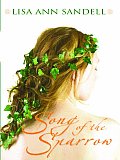
Song of the Sparrow

I loved this book.

Sure, I have a bit of a soft spot for books about the Arthurian legend, and so I would have probably liked this book anyway. But, it was a beautiful story, a captivating take on the legend, masterfully written.

It’s written in free verse, and I couldn’t imagine it being done any other way. The simplicity of the text brought out the story, the emotions, the choice of words that much stronger. And because of that, they — and the story — resonated in a way that longer, more detailed works haven’t.

Lisa Ann Sandell takes a new perspective on the story, writing it from Elaine’s point of view. (She’s the infamous Lady of Shalott; if you’re good, you will have read Tennyson’s poem. If you’re like me, you will mostly know her from Anne of Green Gables.) Elaine’s mother died 8 years ago, and ever since then, she’s lived with her father and brothers in the war camp. Lancelot is her hero, her friend, as is all the rest of the men: Arthur himself, Gawain, and (in an intriguing, and brilliant, twist) Tristan (from Tristan and Isolde). Elaine’s happy enough, spending her days mending and healing and being in nature. And then life changes: Arthur becomes the dux bellorum (the war chieftain), and Gwynivere arrives.

It’s a simple enough plot, but between the characterizations (I had tears streaming down my face at the end), and the elegance of the poetry, the book is a captivating read.

I really have only one complaint: the cover. It’s a beautiful enough cover, but I became annoyed with it because of both the description on the blurb (“Elaine has a temperament as fiery as her long red hair”) and this passage:

Eyes of hazel-green like forest ferns
and mud,
and long, thick hair my father once told me
was the color of wheat and summer strawberries.

I ask you: does that girl have hair the color of wheat and summer strawberries? No. She has dishwater blonde hair, the color mine was in high school. This is wheat and summer strawberries:
I do have to admit that it wouldn’t bother me as much if I didn’t have a red-haired daughter. Still, I won’t let the cover get in the way of highly recommending this book. It truly is wonderful.

The Year of Living Biblically

I’ve had my eye on this for a little while; I know it’s been making the blog rounds where it’s been getting overwhelmingly positive reviews. So, when Hubby’s colleague loaned it to us a month ago, I jumped at the chance to skip the hold line at the library and actually read the book.

A. J. Jacobs is a man with a mission, crazy though it might be (especially for an agnostic, secular Jew): to live the teachings of the Bible — all of them — as literally as possible for an entire year. He grows a huge beard, he wears white, he dances with joy, he sacrifices an animal (well, pays to have one sacrificed), he prays… the list goes on.

It’s an ambitious project, as Jacobs soon finds out; he’s attempting to do in one year what most people don’t accomplish in a lifetime. But he’s game, almost naively so, to give it a try. And the result is a funny, fascinating, enlightening book.

Jacobs spends eight months of the year exploring the Old Testament/Hebrew Bible, partially because he’s Jewish (at least by heritage) and partially because so much of the Bible (comparatively speaking) is made up of the Old Testament. It’s an interesting journey, full of bumps and starts and failures and revelations. I thoroughly enjoyed his journey with prayer; being reminded, in the process, of things that I could be doing better. I enjoyed his experiences with the weirder aspects of the Bible (like not wearing mixed fibers), and his
ultimate realization that sometimes you do things just because God asked you. I liked the New Testament part less, mostly because — and Jacobs admits that this is a problem — without believing in Jesus as the Savior, the New Testament isn’t as easy to follow. Still, he makes a go at it, exploring many facets of Christianity (including snake handlers… go figure) with an open mind.

It helps that Jacobs is a witty, engaging writer, as well as an honest and forthright one (well that is one of the commandments, after all). It’s an excellent read.

Expanding Horizons: February Prize Package

I’m so happy with the way things are going. I’m behind, but I promise I’ll read two books this month (not that you care, but making it public may help me to keep up!)… I’ve really enjoyed reading all the reviews that people have been posting, and my TBR list is growing by leaps and bounds.

So… February’s prize pack (remember I said I had to do several so each of my girls could have a turn drawing for them?) has a Native peoples theme (plus some goodies) and a decision for you to make: either Whale Rider, the movie (because it’s one of my favorites) and Whale Rider the book; or The Absolutely True Diary of a Part-Time Indian, your choice. I’m throwing in a box of Girl Scout cookies (because C is selling them; you have a choice between Thin Mints, Thanks-a-lot, and Lemonades because that’s what we’ve ordered) for good measure, and because we’ll have them around the house.

But you just don’t get this for nothing. The catch: You have one week — until Friday, February 8th, to read and comment on one-third of the reviews that have been posted. That’s 11 people (other than yourself). Then come back here, comment that you’ve done it, and I’ll enter you in the drawing on February 9th.

I’ll open this up to anyone who wants to go and comment, even if you haven’t posted a review yet.

Have fun!

Northanger Abbey

I read this one ages ago, and the one-line summation that currently exists on my blog is this: “I didn’t particularly like this story. Perhaps I ought to re-read it sometime.”

I don’t remember my motivations behind that statement; I went through an Austen phase about five years back, where I read all of her works in quick succession over the winter. Perhaps I was just worn out: too much Austen too fast. Perhaps I was put off by the Gothic novel parody; I hadn’t (and still haven’t) read one of them, so I couldn’t appreciate the joke inherent in Northanger Abbey‘s plot.

Whatever the reason, I’ve been staunchly in the camp that mocks this book, calling it boring and insipid, and not nearly as brilliant as her other works.

I’m here to eat some crow and admit that I was wrong: I like Northanger Abbey.

Why, you may ask? What changed my mind? I think a lot of my change of heart came about because I started this challenge with this one. I was dubious — starting with my least favorite Austen didn’t seem like a good way to begin things — but, being a dutiful reader (and one who is willing to stick with her plan), I decided just to go for it. I came to this book fresh — I haven’t read an Austen book in a long time — and decided to give up my prejudices. The other thing that helped, however, was a very informative and interesting introduction by Claudia L. Johnson. In it, she explains the origins of Northanger Abbey (including Austen’s irritation at the manuscript being bought in 1803, but never published) as well as the jokes inherent in the novel. Because I read the introduction, I was able to more fully enjoy the novel.

And I did enjoy it. I don’t think that it’ll be my favorite Austen novel, but it is a charming little book, a quintessential Austen novel. There’s Catherine, the silly girl, completely oblivious to society around her. Isabella, her “beloved” friend, is the social climber, exchanging both Catherine’s friendship and Catherine’s brother’s honest affections for something more lavish. Eleanor is the perfect, true, honest friend. Henry is charming in his role as the perfect Austen hero: knowledgeable, but not overbearing, falling in love with Catherine for her imperfections rather than in spite of them. The “bad” elements are there, too: there’s John the boor, who went so far as to “kidnap” Catherine for an afternoon, and then became infuriated that she doesn’t return his affections. And General Tilney in the role of the overbearing, disapproving parent who attempts to keep the lovers from happiness. Still, it wouldn’t be an Austen novel without the happy ending, though in this case, it’s incredibly, almost unbelievably, contrived. Maybe it’s more accurate to call this Austen-lite. She became a better writer, delving more deeply into characters and motivations and relationships as she went on, which is why her later books are the ones that are truly the classics. Still, this one is worth digging out and reading every once in a while, if only for the last line:

To begin perfect happiness at the respective ages of twenty-six and eighteen, is to do pretty well; and professing myself moreover convinced, that the General’s unjust interference, so far from being really injurious to their felicity, was perhaps rather conducive to it, by improving their knowledge of each other, and adding strength to their attachment, I leave it to be settled by whomsoever it may concern, whether the tendency of this work be altogether to recommend the parental tyranny, or reward filial disobedience.

Just a Friendly Reminder

Two deadlines today: the deadline for the February Expanding Horizons contest ends at midnight (CST) tonight. Right now, the odds are pretty good, seeing as only 4 people have actually jumped through the metaphorical hoop. (I would just send everyone a little something, but that would deprive C of the pleasure of actually drawing a name!) Also, the deadline for the February Bookworms Carnival (of Awesomeness) is today… get your posts in!