The Sisterhood of the Traveling Pants

There are two types of books that I try to avoid. The first I call the Train Wreck: the book where, pretty much from the start, you know the characters are DOOMED, and it’s just a matter of reading until the end when they all self-implode. Wuthering Heights (I know, some people like the book) was that way for me.

The second is the Soap Opera: those books that read exactly like a soap, and suck me in. I hate being sucked in by things that are, essentially, worthless. Or pointless.

Unfortunatly, Traveling Pants was the latter.

Confession time (ready?): I read, and felt guilty about reading and liking, those horrible (something I recognized while reading them) Sweet Valley High books. Anyone else remember these? I can’t belive (now) that I actually spent time reading them. Traveling Pants is EXACTLY (well almost) like those books. You know the story: four teenage girls have Problems and have to Deal with Life and the Pants give them the Courage to do so.

There are most likely teenage girls out there who love this book and find Truth and Honesty and Inspiration from it.

And the real sad thing is that I was probably one of them.

Good thing we grow up, right?

In the Shadow of the Pali

I picked this one up because of the subtitle: A Story of the Hawaiian Leper Colony. See, my dad served a mission for our church in Hawaii during the late 1960s. Among other places he served — the Big Island, Waikiki, Maui — he served on Molokai and visited the leper colony there. I don’t remember many of the stories he told (another reason to write them down, Dad!), but I do remember that he was very moved by his experiences with the lepers. So, I was curious to see what Lisa Cindrich (who is neither Hawaiian, nor lives there — she’s in Kansas, of all places) would do with their stories.

I thought the book was a really powerful read. It took a while to get in to — it’s based in the 1870s, not long after the colony was established by the Hawaiian government and the main character, Liliha, is not at all sympathetic. Or at least isn’t for a very long time. There were times in the first several chapters that I felt like putting it down and not coming back. Not because it was bad, but because I just couldn’t stomach the anger, or the pain, or the descriptions of the lepers.

The book got better as the story went on. And the anger and hatred are understandable. Cindrich had a Christian woman character, and while at times she seemed cloying, I think in the end she served a good purpose to balance out the anger and hatred Liliha and another character — Kalani — felt for their situation and each other. The most pathetic and depressing character was Pauahi: a woman who let Liliha (who’s 13, I think) live with her, but essentially made Liliha her servant, depriving her of much, not the least of which was food. And she kept saying Liliha should be grateful for all that she does for her. That the condition of the place would drive someone to act like that is truly despicable.

The ending was predictable and somewhat cliche, but I let it go. Even with that, it’s an excellent book.

Memoirs

So, I read two memoirs this week. Well, read one, tried to read the other. Which actually got me to thinking about memoirs and what makes a good one. And yes, my random thoughts were fueled by the A Million Little Pieces debacle, though only in part.

The one I got through — Journey from the Land of No by Roya Hakakian — was an interesting, introspective, delightful yet haunting look at the Iranian revolution through the eyes of a young girl who just happened to be a Jew. I checked it out because it looked interesting (the subtitle is “A girlhood caught in Revolutionary Iran”), but I got something much more than I was expecting. I got reflections on a country changed, reflections on her faith and culture and how they didn’t always mesh. She experienced anti-Semitism, and lived through it. And, interestingly enough considering my last book group, she dealt with the rule to wear head-scarves and her feelings about it (she compared it to a uniform; something which she had to wear, but never quite felt like herself in it). It was beautifully written and an excellent book.

The other — Cursed by a Happy Childhood by Carl Lennertz — wasn’t so great. I liked the premise (or at least the title); if I ever wrote a memoir it’d be something like this. Especially since my childhood/young adulthood was neither traumatic, dramatic or remotely engaging in any way. (Sorry Mom and Dad — happy homes don’t necessarily make good books!) Still, reading the 30 pages I got through in this book was a trial, to say the least. The book tried to be witty and pithy and just fell short, at least for me. No new observations (like “Visit a library; it’s wonderful” or “My daughter is discovering that my music isn’t that bad”). No real insights. I was complaining to my husband, who (very accurately, I supposed) said, “You’re beyond this book. It’s for people who haven’t realized these things.” Yes, but who might that be? Maybe I’m just miffed because he’s already written my memoir (except I’m a woman, who lived in suburbia and will have four daughters instead of only one).

So, what makes an engaging memoir? Is it life experiences — this is where A Million Little Pieces comes in: the bigger, the badder, the more desperate makes for the great book? I know conflict makes the story (it’s only words and fluff without it), but what is it that would drive someone to make up experiences in order to sell the book? Why do we want to read about people’s lives who have been desperate (or sick, or traumatized or whatever) and have overcome? Why do we look at the ones who didn’t, and say, “Well, that’s nice, but I really don’t want to read about it”?

I wish I knew.

Snow: An Update

So, the book group met last night. Interestingly enough, the main comment was: “Can someone explain what’s going on in this book, please?” Many found it dense and unreadable. In fact, out of the 12 of us, only three had the endurance to read the book from start to finish. That said, there was some interesting discussion. One woman compared the book to Nabakov — maybe it’s not supposed to be “realistic”; maybe it’s all an exaggeration to prove a point. Several wondered if it wasn’t really written for the Turks, but rather as a pointed barb at the West. I made my point about not having the right background to enjoy this book, but a woman countered with “But I read to learn new things.” (I didn’t get to make my counter point: well, then, read non-fiction. I’m not sure you’re supposed to learn things from fiction. Or maybe I’m wrong here.) I did get into a heated, though short, argument with a woman where I found myself defending Islam (the requirement to wear head scarves in particular). I agree with some of what she said — that Muslim-dominated countries have a tendency to opress women — but the fact that she was putting it as “all relgion oppresses women, especially Islam” really made me uncomfortable. (I challenged her by saying that she was making broad generalizations about religion. She said, “Damn right I am.” Okay then.) When another woman chimed in with “I’m sure they’re intelligent, but they’re brainwashed” I backed down. I don’t like being told that you have to make a choice between being intelligent and being religious. I don’t feel I’ve been brainwashed, and I consider myself both intelligent and religious. Granted, I’m also American. Maybe things would be different if I wasn’t.

On top of that, we talked about immigrants, language retention, national health care, suicide bombers, and feminism (which led to abortion and what Democrats could do to win an election). Whew.

In the end, though, I still don’t like the book all that much.

I’d like to place an order please

I love catalogs.

(This feels like a confessional. Is there a support group for those of us addicted to ordering-by-mail?)

It’s not that I order a lot of stuff, though I have been known to place an order for something not completely unnecessary just because I love receiving stuff in the mail, much to my husband’s (and our pocketbook’s) chagrin. Mostly I like getting the catalogs in the mail. I know you can order all the stuff over the Internet, but where is the fun in that? It’s convenient when I know exactly what I want, but to just browse (which is what catalogs are for, aren’t they?), it’s not as exciting. I once read someone saying that he (of course) loved to get the Victoria’s Secret catalog — it was, for him, kind of like a secret feminine world that he invented stories about. I can relate (well, not to the Victoria’s Secret thing): every time I get a catalog, it’s like opening a whole new shopping world of fantastically overpriced (usually) but wonderful things.

There are four catalogs that if I had all the money in the world, I’d order everything in: Chinaberry (for the books), Lands End (for the clothes, though I think I like Lands End Kids better), Baker’s Catalog (great cooking supplies), and Pottery Barn/Pottery Barn Kids (mostly for decorating ideas). Every time one of them comes, I drop everything else and spend twenty heavenly minutes looking at all the things I can’t order. Then I spend the next day or so obsessing over said items and fighting the urge to just pick up the phone and order something.

I am not the catalog queen, though. The woman who lived in our house before us was. Over the past four months, catalogs that I’ve never heard of have come in the mail. Along with some forgotten ones, too. And that’s reignited my love of catalogs. I haven’t seen Williams Sonoma for a long time, and I’ve missed it. I enjoyed browsing through the Gaiam catalog, and I’ve been amused at the overpriced clothes at Title Nine (along with the “life stories” of “real women”). There have been others: Sundance, some Hawaiian shirt catalog, and a few wine and cooking ones that weren’t especially memorable. I’ve been good, though, and I haven’t ordered anything.

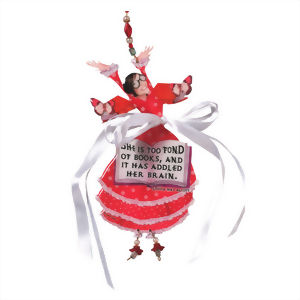
But it made my week when Femail Creations showed up in the mail. I died laughing — this catalog was filled with some hokey, some fun and some incredibly pointless things. Still, I was hooked when I saw this:

The text says: “She is too fond of books, and it has addled her brain.” Louisa May Alcott was supposed to have said it. She may not have. At any rate, I need this. No, really.

I don’t need this, but I really laughed:

And then there’s this:

But not for me. For a friend.

I’d like to place an order, please.

Inkspell

I really wanted to like this one. And… I did. But, I really wanted to like it. And… I just couldn’t.

The second in what I guess is supposed to be at least a trilogy, Inkspell has many problems that either didn’t exist for me in Inkheart, or that I was willing to forgive. This time around, I couldn’t. The story went from being a charming, fun idea — which is what I really loved about Inkheart — to being an adventure story, and a complicated and slow-moving one at that. I should have been suspicious when I opened the book and there was a list of characters with descriptions. Any book with that has the potential to be overly complicated. And it was. At least four major plot lines, too many major characters — with none taking the lead (except perhaps Dustfinger, but not even him, really) — not enough active conflict (though it was lurking in the background), and, in my book the crime of all crimes, no resolution at the end. Okay, I can forgive the last one (do I have to read the NEXT book to find out what happens?!) — it is in a series after all. But, that doesn’t mean the story has to just… stop. It can come to its own resolution, right? Rowling has done it — each HP book has its own ending while keeping the series alive. You don’t have to read book 5 to understand book 6. Not really. But, Inkspell can’t stand alone. There is no ending.

I think the hardest thing was keeping myself interested in the story for most of the book. It took until I was 2/3 of the way through to get interested in it. But, that’s 300 or so pages of writing to wade through to get to the interesting part. Not exactly fun.

Still. I don’t wish for the time back. I think I just wish I could have gotten through it faster.

The Cuckoo Tree

I picked this book up because Julie mentioned Joan Aiken in a post last month, and honsestly, she’s another author I’ve never even heard of. I missed a lot as a child. Surprisingly, our little library had several books by her (perhaps because she was writing in the 60s and 70s?). I checked out a couple. One — Midnight is a Place — I just couldn’t get into. At all. Fell flat after about 20 pages. So, I tried The Cuckoo Tree, and had more success. It wasn’t one of those couldn’t-put-it-down books, but it was enjoyable. Except she wrote in dialect, which is maddening for me as a reader. “Eye thankee for awl yee downe fur mee.” Eek. I know it lends atmosphere, but it’s terribly difficult to get through. At least, for me.

Anyway. I don’t know if I’m going to rush out and get any more of her novels — unless someone highly recommends another one — but I’m glad I at least know who Joan Aiken is now.

Observations on a Writers’ Group

Being an “aspiring” writer (I’m not entirely willing to take on the implications of declaring myself a “writer” yet), I started going to a local writers’ group. I’ve known about it for months (it’s run by the mom of our babysitter), but hadn’t made the time (gotten up the courage?) to go. But, yesterday, I figured it’s a new year, why not give it a try.

There were five of us there (not including my daughter) — four women and one man. Three stay-home-moms, two university professors. Interesting mix.

Observation #1: I hate being the newcomer (excuse why I never go), even though the others made me feel welcome. It’s still intimidating. Everyone already knows each other, and has a history together. I’ve got… a two-year-old who needs to eat lunch (which I brought). Thankfully, my dear sweet daughter wasn’t terribly disruptive (other than displacing the group from the comfortable living room to the not-so-comfortable dining room). If she’d only been less obsessive about the dog and going potty…

Observation #2: What’s it with science fiction writers? The only other person (aside from me; intimidation aside, I brought something to share) who read what they’d written was a sci-fi writer. He’d been working on this story for 2 years or so, and was getting ready to submit it to some contest or another. I don’t want to be cruel, and I have to admit that I was managing my daughter much of the time, but… I thought his story was lame (I obviously didn’t tell him this, not wanting to offend on my first day). There was way too much exposition in my view and not enough action. And when you boil it all down, after 7 single-line spaced typed pages and 45 minutes of reading, there wasn’t much story there. The basic plot: A guy is mad at his neighbor’s wife (because she implicated his daughter in some theft that his daughter didn’t do; the writer had to explain that after), and wants to kill her, but doesn’t but then she dies via breast implant explosion (gross!) and he feels guilty.

Why is it that sci-fi writers feel they can devote all their time to world creation (that’s what most of the exposition was about: wry and slightly humorous observations of his future world) and none to the story? I know, much of science fiction/fantasty is like that. But it seems to me that they would be better served by coming up with a good story — or two or three good world ideas (Card talks about this in his intro to Speaker fo the Dead; how it took two different ideas — that of a speaker and that of an alien race — to make a compelling story) — and then create a world to fit it.

Observation #3: I’m not dealing with people who read children’s fiction. I read my stories — two versions of the same one — and I got comparisons to Barney and illusions to Dr. Seuss. Not that I’m complaining; they did make some valid observations, and some helpful suggstions. But I do have to admit that I was disappointed that their points of reference were so limited. Then again, it’s not like I can give constructive criticism on poetry, so I really have no reason to complain here.

I’m going to go back, in spite of the bad science fiction and lack of children’s writing refrences. I need something to motivate me to write… and there’s nothing like an audience, right? Maybe I’ll even get into the habit of posting observations on our weekly (mostly) meetings here. Could make it even more interesting.

Possession

Admittedly, I am not a huge fan of crictics’ darlings, or even “English Lit” books. I keep trying, though, to broaden my horizons, guilting myself into checking out and reading various classics or critically acclaimed books. And every once in a while, I surprise myself by actually liking the book.

This was one of those times. I hadn’t even ever heard of A.S. Byatt (male or female?) or the book (hey, wasn’t that a movie with Gwyneth Paltrow?) until Laura recommended this one to me. It was slow going at first — I mean, really how much do I want to know about English PhDs in the late 1980s — but as the story progressed, I found myself more and more intrigued and involved in the story. I admit that I skipped most of the poetry (and probably missed out on some plot points, but I survived), but I read and enjoyed the letters, and honestly loved the feeling of discovery and chase. (Look: it’s a thriller for English Lit geeks! My husband commented one night, “Didn’t she kind of make English PhDs look cool?” Well, um, yeah.) Maybe it’s the journalist in me; maybe it’s a buried family historian. I don’t know. But I loved that Roland and Maud were discovering hidden secrets and stories. And I didn’t even mind the twist ending, or the three flashback chapters, though perhaps I would have preferred it all be discovered through the letters.

Granted, it’s not a perfect book in my opinion: too long, too many poems, too many minor characters (that really didn’t DO anything in the end). But, I’d say it was worth the time spent reading it.

Books on my Doorstep

My husband’s brother and his wife gave us gift certificates to Barnes and Noble for Christmas… they must know us well. The package didn’t come until after, but better late than never! We had fun ordering books (since there’s no B&N around here — our town is much too small for that — we used B&N.com) and half arrived yesterday. What fun!

My order came yesterday, and in it was: Inkheart, Dragonsong, Dragonsinger, and Eats, Shoots & Leaves (you can tell where my interests lie!)

What’s still to come (hubby’s order): Speaker for the Dead, Dooms Day Book, and What are People For? (that’s not exactly his interests; if left to his own wishes, there’d be some political and/or philosophy books there… granted, they’re also more expensive…)

The only one we haven’t previously read is the Wendell Berry book, and he’s got a decent enough track record with us that we felt comfortable buying that one new.

See, although I love books, I hate buying them unless I know I’m going to like the book. (Which is why we have more picture books than anything around the house; they’re so much easier to judge the worth of than a fiction or non-fiction book.) I just can’t justify spending money on a book, then not absolutely loving it. In my opinion, that’s what libraries are for: to weed out all the “bad” books. I feel much less guilty about not finishing a book I’ve checked out than one that I’ve bought. So, instead of buying new books, we focused on filling in the gaps to our little collection. No matter: I still can’t wait to re-read them!